What does a music podcast guest outreach template look like?
A music podcast guest pitch that gets replies is six lines: who you are in one line, one specific detail proving you listened, what the guest gets, the format in numbers, two or three concrete dates, and a single clear question. Under two hundred words total. Most guests appear unpaid, so what you are selling is reach and an easy experience, and every extra requirement you add lowers the yes rate.
How the conversation gets made
Find by sound
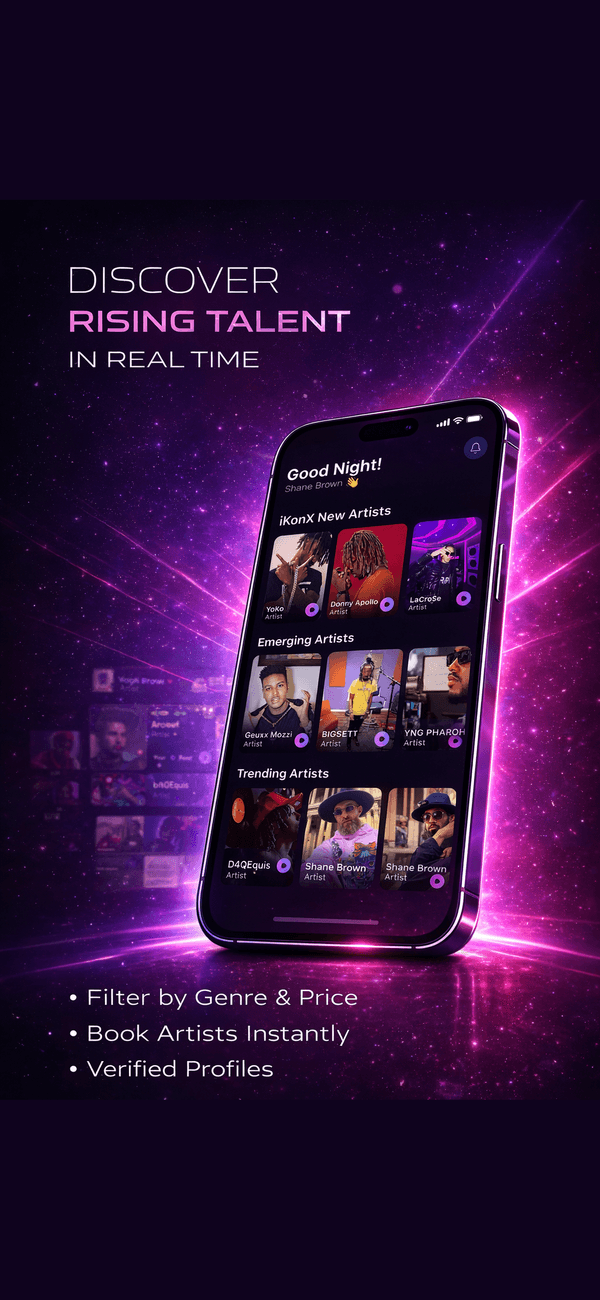
Search verified music artists by the sound your audience already loves · no publicist gate, no cold list.
Contact direct
Message the artist on-platform. The conversation starts with the person who will sit in the chair.
Book the slot
Agree the terms and lock the date. The artist keeps 100% of what they set · you pay a flat 10%.
Most podcast pitches fail on length and vagueness rather than on the show being too small. A long, flattering message that never states the format or a date is a task, and tasks get postponed indefinitely.
The most common failure is opening with yourself. Three paragraphs about the podcast's mission arrive before any mention of the guest, and the reader has no reason to reach paragraph two. The artist's question in the first three seconds is why me and what does this cost me, and a pitch that does not answer both quickly gets closed.
The second failure is fake personalisation. Saying I love your work is not a specific detail, it is the thing everyone says. A pitch that names an actual track, an actual lyric or an actual decision proves a human listened, and that single sentence separates a real pitch from a mail merge more reliably than anything else in the message.
The third failure is asking for too much at once. Ninety minutes, in person, all members, plus a live performance is most of someone's working day. Every added requirement lowers the yes rate, and hosts add them because they are picturing the ideal episode rather than the one that will actually happen.
The fourth is targeting. For established or celebrity guests the publicist is the gatekeeper, and a cold email into that system is a lottery ticket rather than a conversation. Independent and rising artists handle their own inbox and treat a good interview as promotion they did not pay for, which is a completely different transaction.
Around the template, three habits do most of the work.
Target the reachable middle. Independent and rising artists handle their own inbox and treat a thoughtful interview as free promotion. For established guests the publicist is the primary gatekeeper and their job is to filter, so a cold pitch there is a lottery ticket. Build the first twenty episodes on the reachable tier, then use those as proof when you eventually pitch upward.
Time it to a release. Find out what the artist has coming, then pitch two to three weeks ahead of it. Anchoring to a single, an EP, a tour date or a video moves reply rates more than any subject-line trick, because you stop being an interruption and start being useful.
Follow up twice, then stop. One follow-up after five to seven days and one after another week, each adding something rather than repeating. Then leave it. A third and fourth chase costs you the relationship for a future season, and silence is usually timing rather than rejection.
Do not lead with money. Most podcast guests appear for free, including on very large shows, so offering a fee sets a precedent you cannot sustain across a season. Offer promotion, clips and reach instead.
Then compound with referrals. Warm introductions convert better than cold outreach, so ask every guest to recommend one artist while the episode is still fresh. A show that does this from episode one has no cold-pitch problem by episode twenty.
iKonX is building the Podcasts side around the targeting half of this: verified artist profiles and direct contact, with no publicist layer in between. Where a paid collaboration is booked, the artist keeps 100 percent of the price they set, iKonX takes 0 percent platform commission, and the buyer pays a flat 10 percent on top. Most interviews are unpaid, so for a host the value is the direct line rather than the payment rail.
Roadmap honesty: Podcasts is a roadmap side of iKonX, launching soon.
The whole network lives in one app.
iKonX puts every side of the music business in your pocket. Artists set their own price and keep 100% of it · iKonX takes 0% platform commission. Browse, message, and book straight from the app.

The best guest isn't the most famous · it's the one your audience discovers here first.
The template, line by line
How do small podcasts land notable guests without a booking agent or a budget?
- Line 1, who you are, in one sentence. Show name, what it covers, and one number that gives scale if you have one. If you do not have a number yet, skip it rather than inflating it. One line, then move on.
- Line 2, the specific detail. Name an actual track, a production choice, a lyric, a decision they made. This is the line that proves a person wrote the message, and it is the single highest-leverage sentence in the pitch. Generic praise here wastes the slot entirely.
- Line 3, what they get. The audience, the clips they can reuse, the link placement, and the timing against whatever they are promoting. Be concrete and be honest about scale; a small show that is honest reads better than a small show pretending.
- Line 4, the format in numbers. Thirty minutes, remote, recorded on video or audio only. Numbers convert a vague commitment into something the reader can picture and accept in ten seconds.
- Line 5, two or three concrete dates. Named days and times, not whenever suits you. Offering dates is what turns a decision into a reply, because open-ended asks require the reader to do work before they can answer.
- Line 6, one question. Exactly one, and make it a yes or no. Multiple questions produce zero answers. End there, and resist adding a postscript with a fourth request.
What works in a pitch and what gets it deleted
| In the pitch | Works | Gets deleted |
|---|---|---|
| Opening line | One line on the show, then straight to them | Three paragraphs about your mission |
| Personalisation | A named track, lyric or production choice | I love your work |
| The offer | Audience, clips, link, timed to their release | Great exposure for you |
| Format | Thirty minutes, remote, named platform | An in-depth conversation |
| Scheduling | Two or three named dates and times | Whenever suits you |
| The ask | Exactly one yes-or-no question | Four questions and a postscript |
| Length | Under two hundred words | Anything that needs scrolling |
| Money | No fee mentioned; most guests are unpaid | Leading with a fee you cannot repeat |
Guidance is dated and sourced. Most podcast guests appear for free, and even large shows commonly do not pay guests (podwritten.com, 2025). Cold-pitch craft is well documented: make it about the guest, open with a specific detail, lead with what is in it for them and keep it concise (amplify.matchmaker.fm, 2025). Warm referrals and asking past guests for introductions convert better than cold outreach (voices.com, 2025). For established and celebrity guests the publicist is the primary gatekeeper, and email is the respectful channel (bookingagentinfo.com, 2025). Where hosts outsource this, podcast booking agency retainers run roughly 1,500 to 5,000 dollars a month with per-placement fees of 200 to 1,500 dollars (podseeker.co, 2025). The six-line structure and the two-follow-up cadence are practitioner guidance, not measured reply-rate studies; reply rates vary widely by show, genre and timing. The only fixed claim here is the iKonX model: the artist keeps 100 percent of the price they set, iKonX takes 0 percent platform commission, and the buyer pays a flat 10 percent on top. iKonX is free to download and explore, full access to paid features is a flat 9.99 dollars a month, and the only payout deduction is a low, sub-5 percent withdrawal fee, below the industry standard.
Direct contact. No publicist. The artist keeps 100%.
Podcast guest outreach: FAQ
How long should a podcast guest pitch be?
Under two hundred words, six lines. The reader is deciding in the first three seconds whether this is worth their time, and a message that needs scrolling has already lost. Every sentence should be doing a job: who you are, why them specifically, what they get, the format in numbers, the dates, and one question. If a line is not doing one of those six jobs, cut it.
What should the first line of a podcast pitch say?
One line on your show, then move immediately to them. The most common failure is three paragraphs about your mission before the guest is mentioned at all. The artist's question is why me and what does this cost me, and a pitch that does not answer both quickly gets closed. Your show's story belongs in the episode, not in the pitch.
How many times should you follow up on a podcast pitch?
Twice, then stop. One follow-up after five to seven days, one after another week, each adding something new rather than repeating the original. Then leave it. A third and fourth chase costs you the relationship for a future season, and silence is usually about timing rather than rejection. Artists who are mid-release often come back months later if the first pitch was gracious.
Should you offer to pay a musician to come on your podcast?
Usually not. Most podcast guests appear for free, including on very large shows, so a fee sets a precedent you cannot sustain across a season. Offer reach, clips they can reuse, and a link placement timed to something they are promoting. If you do want to outsource booking instead, agency retainers run roughly 1,500 to 5,000 dollars a month with per-placement fees of 200 to 1,500, which is a different decision entirely.
Does iKonX take a commission if I pay an artist to appear?
No. The artist keeps 100 percent of the price they set and iKonX takes 0 percent platform commission, with you paying a flat 10 percent on top. Most interviews are unpaid, so for a host the real value is the direct line to verified artists rather than the payment rail. The only deduction on the artist side is a low, sub-5 percent withdrawal fee when moving earnings to a bank, a transfer cost and never a commission. iKonX is free to download and explore, full access is a flat 9.99 dollars a month, and Podcasts is a roadmap side, launching soon.
Explore the connected sides of the network
Your next guest is one message away.
iKonX is building a Podcasts side where you find verified artists open to interviews and reach them directly. Artists keep 100 percent of the price they set, and iKonX takes 0 percent commission.

DOWNLOAD THE FREE PDF TODAY:
The Music-Guest Booking Kit
Outreach DM templates + a sound-fit guest-vetting checklist for landing music artists as podcast guests.
Get the free PDF ->