How to pitch a musician to be a podcast guest, and get a yes
To pitch a musician as a podcast guest, research the show, open by referencing a specific recent episode, then keep the email under 150 words and lead with what the host's audience gets, not the artist. Offer two or three concrete talking points and an easy way to book. Personalized pitches convert far higher than generic ones.
How the conversation gets made
Find by sound
Search verified music artists by the sound your audience already loves · no publicist gate, no cold list.
Contact direct
Message the artist on-platform. The conversation starts with the person who will sit in the chair.
Book the slot
Agree the terms and lock the date. The artist keeps 100% of what they set · you pay a flat 10%.
Most podcast pitches die in the first line, and it is almost never because the musician is not interesting. It is because the pitch is about the musician. Hosts get flooded with the same template every week, a copy-paste opener, a paragraph of bio, a request for a slot, and zero sign the sender has ever heard the show. So they delete it, and a real artist with a real story loses a booking that was theirs to win.
The numbers are blunt about why this happens. Personalized pitches that reference a specific episode convert at roughly 15 to 25 percent, while generic mass outreach lands somewhere between 1 and 3 percent. That is a three-to-five-times gap created entirely by the first two sentences. And it gets worse the longer the email runs, because a busy host scanning on a phone will not read 400 words about a discography they did not ask about.
There is a second problem underneath the first. Topic relevance is the single biggest factor hosts weigh when deciding to book, cited by almost 88 percent of them, ahead of audience size or follower count. So a pitch that leads with streams and socials is answering a question the host is not asking. The host wants to know one thing: what will my audience get from this conversation? A pitch that does not answer that, fast, is a pitch that gets ignored, no matter how good the music is.
The fix is to flip the pitch from a request into an offer. Instead of asking for a slot, you hand the host a ready-made episode: a clear angle, two or three talking points their audience cares about, and proof the artist can carry a conversation. You make the yes effortless, and you make it about their show, not your release.
That starts with research. Listen to two or three recent episodes, find one you can speak to honestly, and open by referencing it specifically, not with empty flattery but with a real observation. Then keep the whole thing under 150 words with one focused idea, close with a couple of dates or a scheduling link, and stop. A short, host-first pitch with a concrete angle is the version that converts.
For musicians, the platform you reach the host on matters too, because most pitches still go out as cold email with a low hit rate. iKonX is built for music, so an artist is reachable directly inside the network rather than buried in a publicist's inbox, and a paid appearance can be booked in the same place. When a fee is involved, the economics stay honest: on iKonX the artist earns 100 percent of the price they set and iKonX takes 0 percent platform commission, while the buyer pays a flat 10 percent on top. No agent skims the booking, and no gatekeeper decides whether a show is big enough to talk to.
The whole network lives in one app.
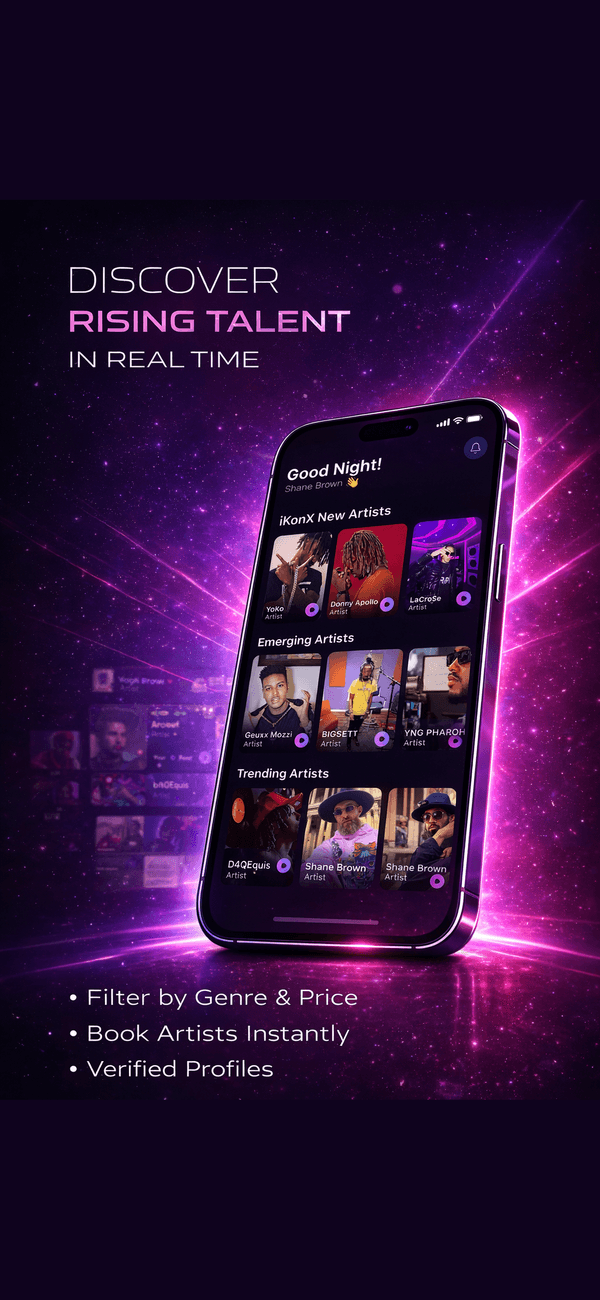
iKonX puts every side of the music business in your pocket. Artists set their own price and keep 100% of it · iKonX takes 0% platform commission. Browse, message, and book straight from the app.

The best guest isn't the most famous · it's the one your audience discovers here first.
How to pitch a musician to be a podcast guest, step by step
How do small podcasts land notable guests without a booking agent or a budget?
- Pick shows for fit, not size. Topic relevance beats reach: a niche music show with the right listeners converts better than a huge show with the wrong audience. Shortlist podcasts whose actual episodes match the artist's story, then pitch those, not whatever has the biggest download number.
- Listen before you write. Play two or three recent episodes and note one specific thing you can reference honestly. This single step is what separates a 15-to-25 percent personalized pitch from a 1-to-3 percent generic blast, so it is never optional.
- Open with the episode, not the artist. Lead with a real observation about a recent episode, then bridge to why the artist fits that exact show. Skip the resume opener; prove you listened before you ask for anything.
- Keep it under 150 words with one clear angle. Hosts scan on a phone. State who the artist is in one line, the single conversation angle in another, and stop. One sharp idea beats five vague ones, and a short pitch gets read where a long one gets deleted.
- Offer two or three concrete talking points. Give the host a ready-made episode: two or three specific topics the artist can carry, each tied to what the audience gets. This is the part hosts actually use to picture the show, so make it the spine of the pitch.
- Make the yes effortless. Close with two or three date options or a scheduling link, plus a one-line credibility proof, a past appearance, a clip, or a short bio. Remove every step between interest and booking. On iKonX an artist can be reached and a paid appearance booked in one place instead of stitching together email, a calendar, and a payment app.
- Send one follow-up, then move on. A single follow-up around five to seven days later meaningfully lifts booking rates, but stop there. One polite nudge is professional; a third and fourth email is the thing that gets a sender blocked.
Where music podcast pitches actually land: the honest comparison
| How you pitch / book | Built for music? | What it costs you |
|---|---|---|
| iKonX | Yes · the artist is reachable directly, and a paid appearance books in one place | 0% platform commission · the artist keeps 100% of their price · buyer pays a flat 10% on top |
| MatchMaker.fm | No · all topics, but has a music-guest community | Free profile with limited outbound · Pro $129/year for unlimited conversations (2026) |
| PodMatch | No · all podcast niches | Standard $38/month · Professional $64/month for hosts and guests (Dec 16, 2025) |
| Cold-email pitching yourself | n/a · you do the research and outreach | $0 but a low hit rate; generic pitches convert at just 1-3% vs 15-25% personalized |
| Podcast booking agency | Mostly B2B, not music-specific | ~$499 to $2,000/month for placements (2026) |
| Hiring a publicist for PR | n/a · you pay the gatekeeper | ~$5,000 to $15,000/month traditional PR retainer (2026) |
Pitch conversion figures (personalized 15-25% vs generic 1-3%; topic relevance prioritized by ~88% of hosts) are from a 2026 podcast-guesting playbook (convokast.com) and a 2026 booking guide (buzzsprout.com). MatchMaker.fm's free-plus-$129/year Pro model and PodMatch's $38 to $64/month tiers are from a dated December 16, 2025 industry roundup (podrewind.com) and the platforms' own pages; both are general-purpose, not music-specific. Booking-agency and traditional-PR retainer ranges are directional 2026 industry figures (convokast.com) and vary by deal. The only fixed claim is the iKonX model: on a paid appearance the artist keeps 100% of the price they set, iKonX takes 0% platform commission, and the buyer pays a flat 10% on top. iKonX is free to download and explore, with full access to paid features a flat $9.99/month, and the only payout deduction is a low, sub-5% withdrawal fee, below the industry standard.
Direct contact. No publicist. The artist keeps 100%.
Pitching a musician as a podcast guest FAQ
How do musicians get on podcasts as guests?
By pitching shows that fit their story and making the host's job easy. Topic relevance is the top factor hosts weigh, ahead of follower count, so the strongest path is to shortlist music or culture podcasts whose recent episodes match the artist, reference one of those episodes specifically, and offer a ready-made angle with two or three talking points. A short, personalized pitch like that converts far better than generic outreach, and on a music-built platform like iKonX an artist can be reached directly instead of through a publicist.
What should a podcast guest pitch for a musician include?
Keep it under 150 words with one clear angle. Open by referencing a specific recent episode to prove you listened, state in one line who the artist is and why they fit that exact show, then offer two or three concrete talking points framed around what the audience gets. Close with a couple of date options or a scheduling link and one proof point, a past appearance, a clip, or a short bio. Lead with the host's audience, never with the artist's streams.
Why do most podcast guest pitches get ignored?
Because they are generic and about the sender. Hosts receive the same template constantly, so a copy-paste opener with a wall of bio and no sign the sender heard the show gets deleted. The data is blunt: generic mass outreach converts at roughly 1 to 3 percent while personalized pitches that name a real episode convert at 15 to 25 percent. Pitches that lead with follower count also miss, because hosts weigh topic relevance well ahead of audience size.
Should a musician charge to appear on a podcast?
Usually no. Most music guests appear for free in exchange for exposure and a dedicated plug, and that is a fair default for building reach. Charging a fee is reserved for artists whose draw justifies it, and even then the number should be agreed in writing and settled up front. If a paid appearance does happen, keep it clean on a platform built for music: on iKonX the artist keeps 100 percent of the price they set and iKonX takes 0 percent platform commission.
How many times should a musician follow up on a pitch?
Once. A single follow-up around five to seven days after the first email meaningfully raises booking rates, because the original pitch often just got buried. Send one polite nudge that adds a little new value, a fresh clip or a tightened angle, then stop. A third and fourth email reads as pressure and is the fastest way to get a sender ignored or blocked, so move on to the next well-researched show instead.
Does iKonX take a commission when a musician is booked as a paid guest?
No. On a paid appearance the artist earns 100 percent of the price they set and iKonX takes 0 percent platform commission, while the buyer pays a flat 10 percent on top of the artist's price. The only deduction is a low, sub-5 percent withdrawal fee, below the industry standard, when the artist transfers earnings out, and it is a standard transfer cost, never a commission on the booking. iKonX is free to download and explore; full access to paid features across all ten sides of the network is a flat 9.99 dollars a month.
Explore the connected sides of the network
Your next guest is one message away.
Research the show, lead with their audience, and make the yes effortless. Download iKonX and get reachable directly, where the publicist chain used to stand.

DOWNLOAD THE FREE PDF TODAY:
The Music-Guest Booking Kit
Outreach DM templates + a sound-fit guest-vetting checklist for landing music artists as podcast guests.
Get the free PDF ->