How do you get bands on your podcast?
You get bands on your podcast by pitching one member rather than the group, timing it to a release or a local show date, and solving the scheduling and microphone problems before you ask. A band is not one guest, it is three to five calendars and a room that needs enough mics. Most guests appear unpaid, so what you are offering is reach and a good experience, and the easier you make the logistics the more often the answer is yes.
How the conversation gets made
Find by sound
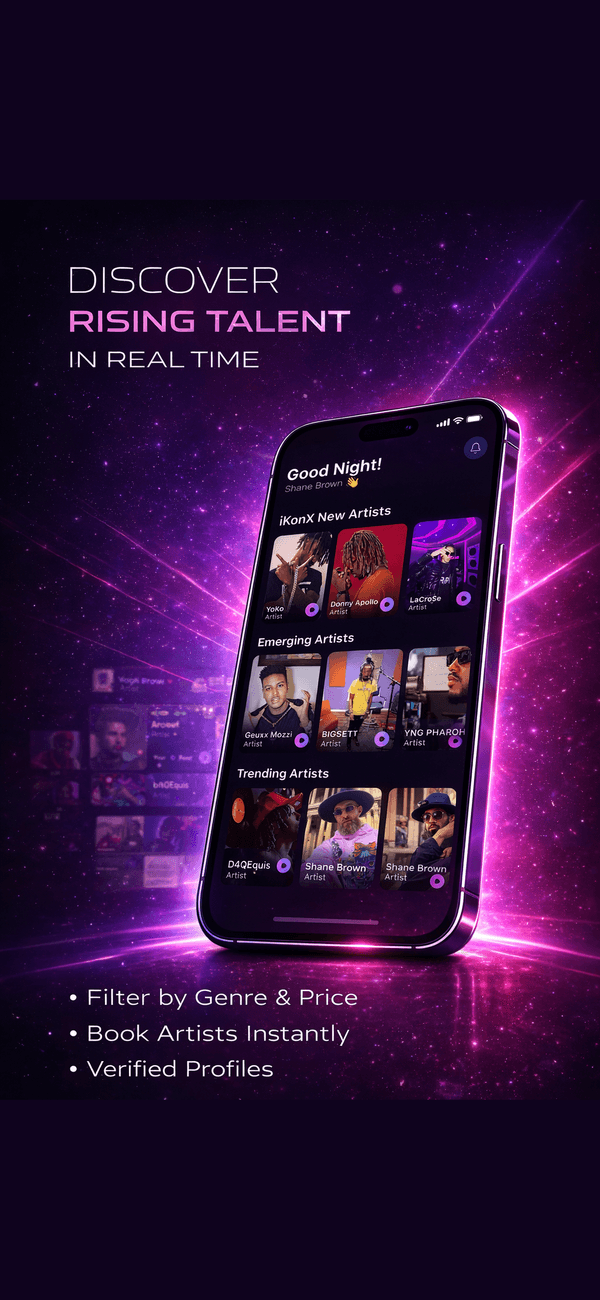
Search verified music artists by the sound your audience already loves · no publicist gate, no cold list.
Contact direct
Message the artist on-platform. The conversation starts with the person who will sit in the chair.
Book the slot
Agree the terms and lock the date. The artist keeps 100% of what they set · you pay a flat 10%.
Hosts who book solo musicians easily often stall completely on bands, and assume bands are simply harder to reach. The reachability is the same. The logistics are not.
A solo guest is one calendar and one microphone. A four-piece is four calendars that have to align on a weekday evening, plus a room with four working mics, plus an interview where somebody has to decide who answers. Each of those is a small problem, and stacked together they are enough friction that a band will politely agree in principle and never actually book.
The second problem is that hosts pitch the band as an entity. Messaging a band account usually means messaging whoever runs social that month, which is the least empowered person to commit four people to a date. Nothing happens, and it looks like disinterest.
The third problem is over-asking. A pitch requesting ninety minutes, in person, with all members, plus a live performance, is asking a working band for most of an evening plus load-in. Every additional requirement lowers the yes rate, and hosts add requirements because they are imagining the ideal episode rather than the one that will actually happen.
Then there is the money question, which trips up new hosts. Most podcast guests are unpaid, including on very large shows, so budgeting a band fee is usually unnecessary. What is not free is your setup: a group interview needs enough microphones, and thin audio on a four-way conversation is the fastest way to lose listeners.
Remove the friction before you send the pitch, and the yes rate changes sharply.
Pitch one member, not the band. Find the member who does interviews, usually the songwriter or the frontperson, and pitch them directly. One person can say yes to themselves immediately, and they can bring whoever else wants to come. A band account cannot commit four calendars; a person can commit one.
Offer the two-member option explicitly. Say in the pitch that two of you is perfect. This single sentence converts more band bookings than anything else, because it turns a four-calendar problem into a two-calendar one and quietly removes the drummer-cannot-make-Tuesday objection before it is raised.
Time it to something they already have. A release, a tour date, a local show. Anchor to that and you stop being an interruption. This is the same principle that works for solo artists and it matters more for bands, because you are asking more people for the same evening.
Solve the audio before you invite them. Decide now whether you can record three or four people properly. If you cannot, run it remote or cap it at two. A great conversation with two members beats a muddy one with five, and listeners forgive a smaller lineup far more readily than bad sound.
Do not offer a fee by default. Most guests appear free, including on large shows, so leading with money sets a precedent you cannot sustain across a season. Offer reach, clips they can reuse and a link timed to their release.
iKonX is building the Podcasts side around the reachable-middle problem: verified artist profiles and direct contact, without a publicist layer. Where a paid collaboration is booked through the platform, the artist keeps 100 percent of the price they set, iKonX takes 0 percent platform commission, and the buyer pays a flat 10 percent on top. Most interviews are unpaid, so for a host the value is the direct line rather than the payment rail.
Roadmap honesty: Podcasts is a roadmap side of iKonX, launching soon. It solves finding and contacting artists, not scheduling or recording.
The whole network lives in one app.
iKonX puts every side of the music business in your pocket. Artists set their own price and keep 100% of it · iKonX takes 0% platform commission. Browse, message, and book straight from the app.

The best guest isn't the most famous · it's the one your audience discovers here first.
How to book a band on your podcast, step by step
How do small podcasts land notable guests without a booking agent or a budget?
- Identify the interview member. Usually the songwriter or frontperson. Pitch that individual by name rather than the band account, because one person can accept for themselves today while a band account has to convene a decision.
- Check what they have coming. A release, a tour date, a local show. Pitching two to three weeks ahead of something they are already promoting puts you in the window where they want the conversation rather than the one where it is a favour.
- Say the two-member option in the pitch itself. Write that one or two of you is perfect, all of you is welcome. This removes the scheduling objection before it forms and is the single highest-leverage sentence in a band pitch.
- State the format in numbers. Length, remote or in person, and two or three concrete dates. Thirty minutes remote on one of these three evenings is a decision. Whenever suits you is a task nobody completes.
- Settle the microphone question honestly. Count your working inputs. If you can record two people well and four badly, book two. Thin, echoey group audio loses listeners faster than a smaller lineup ever will.
- Assign the questions in advance. With a group, decide who takes which topic so the quiet member is not silent for forty minutes and the talkative one is not answering everything. Tell them you will do this; bands appreciate it and it makes the episode noticeably better.
Band interview formats, and what each one costs you
| Format | Calendars to align | Mics needed | Yes rate |
|---|---|---|---|
| One member, remote | 1 | 0, they use their own | Highest |
| Two members, remote | 2 | 0, they use their own | High |
| Two members, in person | 2 | 2 to 3 | Medium |
| Full band, in person | 3 to 5 | 4 to 6 | Lowest |
| Full band plus live performance | 3 to 5, plus load-in | 6 or more | Very low without a relationship |
Context is dated and sourced. Most podcast guests appear for free, and even large shows commonly do not pay guests (podwritten.com, 2025). For established or celebrity guests the publicist is the primary gatekeeper, which is why the reachable middle of independent bands responds so much better to direct contact (bookingagentinfo.com, 2025). Warm referrals and asking past guests for introductions convert better than cold outreach (voices.com, 2025). Guest-matching platforms exist but are general-interest rather than music-specific, with PodMatch tiers running roughly 6 to 64 dollars a month and Matchmaker.fm Pro around 129 dollars a year (podrewind.com, 2025-12-16). Booking agency retainers run roughly 1,500 to 5,000 dollars a month with per-placement fees of 200 to 1,500 dollars (podseeker.co, 2025). Yes-rate rankings are an editorial judgement based on the number of constraints each format imposes, not measured data. The only fixed claim here is the iKonX model: the artist keeps 100 percent of the price they set, iKonX takes 0 percent platform commission, and the buyer pays a flat 10 percent on top. iKonX is free to download and explore, full access to paid features is a flat 9.99 dollars a month, and the only payout deduction is a low, sub-5 percent withdrawal fee, below the industry standard.
Direct contact. No publicist. The artist keeps 100%.
Getting bands on your podcast: FAQ
How do you get a band to agree to a podcast interview?
Pitch one member rather than the band account, and say explicitly that one or two of them is enough. A band account is usually run by whoever handles social that month, and that person cannot commit four calendars. An individual can accept for themselves in ten seconds. Anchoring the ask to a release or a local show they are already promoting raises the reply rate further.
Do you have to pay bands to appear on a podcast?
Usually no. Most podcast guests appear for free, including on very large shows, so budgeting a band fee is rarely necessary and leading with money sets a precedent you cannot sustain across a season. What bands actually want is reach, clips they can reuse on their own channels, and a link placement timed to something they are promoting.
How many microphones do you need to interview a band?
One per person is ideal, so a four-piece needs four plus yours. If you cannot record that many properly, cap the booking at two members or run it remote so each person uses their own setup. Thin, echoey audio on a five-way conversation loses listeners much faster than a smaller lineup does, and listeners forgive fewer guests far more readily than bad sound.
Is it better to interview a whole band or just one member?
For most shows, one or two members produces the better episode as well as the easier booking. Group interviews tend to drift, with one member answering everything and another silent for forty minutes unless you assign topics in advance. Two members gives you dynamic and disagreement without the crowd-control problem, and it halves the scheduling difficulty.
Does iKonX take a commission if I pay a band for an appearance?
No. The artist keeps 100 percent of the price they set and iKonX takes 0 percent platform commission, with you paying a flat 10 percent on top. Most interviews are unpaid, so for a host the real value is the direct line to verified artists rather than the payment rail. The only deduction on the artist side is a low, sub-5 percent withdrawal fee when moving earnings to a bank, a transfer cost and never a commission. iKonX is free to download and explore, full access is a flat 9.99 dollars a month, and Podcasts is a roadmap side, launching soon.
Explore the connected sides of the network
Your next guest is one message away.
iKonX is building a Podcasts side where you find verified artists open to interviews and reach them directly. Artists keep 100 percent of the price they set, and iKonX takes 0 percent commission.

DOWNLOAD THE FREE PDF TODAY:
The Music-Guest Booking Kit
Outreach DM templates + a sound-fit guest-vetting checklist for landing music artists as podcast guests.
Get the free PDF ->