How do you book live music for a bar or brewery?
Booking live music for a bar or brewery is a rotation problem, not a one-off booking. Set a fixed per-slot budget, source three to five reliable local acts you can cycle, and pay a flat guarantee rather than a door split, because a taproom crowd is walk-in traffic the act cannot control. A solo or duo acoustic act usually fits a bar budget best, with national solo musician costs averaging around 429 dollars and most bookings landing between 313 and 586 dollars.
Bars and breweries book live music badly for a specific reason: they treat it like a special event when it is actually a recurring operations slot.
A one-off booking is a project. You find an act, negotiate, confirm, and it is done. A weekly or monthly live music night is a supply chain. You need acts who show up, fit the room, play the right length and volume, and can be rebooked without renegotiating from scratch. Most venues never build that supply, so every month restarts the same scramble, usually two weeks out, usually with whoever answers first.
The second mistake is the door split. Splitting the door sounds fair, and at a ticketed venue it is. At a taproom it is not, because the audience is largely walk-in traffic that came for the beer. The act cannot control the crowd size, so a door split asks them to absorb a risk they have no lever over. Good local acts learn quickly which venues pay a guarantee and which ask them to gamble, and they route around the second kind.
The third mistake is scope creep in reverse: the venue assumes the act brings a PA, the act assumes the venue has one, and both find out at 7pm. For a recurring slot this is worth solving once, permanently, rather than on every booking.
How to set up a live music night at a bar or brewery, step by step
Treat it as three decisions made once, then repeated.
Decide the slot and the budget before the act. Pick the night, the start and finish time, and a fixed fee per slot your bar can pay whether forty people show up or a hundred and forty. That number is now a constant, which means every future booking is a yes or no rather than a negotiation. For most bars and taprooms a solo or duo acoustic act is the right fit on both budget and volume, and national benchmarks put solo musicians at an average around 429 dollars with most bookings between 313 and 586 dollars. A singer-songwriter for a one hour set commonly runs closer to 300 dollars.
Build a rotation, not a booking. Your goal is three to five acts you can cycle so the room stays fresh and no single cancellation breaks the calendar. Source locally and directly, because a rotation only works if you can reach the act without going through an intermediary each time.
Pay a guarantee, and pay it the same night. A flat guarantee paid promptly is the single strongest reason a good local act keeps your slot on their calendar. It is also cheaper than it looks, because a reliable rotation removes the emergency premium you would otherwise pay for last-minute replacements.
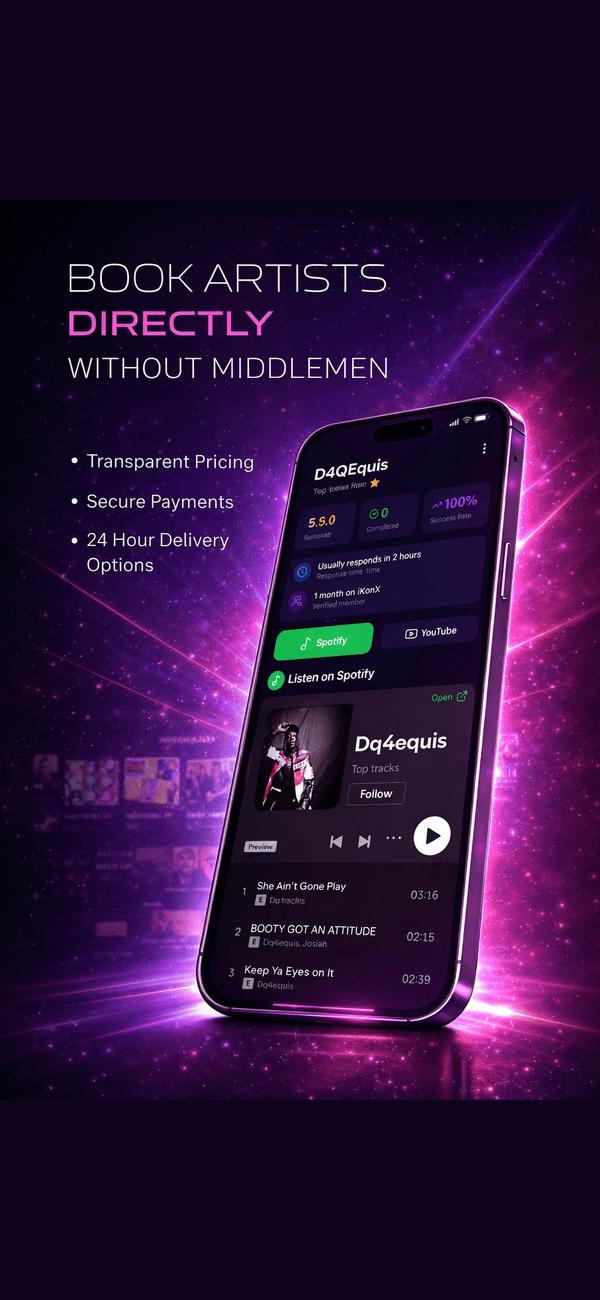
iKonX is building the Promoters side for exactly this sourcing problem: search bookable local artists with prices listed up front and contact them directly, with no agent or agency in the middle. Artists keep 100 percent of the price they set, iKonX takes 0 percent platform commission, and you pay a flat 10 percent on top. Compare that to booking marketplaces, where a planner-side service fee of roughly 10 to 12 percent sits alongside a separate performer-side fee, or where a 5 percent booking fee plus a 5 percent commission is built into the quote.
Roadmap honesty: Promoters is a roadmap side of iKonX, launching soon. Today it solves finding and contacting local acts, not contracts or payroll.
Empty date
You have a room and a night with nothing on it yet.
Browse artists
Search verified indie acts with transparent pricing. No agent, no gatekeeper.
Lock the fee
Agree the price the artist set. They keep 100% · you pay a flat 10% on top.
Confirm + pay
Message direct, confirm the details, and pay securely in the app.
Doors open
The act shows up, the room fills, you book the room and keep the night.
Move this week · the good dates fill fastest.
The whole network lives in one app.
iKonX puts every side of the music business in your pocket. Artists set their own price and keep 100% of it · iKonX takes 0% platform commission. Browse, message, and book straight from the app.

Transparent booking fees, no surprises
$300 to $600
A local indie act for a small private show or pop-up.
100% to artist$600 to $1.5k
A headline slot or support for a ticketed venue night.
You pay flat 10%$1.5k and up
A lineup placement scaled to the act and the draw.
No broker cutWhat live music costs a bar or brewery per slot in 2026
| Act type | Typical per-slot cost | Fits a bar or taproom? |
|---|---|---|
| Solo or duo acoustic | National solo average around 429 dollars, most bookings 313 to 586 | Best fit on budget and volume |
| Singer-songwriter, one hour | Commonly around 300 dollars | Strong fit for shorter slots |
| Full band, three to five pieces | National band benchmark near 590 dollars, rising with size and hours | Only with space, power and volume headroom |
| Booking marketplace | The fee plus a client-side service charge of roughly 10 to 12 percent, or a 5 percent booking fee plus 5 percent commission | Works, at a per-booking cost |
| iKonX (Promoters launching soon) | The price the artist lists, plus a flat 10 percent on top | Direct to local acts, no agent |
Cost benchmarks are dated and sourced. National solo musician cost averages about 429 dollars with most bookings between 313 and 586 dollars, varying by duration, event type, skill, travel and union status (thumbtack.com, 2025-10-20). National band booking typically lands near 590 dollars with most events between 431 and 809 dollars (thumbtack.com, 2025). A singer-songwriter commonly costs about 300 dollars for one hour (gigsalad.com, 2026). Marketplace fee structures differ: GigSalad charges providers a 5 percent booking fee on free membership and 2.5 percent on paid, alongside a 10 to 12 percent client-side service fee (help.gigsalad.com, 2025), while The Bash charges a 5 percent booking fee plus a 5 percent commission built into the quote (thebash.com, 2025). Ranges vary by city, set length, travel and gear. The only fixed claim here is the iKonX model: the artist keeps 100 percent of the price they set, iKonX takes 0 percent platform commission, and the buyer pays a flat 10 percent on top. iKonX is free to download and explore, full access to paid features is a flat 9.99 dollars a month, and the only payout deduction is a low, sub-5 percent withdrawal fee, below the industry standard.
Bar and brewery live music: FAQ
How much should a bar pay a band in 2026?
Set a flat per-slot fee your bar can pay on a slow night rather than a number tied to the door. For a solo or duo acoustic act, national solo musician costs average around 429 dollars with most bookings between 313 and 586 dollars, and a one hour singer-songwriter set commonly runs closer to 300. A full band pushes higher, with a national band benchmark near 590 dollars rising with size and set length. City, night of week and set length move all of these.
Should a bar pay a guarantee or split the door?
Pay a guarantee. A door split makes sense at a ticketed venue where the act drives attendance, but a taproom crowd is largely walk-in traffic that came for the beer, so a split asks the act to carry a risk they cannot influence. Good local acts track which venues pay a guarantee and prioritise them. A predictable flat fee is also easier for you to budget and removes the emergency premium you pay when scrambling for a replacement.
How far in advance should a bar book live music?
Three to six weeks is comfortable for a standard slot, and a rotation lets you book several months ahead in one conversation. Extend the lead time for holiday weekends, festival weekends and December, when the same local acts get pulled into higher-paying private events. The real protection is not lead time, it is having three to five acts in rotation so one cancellation does not leave the night dark.
Does the bar or the band supply the PA?
Decide once and write it into every booking, because this is the most common night-of failure. Many solo and duo acoustic acts carry a small PA suitable for a bar, while full bands more often expect the venue to provide sound. If you host music regularly, owning a modest house PA usually pays for itself quickly and makes your slot far easier to book, since acts can arrive with just instruments.
Does iKonX charge a commission for booking a local act?
No. The artist keeps 100 percent of the price they set and iKonX takes 0 percent platform commission. You pay a flat 10 percent on top, so the price listed is the price the act earns. That differs from booking marketplaces that layer a client-side service fee of roughly 10 to 12 percent on top of a separate performer-side fee. The only deduction on the artist side is a low, sub-5 percent withdrawal fee when they move earnings to their bank, a transfer cost rather than a commission. iKonX is free to download and explore, and full access to paid features is a flat 9.99 dollars a month. Promoters is a roadmap side of iKonX, launching soon.
Explore the connected sides of the network
Book the room. Keep the night.
iKonX is building a Promoters side where you search bookable local artists with prices listed up front and reach them directly. Artists keep 100 percent of the price they set, and iKonX takes 0 percent commission.

DOWNLOAD THE FREE PDF TODAY:
The Indie Booking Kit
Offer templates, a fee-range guide, and a doors-to-payout checklist for booking an indie act.
Get the free PDF ->