Pick the format first, then the hours, then talk about money. In that order the number stops being mysterious.
Format is the biggest lever, and it stacks in a predictable order. A solo acoustic act, one player, one small amp, is the most affordable live option and is often the right one for a backyard afternoon with speeches and a buffet. A duo doubles the players and roughly moves the price with it. A DJ typically sits between a solo act and a band, and buys you continuous music and a real PA that doubles as the microphone for the toasts. A full band is the top of the range because you are paying every musician, plus gear, plus a longer setup, plus more travel. If the artist is a union member, the AFM negotiates minimum scale agreements that set a floor a real offer has to clear.
Hours are the second lever. Price against total time on site, not just performance time, because a two-hour set means load-in, sound check, the set, and load-out. Two 45-minute sets with a break is a common and sensible ask for a party, and it is much easier on the performer and the crowd than three straight hours of background music.
Then the logistics that quietly move the price: how far they travel, whether the artist provides the PA or you rent one, whether there is power and a flat surface, and whether the party is indoors if it rains. Nail those down in writing along with the fee, the start time, and the deposit.
One thing worth knowing and not worrying about: a genuine private party for family and friends is generally not a public performance, because 17 U.S.C. 101 defines performing publicly as at a place open to the public or where a substantial number of persons outside a normal circle of a family and its social acquaintances is gathered. A backyard graduation party sits on the private side of that line, while a rented venue open to the public does not. The venue, if you rent one, is the party that handles its own licensing.
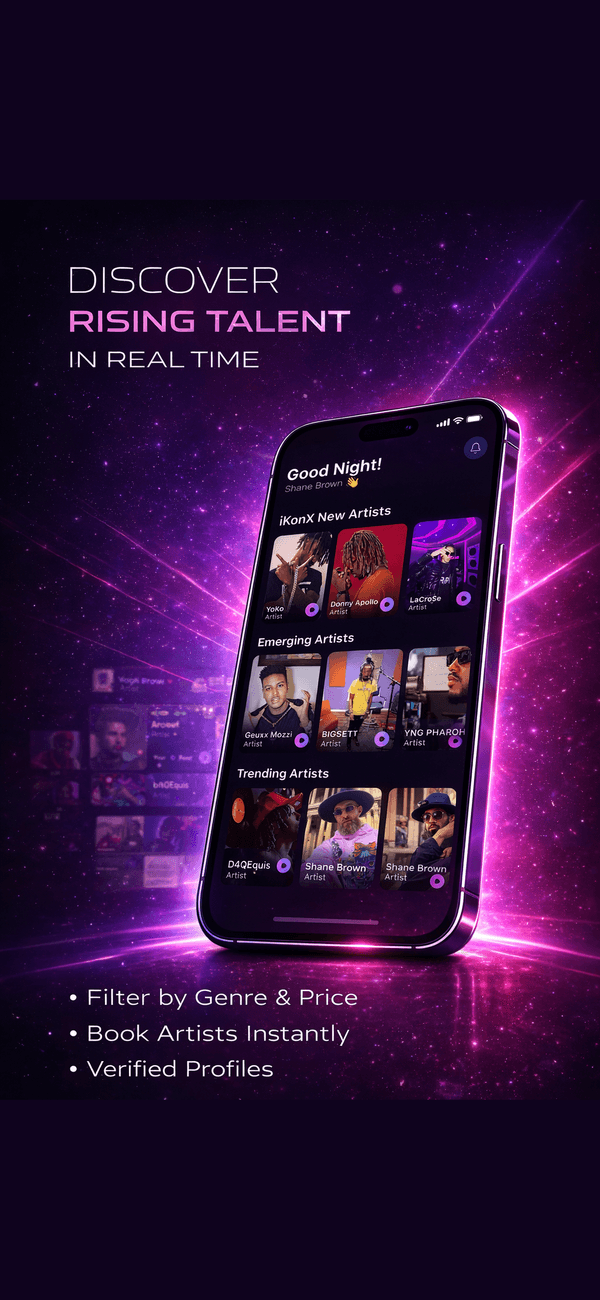
The honest state of iKonX today: it is a live, downloadable app where the people hiring music and the artists playing it connect and pay each other directly, and a full event-side booking workflow with contracts and timelines is on the roadmap. What already works is the part that decides whether the deal is fair: you reach a real artist directly, no agency margin sits in the middle, the artist keeps 100 percent of the price they set at 0 percent platform commission, and you pay a flat 10 percent on top so the total is visible before you commit. iKonX is free to download and explore, and full access to paid features is a flat 9.99 dollars a month.