Events JOIN THE NETWORK · EVENTS
14 Days to doors ·
build the bill now
Headliner

Do I need a license to have live music at my event?

Support Browse verified acts · lock the slot
Openers Confirm the night · 0% platform commission · artists keep 100%
The short answer

Usually yes, and usually somebody already has it. Performing a copyrighted song in public is a public performance under US copyright law, and the right to authorize that performance belongs to the songwriters and publishers, which is why performing rights organizations like ASCAP, BMI, SESAC, and GMR sell blanket licenses covering their repertories. The practical question is therefore not whether a license is needed but who holds it. Most established venues, restaurants, bars, hotels, and event spaces already carry blanket licenses, and if you are having a band at one of those, you are almost certainly covered by the venue. You are the one who needs to think hard when the event is at a place with no license: a warehouse, a park, a private estate rented for a public ticketed event, or a company campus. Private events like a wedding in a private home sit differently in practice, and there is a narrow statutory exemption for certain nonprofit performances, but the exemptions are far narrower than the internet believes. Get the answer in writing from the venue before the date.

Slat 01 · the gap

Nobody plans an event thinking about copyright law. They think about the band, the room, the catering, and the guest list. Music licensing sits in a blind spot precisely because it is invisible when it works, and it works almost all the time, because the venue quietly handled it years ago and never mentioned it.

The trouble starts when the event moves outside a normal venue. A ticketed show in a rented warehouse. A festival in a public park. A big company party on a corporate campus. A charity gala in a space that has never hosted live music before. In all of those cases the assumption that somebody else has the license is doing a lot of unexamined work, and the person holding the risk is usually the event organizer, not the band.

The second problem is the confident misinformation. People will tell you a license is not needed because the band is playing covers and covers are fine, or because the event is free, or because it is for charity, or because it is only a few songs. Those beliefs are mostly wrong. Playing covers is exactly the situation a performance license exists for, since the songwriter of the covered song is the person being paid. Free admission does not by itself remove the requirement. The statutory exemption for nonprofit performances exists but is narrow and has conditions, and it is not a general blanket for anything with a good cause attached to it.


Slat 02 · the lineup

Work the question in three steps, in this order, and do it in writing.

First, ask the venue directly: do you hold public performance licenses, and which organizations. Most established rooms do, and they will answer instantly because they get asked. Get it in an email, not in a conversation, because the value of the answer is that it exists in writing on the day something goes wrong.

Second, if the venue does not hold licenses, or there is no venue because you are in a park or a warehouse, then the responsibility lands on the event organizer, and the licenses are bought directly from the performing rights organizations. They publish licensing information for music users, and event and single occasion licenses exist for exactly this situation. The cost is real but it is generally a small line in an event budget, and it is far smaller than the alternative.

Third, do not rely on folklore about exemptions. The statutory exemption for certain nonprofit performances is real, it is narrow, and it has conditions. If your entire licensing plan is the sentence but it is for charity, you do not have a licensing plan, you have a hope.

Then handle the part you actually control cleanly: hiring the performer. Agree the fee, the set length, the arrival time, and the technical needs in writing, and pay through something that documents the transaction. On iKonX you book a verified artist at a price they publish, so the fee is agreed before the date, and the artist keeps 100% of the price they set, iKonX takes 0% platform commission, and you pay a flat 10% on top. iKonX is free to download and explore, full access to paid features is a flat $9.99/month, and the only payout deduction is a low, sub-5% withdrawal fee when you transfer earnings out, below the industry standard.

Slots open · the bill is filling

100%
of the fee goes to the act · iKonX takes 0% platform commission
Available
0
gatekeepers between you and the act you want to book
Available
10%
flat fee the buyer pays on top · no broker cut, no surprises
Active
See iKonX in action

The whole network lives in one app.

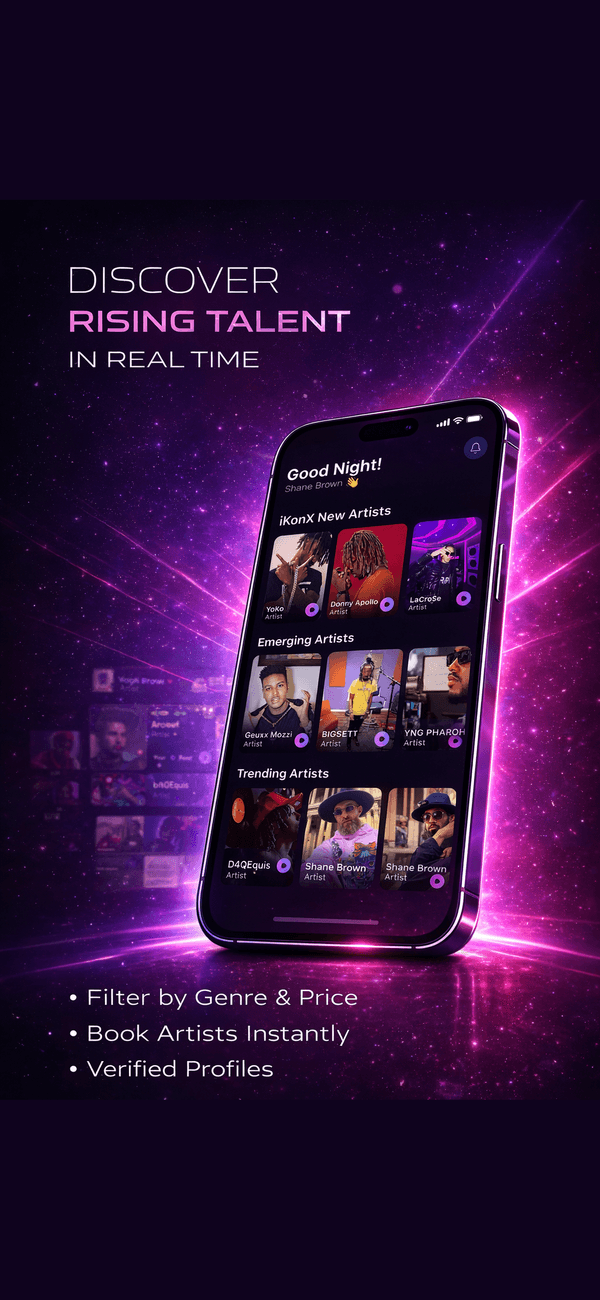
iKonX puts every side of the music business in your pocket. Artists set their own price and keep 100% of it · iKonX takes 0% platform commission. Browse, message, and book straight from the app.

The iKonX app on an iPhone showing the artist discovery screen · where music meets business with 0% platform commission

How to work out who needs the license, step by step

  1. 01Date locked
    Set the night and the room. Everything on the bill hangs off this one fixed point.
  2. 02Stages set
    Decide the stages and the zones. Map where each act plays before you book a single name.
  3. 03Acts confirmed
    Browse verified artists, agree the fee directly, and lock each slot. The act keeps 100% of the price they set.
  4. 04Run of show
    Order the bill headliner to opener, set the set-times, and share the night with the whole lineup.
  5. 05Doors
    Confirm and pay through iKonX, then open the doors on a lineup you built act by act.
  1. Ask the venue in writing whether they hold performance licenses. Name the organizations. Most established venues, bars, hotels, and event spaces do, and an emailed yes is what you want on file.
  2. Establish whether the event is a public performance. Ticketed, open to the public, or held at a place open to the public generally counts. A genuinely private gathering in a private home sits differently in practice.
  3. If there is no venue license, the organizer carries it. A rented warehouse, a public park, a corporate campus, a private estate hosting a public event. In those cases the license is yours to obtain, not the band's.
  4. Buy the license from the performing rights organizations directly. They publish licensing information for music users and offer event and single occasion licenses for exactly this situation.
  5. Do not lean on the exemption folklore. Covers still need a license. Free admission does not by itself remove the requirement. The nonprofit exemption is real but narrow and conditional, and it is not a general pass.
  6. Put the licensing responsibility in the performer's contract. State clearly which party carries the public performance license. Silence there is how the risk quietly lands on you.
  7. Book and pay the performer in writing. Fee, set length, arrival time, and technical needs. On iKonX you book a verified artist at their published price and they keep 100 percent of it at 0 percent platform commission.
The stage map
Main stage
Your headliner act · the top of the bill
Second stage
Support acts · the build-up sets
Opener slot
Local openers · the night's first names

Who usually needs the license, by event type

Where the event isWho normally holds the public performance licenseWhat you should do
Established venue, bar, hotel, restaurantThe venue, via blanket licenses with the rights organizationsGet their confirmation in writing. You are almost certainly covered
Rented warehouse, park, or blank spaceNobody, until the organizer buys oneObtain event licensing yourself, directly from the rights organizations
Corporate event on a company campusOften nobody · the assumption that it is handled is the riskCheck, then license the event. Do not assume facilities has it
Genuinely private gathering in a private homeGenerally treated differently from a public performanceStill confirm your specifics rather than relying on internet folklore
Paying the performer via iKonXYou, and the terms are documentedBook at the published price · artist keeps 100% · 0% platform commission · you pay a flat 10% on top

US copyright law gives the copyright owner the exclusive right to perform the work publicly, which is why public performances of copyrighted songs generally require a license (17 U.S.C. section 106, US Copyright Office, 2025). Performing rights organizations publish licensing information for music users, including event and single occasion licensing (ASCAP published licensing information, 2025; BMI published licensing information, 2025). A narrow statutory exemption for certain nonprofit performances exists at 17 U.S.C. section 110 and has specific conditions; it is not a general exemption for charitable or free events. This is general information, not legal advice, and specifics vary by event, jurisdiction, and repertory. The only fixed claim here is the iKonX model: the artist keeps 100% of the price they set, iKonX takes 0% platform commission, and the buyer pays a flat 10% on top. iKonX is free to download and explore, full access to paid features is a flat $9.99/month, and the only payout deduction is a low, sub-5% withdrawal fee when you transfer earnings out, below the industry standard.

Live music licensing FAQ

Do I need a license if the band is only playing covers?

That is exactly the situation a public performance license exists for. The songwriter of the covered song holds the right to authorize public performances of it, and the performing rights organizations license that right. Covers are the core case, not an exception to it.

What if my event is free to attend?

Free admission does not by itself remove the requirement. Whether a performance is public turns on where it happens and who it is open to, not on whether tickets were sold. A free public event can still be a public performance.

Does the venue's license cover my event?

Usually, if it is an established venue, bar, hotel, or event space. Most carry blanket licenses. Ask in writing which organizations they hold licenses with and keep the email. If there is no venue, or the venue has no license, the responsibility lands on the organizer.

Is there an exemption for charity or nonprofit events?

A narrow statutory exemption for certain nonprofit performances exists, and it has specific conditions. It is not a general pass for any event with a good cause attached. If your entire licensing plan is that it is for charity, you do not have a plan.

Who pays for the license, me or the band?

Whoever the agreement says, which is why the performer's contract should state it explicitly. In practice the venue or the event organizer carries the public performance license, not the musicians. Do not leave it unsaid and hope.

Build the night, act by act.

Get the licensing answer in writing, then book the performer at a price you can see. Download iKonX.

The iKonX app on a phone

Download the iKonX App

Download on theApp Store
Coming Soon onGoogle Play

DOWNLOAD THE FREE PDF TODAY:

The Festival Lineup Planner

A run-of-show grid, a stage-and-set-time worksheet, and a multi-act budget template for building a festival or showcase lineup end to end.

Get the free PDF ->