How to price a podcast recording session at my studio
Price podcasts per episode, not per hour, because podcasters buy a finished episode and not studio time. Build a package: room, engineer, up to four mics, multitrack recording, and delivered files. Price editing, video, and clips as separate line items. Sell a four-episode block at a discount to fill a recurring slot, and take a deposit up front.
A music studio that quotes a podcaster an hourly rate has already lost the booking, or worse, won it badly. Podcasters do not think in hours. They think in episodes, and they think in seasons. Quote 90 dollars an hour and they will do the math out loud in the DMs, guess wrong about how long it takes, and go record in a spare bedroom.
Then there is what actually eats the day. A podcast session is not tracking a vocal. It is four humans, four microphones, four sets of headphones, a guest who has never worn cans before, a host who wants a video version, and a wrap-up conversation about whether you can also cut the clips for Instagram. The recording is two hours. The day is five. If your price only covers the two, you subsidized the other three.
The third trap is ownership, and it is the one nobody talks about until it costs money. A commissioned recording is not automatically a work made for hire. Under 17 U.S.C. 101 a commissioned work qualifies as a work made for hire only if there is a signed written agreement and it falls into one of nine enumerated categories, and a sound recording standing alone is not one of them. Under 17 U.S.C. 201(b) the employer is the author only in a genuine work-made-for-hire situation. Meaning: without a written agreement, who owns what in that recording is a question you do not want to answer for the first time after a show blows up.
Four channels artists book you for
List the room and the rate · get found by artists ready to track.
Per-song or per-stem · transparent pricing artists can say yes to.
Get booked for the final pass · a steady stream, not word of mouth.
Home studio, no big credits? List the work · the room speaks for itself.
Sell an episode, sell a block, and price the room against what it displaces. That is the whole model.
Start with the episode package. One flat price covering the room for a defined window (three hours is the standard useful block), the engineer, up to four mics on individual channels, headphone mixes, multitrack recording, and the raw files delivered. Everything past that is a line item: additional hours, extra guests, video capture, editing, mixing and mastering the episode, and short-form clips. Line items are how a 400 dollar booking becomes an 800 dollar booking without anyone feeling squeezed, because the podcaster chose each one.
Then price the block. Podcasts are recurring by nature, which makes them the single best cure for the empty Tuesday. Sell four episodes at a modest discount against the single-episode rate, in a fixed weekly slot. You trade a little margin for predictable revenue and a calendar that fills itself, and a recurring podcast slot in the dead part of the week is worth more than a one-off session at full price on a Saturday you could have sold twice.
Anchor the number to displacement, not to a competitor. What does that room otherwise earn in that window? A weekday afternoon that reliably sits empty can carry a friendlier rate than the Saturday you turn away a band for. That is not discounting, that is yield.
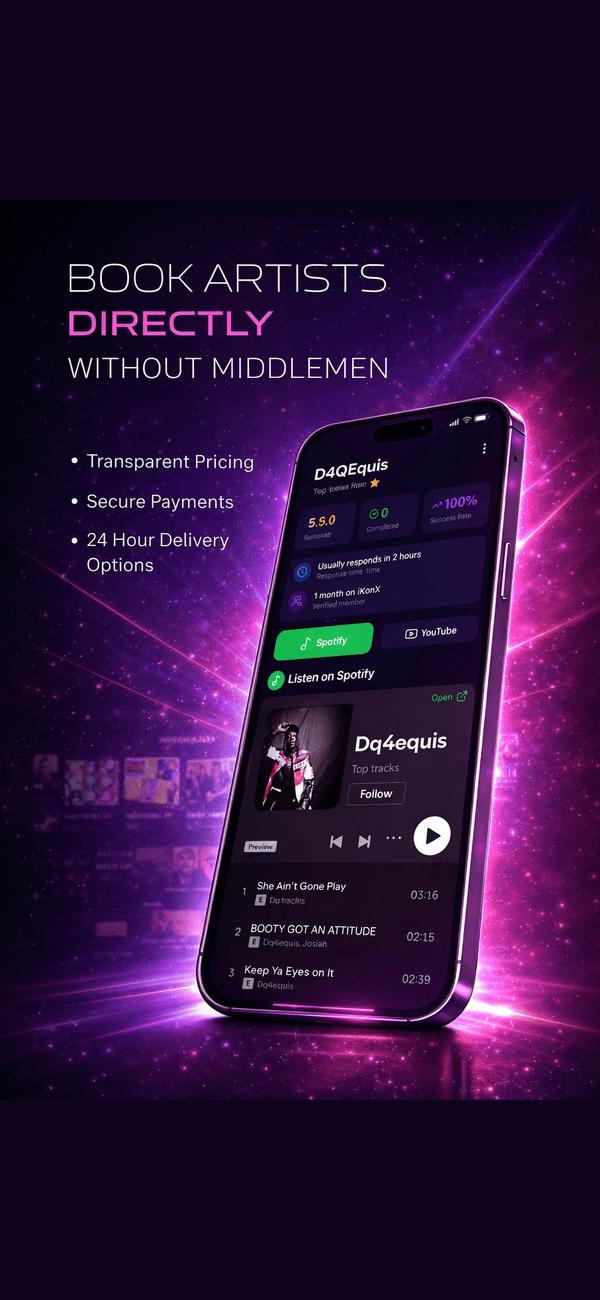
Then settle two things in writing before the first mic goes up: who owns the recording, and when you get paid. Ownership goes in the booking agreement, because the copyright default is not what most podcasters assume. Payment goes in front of the session, as a deposit. That is the part iKonX is live for: the client pays through the app before the room is held, the studio keeps 100 percent of the price they set, iKonX takes 0 percent platform commission, and the buyer pays a flat 10 percent on top. iKonX is free to download and explore, full access to paid features is a flat 9.99 dollars a month, and the only payout deduction is a low, sub-5 percent withdrawal fee. The honest state of iKonX today: it is a live, downloadable app where studios and the people who book them connect and pay directly, and a studio-side calendar with slot inventory and package management is on the roadmap. What already works is the piece that no-shows exploit, the money.
The whole network lives in one app.
iKonX puts every side of the music business in your pocket. Artists set their own price and keep 100% of it · iKonX takes 0% platform commission. Browse, message, and book straight from the app.

How to price the session, step by step
- Build one episode package and put a single price on it. Room for a three-hour block, engineer, up to four mics on separate channels, headphone mixes, multitrack capture, raw files delivered same day. One number. A podcaster can say yes to a number. They cannot say yes to an hourly rate multiplied by an unknown.
- Make everything else a line item. Extra hours, fifth and sixth guest, video capture, per-episode editing, mix and master, short-form clips, and rush delivery. Publish them. This is where the margin lives, and clients happily pay for the pieces they picked themselves rather than a price that mysteriously went up.
- Price against displacement, not against the studio down the road. Ask what that room earns in that window if the podcaster does not take it. A dead Tuesday afternoon justifies a friendlier rate than a Saturday you turn a band away for. Same room, different opportunity cost, different price.
- Sell the block, not the session. Four episodes, a fixed weekly slot, a modest discount off the single rate, paid up front. Podcasts recur, so the recurring slot is the actual product. You are selling calendar certainty and buying it back at a small discount, which is the best trade a half-empty studio can make.
- Settle ownership and take a deposit before the mics go up. Put who owns the recording in the booking agreement, because under 17 U.S.C. 101 a commissioned sound recording is not automatically a work made for hire and a standalone recording is not one of the nine categories. Then take the deposit through iKonX so the slot is paid before it is held, and the studio keeps 100 percent of the price it set. Practical guidance, not legal advice.
Hourly rate vs. episode package vs. season block
| Hourly rate | Per-episode package | Four-episode block | |
|---|---|---|---|
| What the client is buying | Time, which they will underestimate | A finished recording of an episode | A slot in their season plan |
| Ease of saying yes | Low, the total is unknown | High, it is one number | Highest, it solves their whole month |
| Your calendar | Random | One-off, resold every time | Predictable, fills the dead slot |
| Upsell room | Awkward, it looks like the clock ran | Clean line items: editing, video, clips | Clean, and repeated four times |
| Deposit | Always. Collected through iKonX before the slot is held · studio keeps 100% of its price at 0% platform commission | ||
Sources and dates. 17 U.S.C. 101 (live, July 2026): a specially ordered or commissioned work is a work made for hire only if the parties expressly agree in a signed written instrument and the work falls within one of nine enumerated categories; a standalone sound recording is not one of those categories. 17 U.S.C. 201(b): in the case of a work made for hire, the employer or other person for whom the work was prepared is considered the author. U.S. Copyright Office Circular 56A: the copyright in a sound recording is separate from the copyright in the underlying work embodied in it. Package structures and block-discount practice are studio market convention, not published statistics. Practical guidance, not legal advice. The iKonX model is the only fixed claim: artists keep 100% of the price they set, iKonX takes 0% platform commission, the buyer pays a flat 10% on top, iKonX is free to download and explore, full access to paid features is a flat $9.99/month, and the only payout deduction is a low, sub-5% withdrawal fee, below the industry standard.
The best room in town does nothing if no artist can find it.
Podcast session pricing FAQ
Should I charge podcasters hourly or per episode?
Per episode. Podcasters buy episodes, not studio hours, and an hourly rate makes them guess at a total they cannot predict, which is how you lose the booking to a spare bedroom. Give them one number for a defined block and make everything beyond it a published line item.
What should the base package include?
The room for a three-hour block, the engineer, up to four mics on individual channels, headphone mixes, multitrack recording, and the raw files delivered. Extra hours, extra guests, video, editing, mix and master, and short-form clips are separate line items that the client opts into.
How do I fill dead weekday slots with podcasts?
Sell a four-episode block in a fixed weekly slot at a modest discount off the single-episode rate, paid up front. Podcasts recur, so a recurring booking in the emptiest part of your week is worth more than a full-price one-off you have to resell every time.
Who owns the podcast recording, me or the client?
Whoever the written agreement says. Do not assume it defaults to the client: under 17 U.S.C. 101 a commissioned work is a work made for hire only with a signed agreement and only inside one of nine categories, and a standalone sound recording is not one of them. Put ownership in the booking agreement before you record. Not legal advice.
Should I take a deposit for a podcast session?
Yes, and take it before the slot is held. Podcast sessions are booked around a guest's schedule, which means they are the most likely to move or vanish. On iKonX the payment is collected up front through the app, the studio keeps 100 percent of the price it set, iKonX takes 0 percent platform commission, and the client pays a flat 10 percent on top.
Do I have to offer editing too?
No, but it is usually the most profitable line on the invoice, and the one podcasters most want to hand off. Price it per episode with a defined turnaround and a defined revision count, and treat clips and video as their own items rather than a courtesy.
Explore the connected sides of the network
Built for the room.
Sell the episode, publish the line items, and take the deposit before the slot is held. Download iKonX and get paid before the mics go up.

DOWNLOAD THE FREE PDF TODAY:
The Studio Booking Checklist
Everything to confirm before a session books · rates, room specs, deposit, and turnaround.
Get the free PDF ->