How do I record a remote podcast interview with a musician?
To record a remote podcast interview with a musician, use a double-ender setup where each side records its own audio locally in lossless quality, then uploads the clean file after the call, so a dropped connection or compressed call audio never ruins the take. Run it on a platform built for separate per-participant tracks, such as Riverside, Descript, or Zencastr (each has a free tier and a paid plan around 18 to 24 dollars a month in 2026), instead of a plain Zoom call that squashes the sound. Get the artist on a real microphone and closed-back headphones in a quiet room, send a short gear and prep note before the date, and treat any live song as its own separate clean clip rather than trying to perform in real time, because internet latency makes true synchronized playing impossible. The interview is only as good as the guest, so the real first step is reaching a musician who fits your show and locking the booking before you ever press record.
How the conversation gets made
Find by sound
Search verified music artists by the sound your audience already loves · no publicist gate, no cold list.
Contact direct
Message the artist on-platform. The conversation starts with the person who will sit in the chair.
Book the slot
Agree the terms and lock the date. The artist keeps 100% of what they set · you pay a flat 10%.
Recording a remote interview is easy. Recording one with a musician that actually sounds good is where most shows fall apart. A guest who talks for a living can phone in over a laptop mic and it is forgivable. A guest whose entire credibility is sound cannot. If your music interview is muffled, echoey, or chopped up by a frozen connection, the one audience that will notice first is the one you most want to impress: people who care about audio. You booked an artist to make your show feel legit, and bad recording quietly does the opposite.
The traps are specific. The first is leaning on a normal video call. Standard call platforms compress audio hard and in real time, so even if the artist is on a beautiful microphone, the version that reaches your recording is a thin, lossy shadow of it, and instruments and vocals get mangled far worse than speech. The second is recording only your local feed and grabbing the guest off the live stream, which means their track inherits every dropout, every wifi stutter, and every blip the connection threw in. The third is the guest's room: a musician at home is often in an untreated, reflective space with open laptop speakers, so you get echo, bleed, and that hollow bathroom sound no edit fully fixes.
Then there is the part unique to music. At some point a guest will offer to play something live, and a first-time host says yes without realizing that the internet cannot carry two people playing in time together. Latency, even a fraction of a second, makes real synchronized performance impossible across any consumer platform, so the dreamy idea of a live duet over the call simply does not work the way people imagine. None of this is hard once you know it, but the gatekeeper here is not the artist saying no. It is the dozen small recording decisions that separate an interview that sounds like a real show from one that sounds like a laggy phone call.
The fix has two halves, and the order matters. Half one is the booking, because the cleanest recording in the world is wasted on a guest who does not fit your show or never shows up. Reach a musician who actually matches your audience, agree the format and the date, and lock it before you spend a minute on gear. Half two is a recording setup built so neither side's audio depends on the call holding together. Solve the booking first, then the sound.
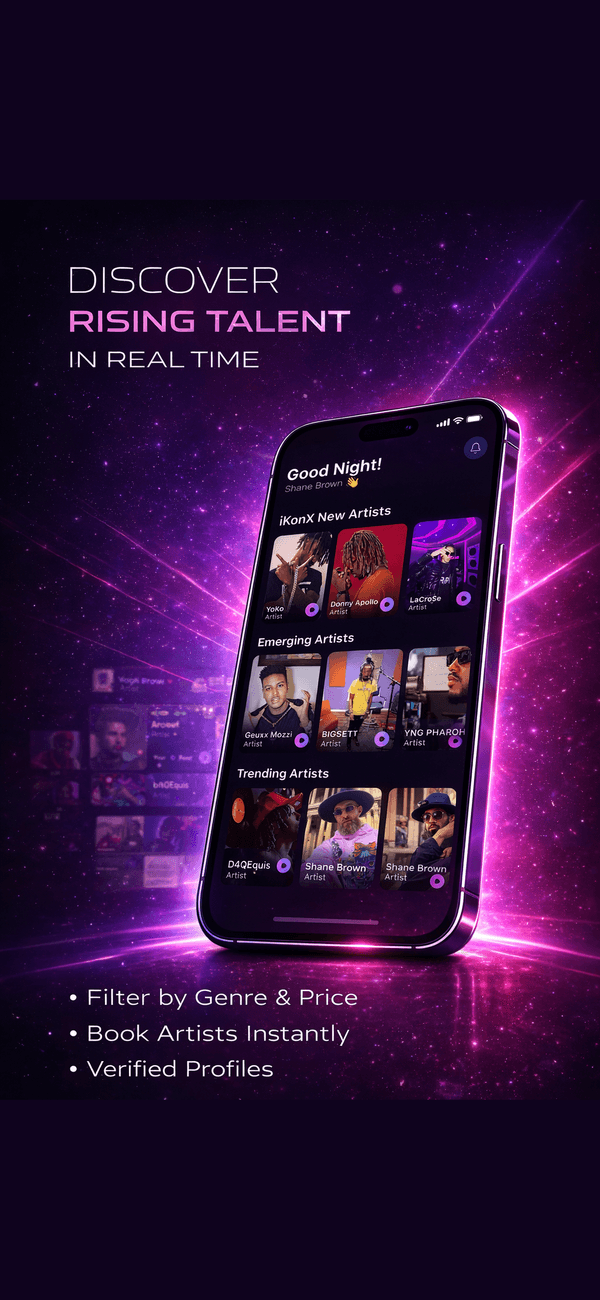
That booking side is where iKonX fits in honestly. iKonX is an artist-first marketplace where musicians keep their own profile (their bio, their links, their newest releases) and you can reach them directly to invite them on your show, instead of guessing at a publicist's inbox and waiting weeks. You message the artist, hear what they have actually put out, and lock the appearance with someone who fits, so by the time you open your recording software the hard part is already done. When an appearance is a paid booking, the model is simple and artist-first: the artist keeps 100 percent of the price they set, iKonX takes 0 percent platform commission, and the buyer pays a flat 10 percent on top. The app is free to download and explore, full access to paid features is a flat 9.99 dollars a month, and the only payout deduction artists ever see is a low, sub-5 percent withdrawal fee, below the industry standard.
To be roadmap-honest: iKonX is the discovery, contact, and booking layer that gets the right musician into your interview, and the searchable podcast-booking side is still being built out, not a finished feature today. iKonX is not a recording platform and it will not capture or master your audio. The setup below, the double-ender, the lossless tracks, the guest's mic and headphones, is on you and your tools. Used together, iKonX gets you a guest worth recording, and the workflow here makes sure that guest actually sounds like one.
The whole network lives in one app.
iKonX puts every side of the music business in your pocket. Artists set their own price and keep 100% of it · iKonX takes 0% platform commission. Browse, message, and book straight from the app.

The best guest isn't the most famous · it's the one your audience discovers here first.
How to record a remote music interview in 5 steps
How do small podcasts land notable guests without a booking agent or a budget?
- Record double-ender: each side captures its own audio locally. This is the single most important decision. Instead of grabbing the guest off the compressed live call, use a platform that records each participant's audio on their own device at full quality, then uploads the clean file after you stop. Riverside, Descript (which absorbed SquadCast), and Zencastr all do this and all have a free tier plus a paid plan in the 18 to 24 dollar a month range in 2026. The payoff is that a frozen connection or a wifi hiccup during the call no longer touches the recording, because the real audio was never traveling over the internet in real time.
- Demand separate tracks in lossless or near-lossless quality. Make sure every participant lands on their own isolated track, ideally a WAV or other uncompressed file at 48kHz, not a single mixed-down MP3. Separate tracks let you fix the guest's level, kill a cough, or tame a room without touching your own voice, which is the difference between a five-minute polish and an unfixable mess. For a music guest this matters double: compressed, mixed audio destroys the very detail that makes an artist worth hearing, so protect the quality at the source rather than hoping to rescue it in the edit.
- Send a short gear and room note before the date. A day ahead, send the artist three plain requests: use a real microphone, a USB mic is fine and beats any laptop or earbud mic by a mile, wear closed-back headphones so your voice does not bleed back into their mic and cause echo, and sit in the quietest, softest room they have (a closet of clothes works better than a tiled kitchen). Ask them to plug into ethernet if they can, or sit close to the router, and to close every other app. Most musicians already own a decent mic and headphones, so this is usually a reminder, not a shopping list.
- Run a five-minute soundcheck and a sync clap before you go. Get on early, have both sides record a few test seconds, and actually listen back to the guest's local file, not just the live call, so you catch a buzz, a too-hot level, or open speakers before they ruin an hour. Have everyone clap once on the count, which gives you a sharp visual spike to line up the separate tracks in editing if they drift. Confirm headphones are on, levels peak around the healthy zone without clipping, and the recording is genuinely capturing locally before you start the real conversation.
- Handle a live song as its own separate clean clip, not a real-time duet. If the artist wants to play, do not try to perform together over the call, because latency makes synchronized playing impossible on any normal platform. Instead, let them perform solo while their local track records cleanly, you stay silent, and you drop the polished clip into the episode afterward. Even better for a key performance, ask them to record it separately on their own gear and send you the file, so you get studio quality with zero call compression. Then keep the conversation and the music as distinct, clean pieces you assemble in the edit.
Ways to record a remote music interview, compared (2026)
| How you record | What it gets you | What it costs you |
|---|---|---|
| Lock the guest on iKonX, then record double-ender | The right-fit musician, reached directly, plus a recording setup where neither side's audio depends on the call holding together | 0% platform commission on a paid booking · artist keeps 100% of their price · buyer pays a flat 10% on top · free to download · full paid access a flat $9.99/month · podcast-booking side in development |
| Riverside.fm | Local per-participant recording, separate lossless audio tracks, up to 4K video, AI editing and clip tools | Free 2-hour tier; Pro around $24/month in 2026 with up to 4K and separate per-participant tracks |
| Descript (absorbed SquadCast) | Studio-quality separate local tracks plus a full text-based editor for cutting the interview like a document | Free tier; paid plans roughly in the $24/month range in 2026 (check the current tier) |
| Zencastr | Separate local audio tracks per guest in lossless WAV, browser-based with no guest install | Free tier with limited hours; paid around $18 to $20/month in 2026 (check the current tier) |
| Plain Zoom or a normal video call | Easy and familiar, fine for a quick chat, but it compresses audio in real time and is not built for separate lossless tracks | Free to about $16/month in 2026; the real cost is sound quality, which is the one thing a music show cannot afford to lose |
Platform pricing here is directional 2026 information, not a live quote: Riverside, Descript, and Zencastr each publish a free tier and a paid plan, and tiers, limits, and feature splits change often, so check each platform's current pricing page before you commit. Riverside's free 2-hour tier and Pro plan around $24/month with up to 4K and separate per-participant tracks reflect its 2026 pricing; Descript (which absorbed SquadCast) and Zencastr figures are 2026 general ranges to verify on their own pages. The point that matters is the method, not the brand: any platform that records each side locally in separate lossless tracks beats a plain compressed video call for a music guest. Zoom pricing is its 2026 published range and Zoom can record, but it is not designed for separate per-participant lossless tracks. The only fixed claim is the iKonX model: on a paid appearance the artist keeps 100 percent of the price they set, iKonX takes 0 percent platform commission, and the buyer pays a flat 10 percent on top. iKonX is free to download and explore, full access to paid features is a flat $9.99/month, the only payout deduction is a low, sub-5 percent withdrawal fee, below the industry standard, and the iKonX podcast-booking side is in development.
Direct contact. No publicist. The artist keeps 100%.
Recording a remote music interview: common questions
How do I record a remote podcast interview with a musician?
Use a double-ender setup where each side records its own audio locally in lossless quality and uploads the clean file after the call, so a dropped connection or compressed call audio never touches the take. Run it on a platform built for separate per-participant tracks, such as Riverside, Descript, or Zencastr, rather than a plain video call that squashes the sound. Get the artist on a real microphone and closed-back headphones in a quiet room, run a quick soundcheck and a sync clap, and treat any live song as its own separate clean clip instead of trying to perform in real time. The booking comes first, though: lock a guest who fits your show before you worry about gear.
What is the best app to record a remote music interview in 2026?
There is no single best app, but the best category is clear: a platform that records each participant's audio locally in separate lossless tracks, not a plain compressed video call. In 2026 the common choices are Riverside (free 2-hour tier; Pro around $24/month with up to 4K), Descript, which absorbed SquadCast (free tier plus paid plans roughly in the $24/month range), and Zencastr (free tier plus paid around $18 to $20/month). Pricing and tiers change, so confirm on each platform's current page. For a music guest, isolated lossless tracks matter more than which brand you pick, because compression is what destroys the detail that makes an artist worth hearing.
Why does a music guest need better audio quality than a normal guest?
Because their credibility is sound. A guest who talks for a living can get away with a laptop mic, but an artist whose work is audio cannot, and the audience that notices bad quality first is the exact music-loving audience you booked them to reach. Normal video calls also compress audio in real time, which mangles instruments and singing far worse than speech, so the artist can be on a beautiful microphone and still arrive thin and lossy on a plain call. Recording each side locally in lossless separate tracks protects the quality at the source, which is the only way to keep what makes the guest sound like an artist.
Can a musician play a song live during a remote interview?
They can play solo, but you cannot truly play together over the call, because internet latency makes synchronized real-time performance impossible on any normal platform. The clean way to handle a live song is to let the artist perform alone while their local track records at full quality, you stay silent, and you drop the polished clip into the episode in the edit. For a key performance, ask them to record it separately on their own gear and send you the file, which gives you studio quality with zero call compression. Then keep the talk and the music as distinct, clean pieces you assemble afterward.
What gear does my musician guest need for a remote interview?
Less than people fear, and most artists already own it. The essentials are a real microphone (a USB mic is perfectly fine and beats any laptop or earbud mic by a wide margin), closed-back headphones so your voice does not bleed back into their mic and cause echo, and the quietest, softest room they have. Wired ethernet beats wifi for stability, and closing every other app helps. You do not need them to own an audio interface or a treated studio; a decent USB mic, headphones, and a soft room cover most of what makes a remote music interview sound professional.
How do I find the right musician to interview on my podcast?
The recording setup only pays off if the guest fits, so finding and reaching the right artist is the real first step. iKonX is an artist-first marketplace where musicians keep their own profiles and you can message them directly to invite them on your show, then see their current releases to research good questions and confirm they match your audience. For a paid appearance the artist keeps 100 percent of the price they set, iKonX takes 0 percent platform commission, and the buyer pays a flat 10 percent on top. The app is free to download, with full paid access a flat $9.99 a month, and the searchable podcast-booking side is in development.
Keep building your music interview show
Your next guest is one message away.
Find the right musician, reach them directly, and lock the interview before you ever hit record.

DOWNLOAD THE FREE PDF TODAY:
The Music-Guest Booking Kit
Outreach DM templates + a sound-fit guest-vetting checklist for landing music artists as podcast guests.
Get the free PDF ->