How do you find performers for a festival? 8 channels for booking a lineup
You find festival performers by using different channels for different tiers of the lineup, not one channel for everything. Headliners and draw acts usually come through booking agents; the middle of the bill comes from open applications, other festivals' lineups and referrals; and daytime and local slots come from artist listing platforms, venue bookers and the local scene. Eight channels cover a full lineup, and most first-time festivals only use two.
Most festival lineups are built backwards. The organiser spends months chasing one headliner through one agent, then fills every other slot in a panic in the final six weeks with whoever replies first.
The result is a lineup with one name people know and a long tail of acts that were available rather than chosen. The daytime stage has three similar acoustic sets in a row. A mid-afternoon slot sits empty because the act that was going to fill it was a friend of a friend who never signed anything.
The deeper problem is treating a lineup as one booking task. It is at least three. The top of the bill is an agency negotiation with offers, radius clauses and deposits. The middle is a curation job where you are choosing between more applicants than you have slots. The bottom is a sourcing job where the challenge is simply finding reliable local acts in time.
Cost compounds the confusion. A booking agent takes 10 to 20 percent of an artist's gross fee, and marketplaces commonly add a 10 to 12 percent planner-side service fee on top of a performer-side fee. Neither is wrong, but using the most expensive channel for the cheapest slots is how a small festival burns its talent budget before the gates open.
The 8 channels for booking a festival lineup
Map each channel to a tier of the lineup, then run them in parallel rather than in sequence.
Build the grid first. List every stage, every slot and every set length before you contact anyone. A grid tells you that you need, say, two draw acts, eight mid-bill acts and twelve local or daytime acts, and each of those numbers points to a different channel.
Top of the bill: agents. Draw acts are almost always represented, so the agent is the door. Send a written offer with the date, the fee, the set length and any radius clause, and expect the agency to take its 10 to 20 percent from the artist's gross, which is priced into what they ask of you.
Middle of the bill: applications and scouting. Open an application window with a clear deadline and ask for a live clip, not just streaming links. At the same time, study the lineups of comparable festivals in your region, because every act on them has already proved they can play a festival stage.
Local and daytime slots: direct sourcing. Listing platforms where artists publish a price, local venue bookers and referrals from acts you have already confirmed will fill these faster than any agency. For budgeting context, national solo musician cost averages about 429 dollars with most bookings between 313 and 586, and national band booking typically lands near 590 dollars.
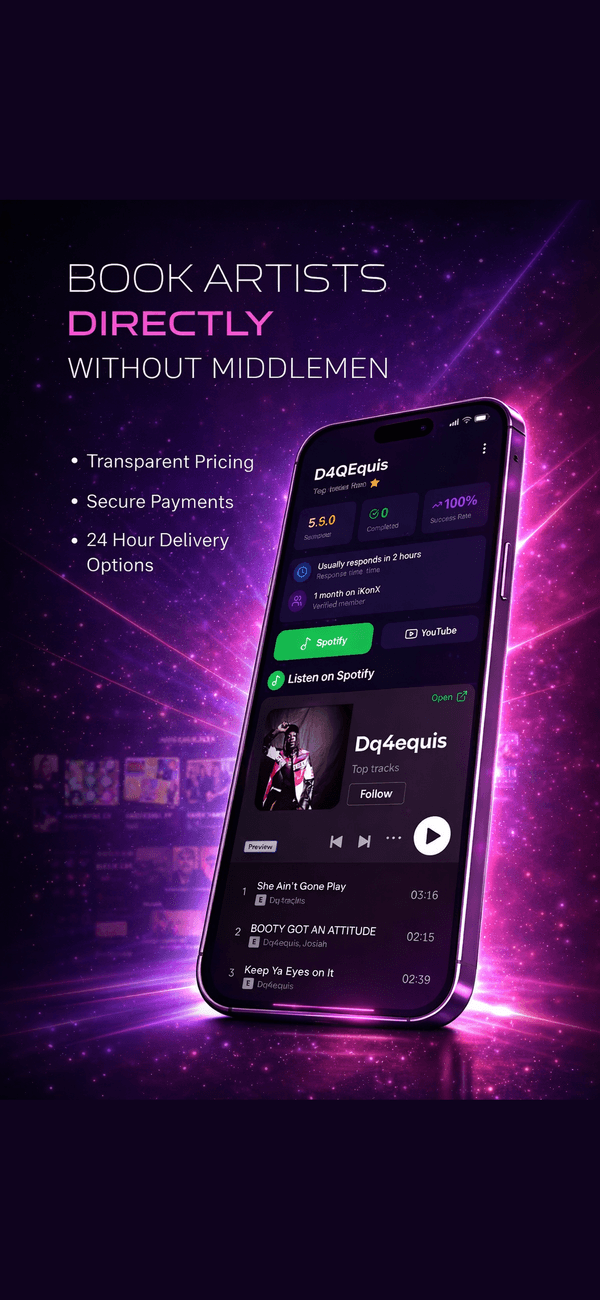
iKonX is building the Promoters side for that third tier, where sourcing is the bottleneck: bookable local artists with prices listed up front, contacted directly, with no agent or marketplace in between. The artist keeps 100 percent of the price they set, iKonX takes 0 percent platform commission, and you pay a flat 10 percent on top.
Roadmap honesty: Promoters is a roadmap side of iKonX, launching soon. It solves finding and contacting acts, not contracts, stage scheduling or payroll.
Empty date
You have a room and a night with nothing on it yet.
Browse artists
Search verified indie acts with transparent pricing. No agent, no gatekeeper.
Lock the fee
Agree the price the artist set. They keep 100% · you pay a flat 10% on top.
Confirm + pay
Message direct, confirm the details, and pay securely in the app.
Doors open
The act shows up, the room fills, you book the room and keep the night.
Move this week · the good dates fill fastest.
The whole network lives in one app.
iKonX puts every side of the music business in your pocket. Artists set their own price and keep 100% of it · iKonX takes 0% platform commission. Browse, message, and book straight from the app.

Transparent booking fees, no surprises
$300 to $600
A local indie act for a small private show or pop-up.
100% to artist$600 to $1.5k
A headline slot or support for a ticketed venue night.
You pay flat 10%$1.5k and up
A lineup placement scaled to the act and the draw.
No broker cutWhich channel fills which part of the lineup
| # | Channel | Best for | Speed | Cost to the festival |
|---|---|---|---|---|
| 1 | Booking agents | Headliners and draw acts | Slow | The fee, with 10 to 20 percent agency commission priced in |
| 2 | Open applications | Mid-bill discovery | Slow, high volume | Your listening time |
| 3 | Other festivals' lineups | Proven festival acts | Medium | Free to research |
| 4 | Artist listing platforms | Local and daytime slots | Fast | The artist's listed price |
| 5 | Venue bookers and promoters | Local stage, plus vetting | Fast | Free |
| 6 | Referrals from confirmed acts | Filling gaps with trusted acts | Fast | Free |
| 7 | Booking marketplaces | Specialist slots | Fast | 10 to 12 percent planner fee on GigSalad |
| 8 | Showcases, studios and radio | New acts nobody else has booked | Medium | Free, costs evenings |
Cost figures are dated and sourced. Booking and talent agent commissions typically run 10 to 20 percent of the artist's gross fee, calculated on the gross (matadortalent.com, 2025), with emerging acts often at the higher 15 to 20 percent end (stagent.com, 2025). GigSalad charges event planners a 10 to 12 percent service fee on the total booking price (help.gigsalad.com, 2026) and charges performers a 5 percent fee on a free membership or 2.5 percent on a paid one (help.gigsalad.com, 2026). For local-slot budgeting, national solo musician cost averages about 429 dollars with most bookings between 313 and 586 (thumbtack.com, 2025-10-20), and national band booking typically lands near 590 dollars with most events between 431 and 809 (thumbtack.com, 2025). Speed and best-fit ratings are editorial. The only fixed claim here is the iKonX model: the artist keeps 100 percent of the price they set, iKonX takes 0 percent platform commission, and the buyer pays a flat 10 percent on top. iKonX is free to download and explore, full access to paid features is a flat 9.99 dollars a month, and the only payout deduction is a low, sub-5% withdrawal fee, below the industry standard.
Finding festival performers: FAQ
How do small festivals find performers?
By splitting the lineup into tiers and using a different channel for each. One or two draw acts come through agents, the middle of the bill comes from an open application window and from scouting comparable festivals, and local and daytime slots come from artist listing platforms, venue bookers and referrals. Small festivals that use one channel for everything either overspend on the bottom of the bill or run out of time filling it.
How far in advance should you book a festival lineup?
Draw acts need the longest lead time because agencies route tours months ahead, so start the top of the bill first and earliest. Open the application window next, with a firm deadline that leaves you time to listen to every submission. Local and daytime slots can be filled later, but filling them in the final weeks is how lineups end up with whoever replied first rather than whoever fits.
Should a festival use an open application form?
Yes, if you will actually listen to what comes in. An application window generates far more options than you have slots, which is ideal for the middle of the bill. Ask for a recent live clip, the act's fee expectation and their availability, publish your stages and slot lengths, and set a deadline.
How much does it cost to book local acts for a festival?
It varies by city, set length and act size. For context, national solo musician cost averages about 429 dollars with most bookings between 313 and 586, and national band booking typically lands near 590 dollars with most events between 431 and 809. Agency-represented draw acts cost far more and carry commission priced into the fee. Set a slot budget per tier before you start contacting anyone.
Does iKonX charge a commission on festival bookings?
No. The artist keeps 100 percent of the price they set and iKonX takes 0 percent platform commission, with you paying a flat 10 percent on top. That differs from an agency taking 10 to 20 percent of the artist's gross or a marketplace charging both sides. The only deduction on the artist side is a low, sub-5% withdrawal fee, below the industry standard, when moving earnings to a bank. iKonX is free to download and explore, full access is a flat 9.99 dollars a month, and Promoters is a roadmap side, launching soon.
Explore the connected sides of the network
Book the room. Keep the night.
iKonX is building a Promoters side where you search bookable local artists with prices listed up front. Artists keep 100 percent of the price they set, and iKonX takes 0 percent commission.

DOWNLOAD THE FREE PDF TODAY:
The Indie Booking Kit
Offer templates, a fee-range guide, and a doors-to-payout checklist for booking an indie act.
Get the free PDF ->