How do concert promoters make money?
Concert promoters make money on the spread: the gap between everything a show brings in and everything it costs to stage. Revenue comes from the ticket door plus ancillary lines that are often more profitable than the tickets themselves, bar and concessions, parking, a 10 to 30 percent cut of the artist's merch, VIP upsells, and, at scale, sponsorship and ticketing fees. The costs are the artist guarantee, the venue, production, marketing, and staffing. The margin is thin: in 2024 Live Nation, the largest promoter on earth, turned 23.16 billion dollars of revenue into just 825 million dollars of operating income, about a 3.6 percent margin. Promoters win by controlling the biggest cost, the artist fee, and stacking the high-margin ancillary revenue on top.
The phrase concert promoter hides a brutal math problem. A promoter fronts the money, the artist guarantee, the venue deposit, the marketing, the staff, before a single ticket sells, then hopes the room fills enough to clear all of it and leave a profit. If the show under-sells, the promoter eats the loss while the artist still collects the guarantee. The public sees a sold-out crowd and assumes the promoter is getting rich; the promoter sees a profit-and-loss sheet where one slow night can wipe out three good ones. It is a high-revenue, thin-margin, real-downside business.
The opacity compounds the risk. The single biggest cost on almost every show is the artist fee, and for a small or independent promoter that number is the hardest one to pin down. Independent artists rarely list a public price, so you are quoting blind. When an act has an agent, that agent takes a standard 10 to 20 percent commission on the fee (Stagent, 2025). Book over DMs and a payment app instead and you lose the listed price, the deposit structure, and any protection if the act ghosts the week of the show. Either way, the number that decides whether you make money is the one you can see least clearly.
How to actually make money as a concert promoter, step by step
The way to make money as a promoter is to treat the show like a profit-and-loss sheet and win on the two things you actually control: the cost of the talent and the revenue you stack on top of the ticket. The door alone is a thin, volatile line, which is exactly why the biggest promoter on earth, Live Nation, netted only about 638 million dollars on 23.16 billion dollars of revenue in 2024 (Live Nation FY2024 results, reported Feb 2025), under three cents on the dollar. The margin is made everywhere else, but every dollar of it depends on first booking the right act at a cost that leaves room for profit, which is why the artist fee is the one number you have to get right.
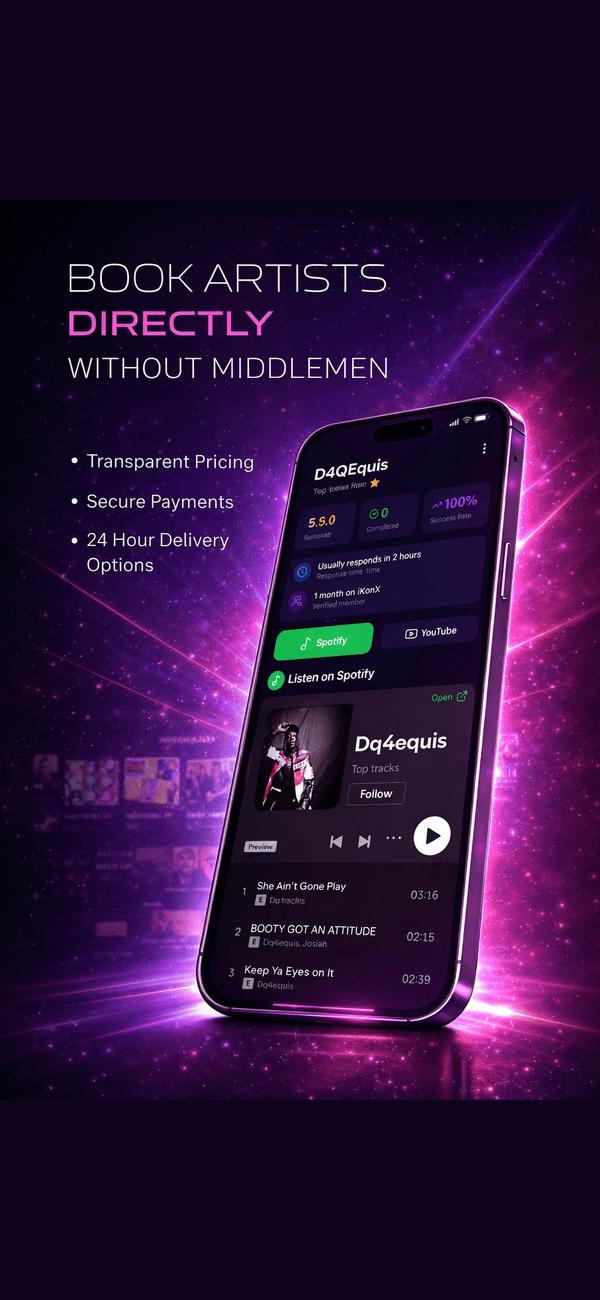
That is where a transparent, direct booking channel changes the math for a promoter. iKonX is an artist-first platform where independent artists own their profile and set their own price. The Promoters side, where you will search bookable indie artists with prices listed up front and reach them directly, is on the roadmap and not live yet, so to be roadmap-honest: today the artist-facing app is live and the Promoters booking experience is being built. When it ships, the model is deliberately simple and disclosed up front. The artist keeps 100 percent of the price they set, and iKonX takes 0 percent platform commission from that price. As the promoter you pay a flat 10 percent on top, in place of an opaque agent cut you never see. iKonX is free to download and explore, full access to paid features is a flat 9.99 dollars per month, and the only payout deduction is a low, sub-5 percent withdrawal fee the artist pays when cashing out, below the industry standard and never taken from your booking budget. A listed price and no broker in the middle means your single biggest cost is knowable before you commit, which is the whole game when your margin is measured in single digits.
Empty date
You have a room and a night with nothing on it yet.
Browse artists
Search verified indie acts with transparent pricing. No agent, no gatekeeper.
Lock the fee
Agree the price the artist set. They keep 100% · you pay a flat 10% on top.
Confirm + pay
Message direct, confirm the details, and pay securely in the app.
Doors open
The act shows up, the room fills, you book the room and keep the night.
Move this week · the good dates fill fastest.
The whole network lives in one app.
iKonX puts every side of the music business in your pocket. Artists set their own price and keep 100% of it · iKonX takes 0% platform commission. Browse, message, and book straight from the app.

Transparent booking fees, no surprises
$300 to $600
A local indie act for a small private show or pop-up.
100% to artist$600 to $1.5k
A headline slot or support for a ticketed venue night.
You pay flat 10%$1.5k and up
A lineup placement scaled to the act and the draw.
No broker cutWhere a concert promoter's money actually comes from in 2026
| Revenue stream | How the promoter earns it | Typical economics (2026) |
|---|---|---|
| Ticket spread (the door) | Gross ticket sales minus the artist fee, venue, production, marketing, and staff | Thin and volatile; Live Nation's concert-heavy business ran about a 3.6% operating margin in FY2024 |
| Bar, concessions and parking | The venue's high-margin sales on show night | Often the real profit at club and mid-size level |
| Merch commission | An agreed cut of the artist's merchandise sales at the show | Commonly 10% to 30% of merch revenue, negotiated per deal |
| VIP, early entry and meet-and-greets | Premium upsells layered on the base ticket | High margin; a small share of buyers paying a large premium |
| Sponsorship and brand deals | Brands paying to reach the audience at festivals and tours | Highest-margin line at scale; a core profit driver for large promoters |
| Ticketing and service fees | Fees added at checkout, at the Ticketmaster scale | Concentrated at the largest promoters; a major profit center alongside sponsorship |
Financial figures are dated and sourced. Live Nation Entertainment reported full-year 2024 revenue of $23.156 billion (up 1.89% over 2023), operating income of $0.825 billion, and net income of $0.638 billion, an operating margin near 3.6% and a net margin under 3% (Live Nation FY2024 results, reported Feb 2025; figures via macrotrends.net, accessed 2026-07-27). Merch-commission ranges (10% to 30%), agent commissions (10% to 20% of the artist fee), and guarantee-versus-door deal structures are directional 2026 industry norms that vary widely by market, act, and venue, so treat them as brackets, not quotes. The only fixed claim is the iKonX model: artists keep 100% of the price they set, iKonX takes 0% platform commission, and the buyer pays a flat 10% on top. iKonX is free to download, full access to paid features is a flat $9.99 per month, and the only payout deduction is a low, sub-5% withdrawal fee. The iKonX Promoters booking experience is on the roadmap and not yet live.
How concert promoters make money: FAQ
How do concert promoters actually make money?
On the spread, the gap between what a show brings in and what it costs to stage. Revenue is the ticket door plus higher-margin lines like bar and concessions, parking, a cut of artist merch, VIP upsells, and, at scale, sponsorship and ticketing fees. Costs are the artist guarantee, venue, production, marketing, and staff, and the promoter keeps whatever is left.
Do concert promoters make good money, or are the margins thin?
The margins are thinner than most people expect. In 2024 Live Nation, the largest promoter on earth, turned $23.156 billion of revenue into $0.825 billion of operating income and $0.638 billion of net income, roughly a 3.6 percent operating margin and under 3 percent net (Live Nation FY2024 results, Feb 2025). Independent promoters can do better per show, but only by controlling the artist fee and stacking ancillary revenue; a single under-sold night can wipe out several profitable ones.
What is the difference between a guarantee, a door deal, and a backend split?
A guarantee is a flat fee the promoter pays the artist no matter what the show sells; the promoter keeps everything above it and eats any shortfall. A door deal pays the act an agreed percentage of ticket revenue, so their pay rises and falls with turnout. A guarantee-plus-backend split combines a smaller guarantee with a share of profits once the show recoups costs, commonly weighted toward the artist above breakeven. Which one protects you depends on how confident you are in the draw.
How much does a promoter pay the artist?
It depends on the act and the room, from a few hundred dollars for a local opener to five and six figures for a touring headliner. The fee is almost always the biggest single cost on the show. When an agent is involved, expect a 10 to 20 percent commission layered on top; booking an independent artist directly removes that cut, which on a small show is often the difference between profit and loss.
How can a small or independent promoter make money on a show?
Book an act sized to the room you can actually fill, keep the booking cost transparent by reaching artists directly, and make your margin on the ancillary lines, bar, VIP, merch cut, and a local sponsor, not on the thin ticket spread alone. Sell out a smaller room rather than half-fill a big one, and run a P and L on every show.
Does iKonX take a cut when a promoter books an artist?
No. The Promoters booking experience is on the roadmap and not live yet, but the model is set: the artist keeps 100 percent of the price they set, iKonX takes 0 percent platform commission, and you pay a flat 10 percent on top instead of an opaque agent fee. iKonX is free to download, full access to paid features is a flat $9.99 per month, and the only payout deduction is a low, sub-5 percent withdrawal fee the artist pays when cashing out, never taken from your booking budget.
Explore the connected sides of the network
Book the room. Keep the night.
iKonX is building a Promoters side where you search bookable indie artists with prices listed up front and reach them directly. Artists keep 100 percent of the price they set, and iKonX takes 0 percent commission.

DOWNLOAD THE FREE PDF TODAY:
The Indie Booking Kit
Offer templates, a fee-range guide, and a doors-to-payout checklist for booking an indie act.
Get the free PDF ->