Events JOIN THE NETWORK · EVENTS
14 Days to doors ·
build the bill now
Headliner

Where are the best places to find local artists to perform at your event?

Support Browse verified acts · lock the slot
Openers Confirm the night · 0% platform commission · artists keep 100%
The short answer

There are nine reliable places to find local artists for an event, and most organisers only ever try two of them. The highest-yield sources are artist listing platforms where acts publish prices, local venue bookers who already know who is reliable, and referrals from acts you have booked before. The three most overlooked are recording studios, music schools and community radio, all of which know local talent early and cost nothing to ask.

Slat 01 · the gap

Finding local acts feels harder than it is, because most organisers search in the two places with the worst signal and conclude their city has nothing.

Those two places are a general web search and social media. A web search returns booking marketplaces and wedding vendors, which is fine but narrow. Social returns whoever posts most, which correlates poorly with who performs well or is even available. Neither surfaces the working local acts who are busy playing rather than posting.

The second problem is that organisers stop at the first source that returns anything. One marketplace produces five options, all in budget, and the search ends. That is not a shortlist, it is whoever happened to be listed on one platform, and it usually means paying marketplace fees for acts you could have reached directly.

The third problem is that vetting and finding get collapsed into one step. The best source for finding an act is rarely the best source for confirming they are good, and organisers who book straight from a listing without a live clip or a reference are gambling. The nine sources below differ enormously on both axes, and knowing which does which is most of the skill.


Slat 02 · the lineup

Use three sources, not one, and separate finding from vetting.

Pick one high-yield source, one high-vetting source, and one wildcard. A listing platform to generate options, a venue booker or past act for a reference, and one of the overlooked three, studios, schools or radio, to surface someone nobody else is calling. Three sources produce a genuine shortlist; one source produces whoever was listed.

Set the budget before you look. A flat number you can pay regardless of turnout. For context, national solo musician cost averages about 429 dollars with most bookings between 313 and 586, a singer-songwriter commonly runs about 300 dollars for an hour, and national band booking typically lands near 590. Knowing your number turns every conversation into a yes or no rather than a negotiation.

Vet on a recent live clip, not a studio recording. Studio audio tells you nothing about whether they hold a room. Ask for something from the last six months, in front of people.

Then put it in writing. Date, load-in, set times, fee, who supplies sound, and a cancellation term. One page, even for a few hundred dollars.

iKonX is building the Events side around source one, because it is the highest-yield and the worst-served: bookable local artists with prices listed up front, contacted directly with no agent or marketplace in between. The artist keeps 100 percent of the price they set, iKonX takes 0 percent platform commission, and you pay a flat 10 percent on top.

Roadmap honesty: Events is a roadmap side of iKonX, launching soon. It solves finding and contacting acts, not contracts or payments.

Slots open · the bill is filling

100%
of the fee goes to the act · iKonX takes 0% platform commission
Available
0
gatekeepers between you and the act you want to book
Available
10%
flat fee the buyer pays on top · no broker cut, no surprises
Active
See iKonX in action

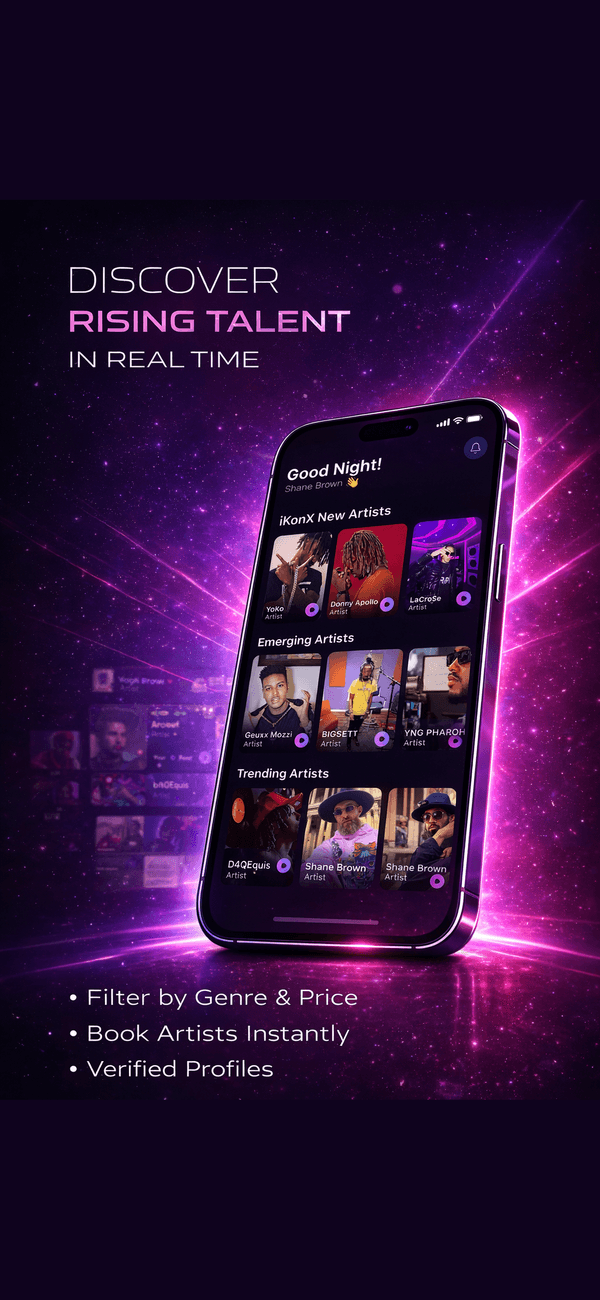
The whole network lives in one app.

iKonX puts every side of the music business in your pocket. Artists set their own price and keep 100% of it · iKonX takes 0% platform commission. Browse, message, and book straight from the app.

The iKonX app on an iPhone showing the artist discovery screen · where music meets business with 0% platform commission

The 9 best places to find local artists to perform

  1. 01Date locked
    Set the night and the room. Everything on the bill hangs off this one fixed point.
  2. 02Stages set
    Decide the stages and the zones. Map where each act plays before you book a single name.
  3. 03Acts confirmed
    Browse verified artists, agree the fee directly, and lock each slot. The act keeps 100% of the price they set.
  4. 04Run of show
    Order the bill headliner to opener, set the set-times, and share the night with the whole lineup.
  5. 05Doors
    Confirm and pay through iKonX, then open the doors on a lineup you built act by act.
  1. Artist listing platforms. Where acts publish themselves as bookable, usually with a price. Highest yield because everyone listed has already decided they want paid work, which removes the slowest question in every other source. Vetting is medium, so still ask for a recent live clip.
  2. Local venue bookers. The people who book music every week in your city. They know who turns up on time, who draws and who is difficult, which is information no listing carries. Costs one conversation and is the best vetting source on this list.
  3. Open mics and local showcases. Go and watch. You see the live reaction, the professionalism and the actual sound before any money moves. Slow, but nothing vets an act better than seeing one work a room.
  4. Referrals from acts you have already booked. The highest-signal source available and the most neglected. A good act knows other good acts and has their own reputation attached to the recommendation, so the filtering is already done.
  5. Booking marketplaces. Vetted, searchable and reliable, at a cost on both sides: commonly a client-side service fee of roughly 10 to 12 percent on top of a separate performer-side fee, or a 5 percent booking fee plus 5 percent commission built into the quote. Worth it when you cannot risk an unknown.
  6. Recording studios and engineers. Badly overlooked. Engineers know who is recording, who is about to release and who is hungry for a stage, often months before anyone else. One email to two local studios is genuinely one of the highest-return actions here.
  7. Music schools and colleges. Excellent for background sets, cocktail hours and acoustic, jazz or classical ensembles on a tight budget. Expect less stagecraft and more reliability, plus staff who are usually delighted to point you at their best students.
  8. Community and college radio. Local stations exist to champion local artists and the people programming them have deep, current knowledge of the scene. Almost nobody asks them, which is exactly why it works.
  9. Community events, markets and festivals. Watch who is already playing to a crowd in your city. Acts working farmers markets and street festivals are experienced at holding attention in imperfect conditions, which is precisely the skill most events need.
The stage map
Main stage
Your headliner act · the top of the bill
Second stage
Support acts · the build-up sets
Opener slot
Local openers · the night's first names

What each source yields, costs and vets

#SourceYieldVettingCost
1Artist listing platformsHighMediumThe artist's listed fee
2Local venue bookersMediumHighestFree
3Open mics and showcasesLowHighestFree, costs evenings
4Referrals from booked actsMediumHighFree
5Booking marketplacesHighHighRoughly 10 to 12 percent client-side, plus a performer-side fee
6Studios and engineersMediumHighFree
7Music schoolsMediumMediumLow fees
8Community and college radioMediumHighFree
9Community events and marketsLowHighFree, costs weekends

Cost benchmarks are dated and sourced. National solo musician cost averages about 429 dollars with most bookings between 313 and 586 dollars, varying by duration, event type, skill, travel and union status (thumbtack.com, 2025-10-20). A singer-songwriter commonly costs about 300 dollars for one hour (gigsalad.com, 2026), and national band booking typically lands near 590 dollars with most events between 431 and 809 (thumbtack.com, 2025). Marketplace fee structures differ: GigSalad charges providers a 5 percent booking fee on free membership and 2.5 percent on paid alongside a 10 to 12 percent client-side service fee (help.gigsalad.com, 2025), while The Bash charges a 5 percent booking fee plus a 5 percent commission commonly built into the quote (thebash.com, 2025). Comparing rates and availability across local acts before booking is the standard sourcing pattern (gigsalad.com/book-music, 2026). Yield and vetting ratings are editorial judgements based on how each source works, not measured data. The only fixed claim here is the iKonX model: the artist keeps 100 percent of the price they set, iKonX takes 0 percent platform commission, and the buyer pays a flat 10 percent on top. iKonX is free to download and explore, full access to paid features is a flat 9.99 dollars a month, and the only payout deduction is a low, sub-5 percent withdrawal fee, below the industry standard.

Finding local artists: FAQ

Where is the best place to find local musicians for an event?

Artist listing platforms give the highest yield, because everyone listed has already decided they want paid work and usually shows a price, which removes the slowest question in every other source. But pair it with a vetting source: local venue bookers know who turns up on time and who actually draws, and that information appears on no listing anywhere. Use one high-yield source and one high-vetting source rather than relying on either alone.

What are the most overlooked sources for local talent?

Recording studios, music schools and community radio. Engineers know who is recording and who is hungry for a stage months before anyone else. Music schools are excellent for background, cocktail-hour and acoustic or classical ensembles on a tight budget. Community and college stations exist to champion local artists and their programmers have current, deep scene knowledge. All three cost nothing to ask and almost nobody asks.

How much does a local artist cost to book?

National solo musician cost averages about 429 dollars with most bookings between 313 and 586 dollars, a singer-songwriter commonly runs about 300 dollars for one hour, and national band booking typically lands near 590 with most events between 431 and 809. City, set length, travel and gear move all of these. Set a flat number you can pay regardless of turnout before you start looking.

How do you vet a local artist before booking them?

Ask for a live clip from the last six months, in front of people, rather than a studio recording. Studio audio tells you nothing about whether they hold a room. Better still, ask a venue booker or an act you have already booked, since both have watched them work. Best of all, go and see them, which is slow but is the only vetting that never misleads.

Does iKonX charge a fee to find local artists?

The artist keeps 100 percent of the price they set and iKonX takes 0 percent platform commission, with you paying a flat 10 percent on top. That differs from marketplaces layering a 10 to 12 percent client-side fee on top of a separate performer-side fee. The only deduction on the artist side is a low, sub-5 percent withdrawal fee when moving earnings to a bank, a transfer cost rather than a commission. iKonX is free to download and explore, full access is a flat 9.99 dollars a month, and Events is a roadmap side, launching soon.

Build the night, act by act.

iKonX is building an Events side where you find bookable local artists with prices listed up front. Artists keep 100 percent of the price they set, and iKonX takes 0 percent commission.

The iKonX app on a phone

Download the iKonX App

Download on theApp Store
Coming Soon onGoogle Play

DOWNLOAD THE FREE PDF TODAY:

The Festival Lineup Planner

A run-of-show grid, a stage-and-set-time worksheet, and a multi-act budget template for building a festival or showcase lineup end to end.

Get the free PDF ->