Labels JOIN THE NETWORK · LABELS

How does an indie label build an artist discovery system?

Unsigned artist ▲ Momentum
Stage Genre ▲ Momentum ✓ Verified

The room already pulled. Career-stage matched, verified, reachable direct.

142 New unsigned artists this week
100% Career-stage matched
0 Gatekeepers between you and contact
The short answer

Indie label artist discovery works when it is a weekly cadence rather than an occasional campaign. The system has four parts: a fixed two-hour weekly slot, a written signing thesis that filters, a tracked shortlist with signal data attached, and a conversion step where you actually reach out. Most small labels build the first three and skip the fourth, which is why they end up with an impressive spreadsheet and no roster.

01 · Discovery

Small labels rarely fail at discovery because they have bad taste. They fail because discovery is treated as something you do when you have time, and there is never time.

What happens instead is a burst. A founder spends a weekend hunting, builds a list of thirty artists, feels productive, and then does nothing with it for two months. By the time they return, the momentum they spotted has either evaporated or been noticed by everyone else. Discovery rewards consistency far more than intensity, and a burst is the least useful shape it can take.

The second problem is filtering. Without a written signing thesis, every promising artist looks equally worth chasing, and the label ends up pursuing whoever replied fastest rather than whoever fits. A thesis is not a limitation, it is what makes a shortlist mean something.

The third problem is that the industry's default channel actively works against small labels. The majors have closed unsolicited submissions entirely, requiring an established industry referral, and only around 2 percent of unsolicited demos to major labels get any response. Indie A and R teams face the same volume without the staff, so an inbox-first strategy inherits all the noise and none of the filtering.

The fourth and most expensive problem is the missing conversion step. Labels build the list and never send the message. Reaching out early costs nothing and starts a relationship before the artist has options; waiting until the case is airtight means bidding against people who moved sooner.

02 · Signal

Build the smallest system that runs every week without heroics. Four components.

A fixed two-hour slot. Same day, same time, in the calendar. Two hours weekly beats a heroic weekend every quarter, because discovery compounds and bursts do not. Protect it the way you would protect a session.

A written signing thesis. One sentence: genre, stage, market, and what you can actually do for an artist that they cannot do alone. This is the filter that turns a long list into a short one, and without it the shortlist is just a list.

A tracked shortlist with signals attached. Not names, names plus evidence. What moved, how fast, from what base. Professional A and R tooling exists for exactly this and is priced as professional software, with Chartmetric Premium at 117 dollars a month and Ultra at 150, and 2026 tools weight short-form sound velocity over a seven to fourteen day window alongside playlist add-rates. You can start with a spreadsheet, but track the same fields.

A conversion step with a deadline. Every week, three messages go out. Not thirty, three. Reaching out before you are certain is the whole advantage, because certainty arrives at the same moment for everyone.

What to weight: velocity over size. A track moving quickly from a small base is a far stronger signal than a large flat number, which is precisely why the tooling weights short-window velocity. Beyond data, the durable signals are live reaction and work ethic, and the people who see those first are promoters, venue bookers and engineers rather than any platform.

iKonX is building the Labels side around the top of that loop: verified unsigned artists with real profiles, contacted directly, without an A and R subscription stack or a gatekeeper. When you book a paid collaboration through the platform, the artist keeps 100 percent of the price they set, iKonX takes 0 percent platform commission, and the buyer pays a flat 10 percent on top.

Roadmap honesty: Labels is a roadmap side of iKonX, launching soon. It solves finding and contacting artists, not contracts, royalty accounting or distribution.
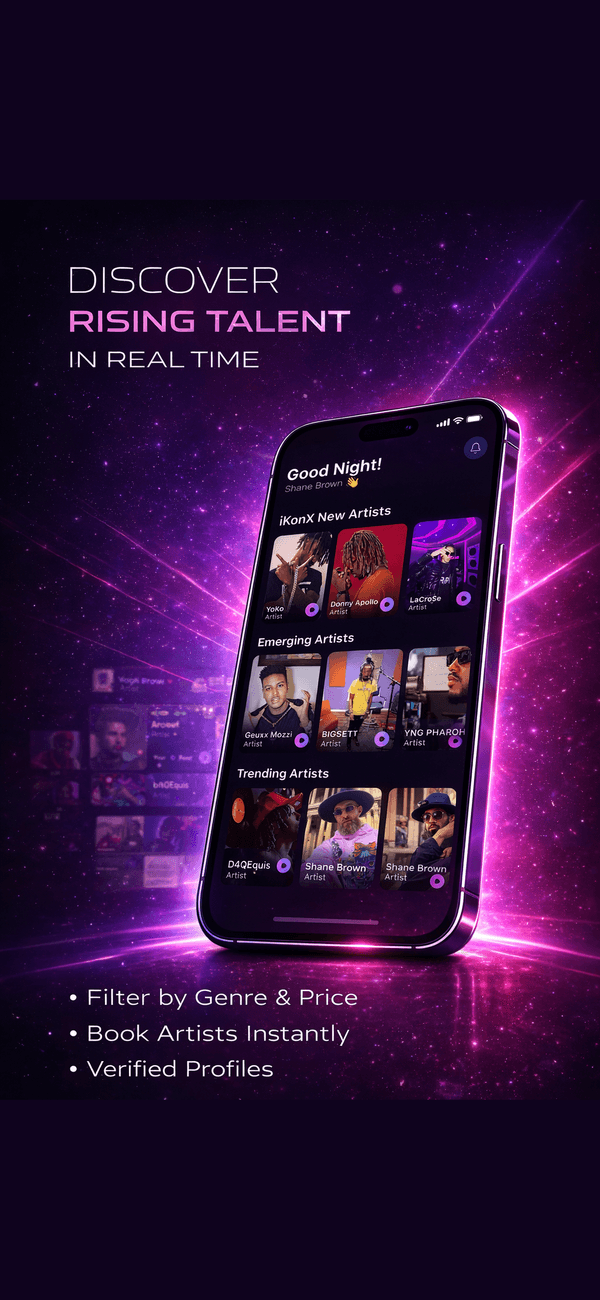
See iKonX in action

The whole network lives in one app.

iKonX puts every side of the music business in your pocket. Artists set their own price and keep 100% of it · iKonX takes 0% platform commission. Browse, message, and book straight from the app.

The iKonX app on an iPhone showing the artist discovery screen · where music meets business with 0% platform commission
03 · The Deck

The weekly discovery loop, step by step

Scout the live room
Stage▲ Momentum
  1. Put two hours in the calendar, weekly, and defend them. Same day, same time. This one decision separates labels that build a roster from labels that maintain a spreadsheet, and it costs nothing but discipline.
  2. Write the signing thesis in one sentence. Genre, stage, market, and what you offer that the artist cannot do alone. Re-read it at the start of every session. Without it you will chase whoever is most responsive rather than whoever fits.
  3. Spend the first hour hunting, the second hour deciding. Hunting without deciding produces a longer list, not a better one. End every session with three names promoted and the rest parked.
  4. Track velocity, not size. Record what moved, how fast, and from what base. Tools weight short-form sound velocity over seven to fourteen days plus playlist add-rates precisely because early movement predicts better than absolute numbers.
  5. Send three messages every week, without exception. This is the step labels skip. A short, specific note costs nothing and starts the relationship before the artist has options. Waiting for certainty means arriving with everyone else.
  6. Work the scene layer once a month. Ask promoters, venue bookers and engineers who impressed them. They watch artists work and see reliability and live reaction, which no dataset captures.
Match by career stage
Genre✓ Verified

Filter the deck to artists at the same rung as your label, so a signing fits where you are now, not where you wish you were.

Reach out direct
✓ VerifiedOpen to contact

No demo pile, no inbox gatekeeper. You contact a verified profile straight from the deck and start the conversation on your terms.

Demo pile vs live discovery

What indie labels track, and which signals actually predict

SignalWhat it tells youPredictive?Where you get it
Short-form sound velocity, 7 to 14 daysSomething is moving nowStrongA and R tooling, from 117 dollars a month
Playlist add-rateEditorial and algorithmic pickupStrongA and R tooling
Live reactionWhether a room respondsStrong, and uncaptured by dataShows, promoters, venue bookers
Work ethic and reliabilityWhether they will survive a release cycleStrong, and only visible in personEngineers, promoters, past collaborators
Total follower countWhere they have beenWeak on its ownAnywhere, which is the problem
Unsolicited inbox volumeWho has the fewest optionsWeakest, selection works against youFree, and expensive in hours

Figures are dated and sourced. 2026 A and R tools weight short-form sound velocity over a seven to fourteen day window alongside playlist add-rates (chartlex.com, 2026), and A and R teams use data across large track catalogues and multiple metrics to surface early movement (hmc.chartmetric.com, 2025). Professional tooling is priced as professional software, with Chartmetric Premium at 117 dollars a month and Ultra at 150 (chartmetric.com, accessed June 2026). Universal Music Group, Warner Music Group and Atlantic Records all decline unsolicited demos and require an established industry referral (avenuear.com, 2025), and only around 2 percent of unsolicited demo submissions to major labels receive a response while indie A and R teams are overwhelmed by the same volume (droptrack.com, 2025). Predictive ratings are an editorial judgement drawn from how the tooling itself weights signals, not a measured study. The only fixed claim here is the iKonX model: the artist keeps 100 percent of the price they set, iKonX takes 0 percent platform commission, and the buyer pays a flat 10 percent on top. iKonX is free to download and explore, full access to paid features is a flat 9.99 dollars a month, and the only payout deduction is a low, sub-5 percent withdrawal fee, below the industry standard.

FAQ

Indie label discovery: FAQ

How often should an indie label run artist discovery?

Weekly, in a fixed two-hour slot, rather than in occasional bursts. Discovery compounds: a small consistent cadence surfaces artists earlier and keeps relationships warm, while a heroic weekend every quarter finds artists whose momentum has already been noticed. The cadence matters more than the hours. Two hours a week beats sixteen hours a quarter, even though the quarterly version feels more productive.

What signals actually predict a signable artist?

Velocity over size. A track moving quickly from a small base is a stronger signal than a large flat number, which is why 2026 A and R tools weight short-form sound velocity over a seven to fourteen day window and playlist add-rates. The signals data never captures are live reaction and work ethic, and the people who see those first are promoters, venue bookers and engineers rather than any platform.

Do indie labels need paid A and R software?

Not to start. The fields matter more than the tool, and a spreadsheet tracking what moved, how fast and from what base gets you most of the way. Paid tooling is priced as professional software, with Chartmetric Premium at 117 dollars a month and Ultra at 150, and it earns that when your constraint becomes speed of detection rather than discipline. Buy it when the weekly loop already runs without it.

Should an indie label accept demo submissions?

Keep it if you like, but cap the time it gets and never make it the pipeline. Selection works against you: artists with genuine momentum usually have options and do not email strangers, while the majors have closed unsolicited submissions entirely and only around 2 percent of those demos get any response. An unbounded inbox absorbs exactly the hours that should go into hunting.

Does iKonX charge a commission if I pay an artist I discovered there?

No. The artist keeps 100 percent of the price they set and iKonX takes 0 percent platform commission, with you paying a flat 10 percent on top. The only deduction on the artist side is a low, sub-5 percent withdrawal fee when moving earnings to a bank, which is a transfer cost rather than a commission on the rate. iKonX is free to download and explore, full access to paid features is a flat 9.99 dollars a month, and Labels is a roadmap side of iKonX, launching soon.

Building

Labels is coming to The Network

Scouting opens soon. Be first to the deck when it goes live · no pressure, just a seat held.

Notify me when it opens ->

Find the talent first. Sign on your terms.

iKonX is building a Labels side where you scout verified unsigned artists and reach them directly. Artists keep 100 percent of the price they set, and iKonX takes 0 percent commission.

The iKonX app on a phone

Download the iKonX App

Download on theApp Store
Coming Soon onGoogle Play

DOWNLOAD THE FREE PDF TODAY:

The Indie Label A&R Scouting Playbook

A modern A&R checklist for finding, career-stage-matching, and signing unsigned artists in 2026.

Get the free PDF ->