The room already pulled. Career-stage matched, verified, reachable direct.
Where do you find demos worth signing?
The demos worth signing are rarely the ones sent to you. In 2026 labels find signable artists through five sources: direct discovery on platforms where artists list themselves, early traction signals in analytics tools, scene and venue networks, trusted referrals, and paid submission platforms. The submission inbox ranks last on signal despite ranking first on volume, which is exactly why indie A and R teams are overwhelmed and majors decline unsolicited material outright.
Most new labels build their sourcing strategy backwards. They open a submissions inbox, publish an email address, and wait. Within a month they have hundreds of files and no way to tell which are worth ten minutes.
The structural problem is selection. An artist with genuine momentum, a growing local audience and a finished record generally does not need to email strangers. They have options. The artists who submit most are, on average, the artists with the fewest alternatives, which inverts the quality signal of your primary channel.
The majors resolved this by closing the door entirely. Universal, Warner and Atlantic all decline unsolicited demos and require an established industry referral. That is not snobbery, it is triage. And the numbers explain why: roughly 2 percent of unsolicited demo submissions to major labels receive any response at all, while indie A and R teams are swamped by the same volume without the staff to process it.
The second problem is that paid submission platforms feel like a solution and are really a filter you rent. They work, in the narrow sense that a human listens. But you are paying to be one of many, and the artist is paying too, with SubmitHub credits at roughly 0.80 to 1.00 dollars each, 10 dollars for 10, 27 for 30 and 80 for 100. That is a real cost for both sides and it does not change who is submitting.
The third problem is the one that decides outcomes: by the time an artist is worth an obvious yes, several other people have noticed. Sourcing is a speed game, and an inbox is the slowest instrument in it.
Invert it. Stop collecting submissions and start hunting, using five sources in descending order of signal.
Direct discovery on artist-first platforms. Places where unsigned artists maintain a real profile because they want work, not because they are pitching a label. The signal is high because the artist is behaving normally rather than performing for A and R, and you reach them before the queue forms.
Early traction data. Analytics platforms surface momentum before it is obvious, weighting signals like short-form sound velocity over a seven to fourteen day window and playlist add-rates. This is what professional A and R teams pay for, at 117 dollars a month for Chartmetric Premium and 150 for Ultra, and it is genuinely the difference between finding an artist early and reading about them.
Scene and venue networks. Promoters, venue bookers and studio engineers know who is good before any platform does, because they watch people work. This source costs nothing but time and is systematically underused by new labels.
Referrals. The channel the majors have standardised on. A recommendation from someone whose taste you trust carries more information than fifty submissions, which is precisely why it became the gate.
Paid submission platforms. Last, not never. Useful for volume and for hearing outside your bubble, but understand you are renting a filter rather than gaining an edge.
iKonX is building the Labels side around the first source, because it is the one with the best signal-to-effort ratio and the thinnest tooling. Verified artist profiles, direct contact with no gatekeeper, and no A and R subscription stack to maintain. When you book a paid collaboration through the platform, the artist keeps 100 percent of the price they set, iKonX takes 0 percent platform commission, and the buyer pays a flat 10 percent on top.
Roadmap honesty: Labels is a roadmap side of iKonX, launching soon. It solves finding and contacting artists. It does not handle contracts, royalty accounting or distribution.
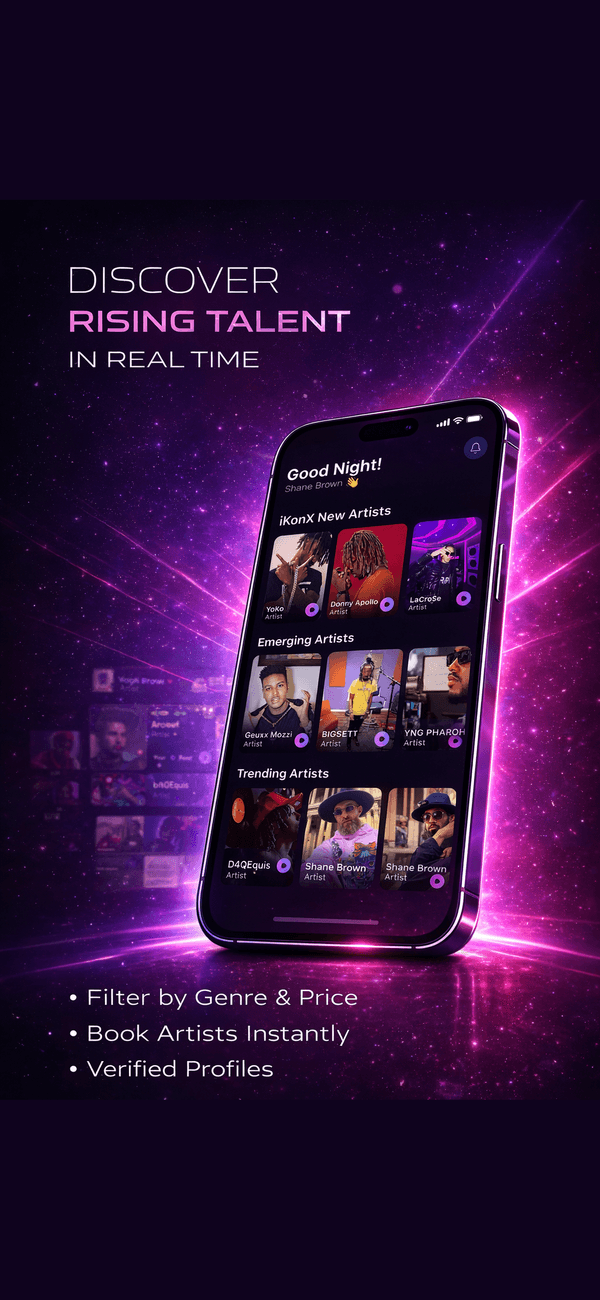
The whole network lives in one app.
iKonX puts every side of the music business in your pocket. Artists set their own price and keep 100% of it · iKonX takes 0% platform commission. Browse, message, and book straight from the app.

How to build a demo pipeline worth signing from
- Close or de-prioritise the open inbox. If you keep it, cap the time it gets. An unbounded submission pile absorbs the hours that should go to hunting, and its average signal is the weakest of your five sources.
- Define your signing thesis in one sentence. Genre, stage, market, and what you can actually do for them. Without it every promising artist looks equally worth chasing and you sign the one who replied fastest.
- Build a weekly hunting routine, not a campaign. Two fixed hours: browse artist-first platforms, check traction movers, message three people whose taste you trust. Sourcing rewards consistency far more than intensity.
- Watch velocity, not size. A track moving quickly from a small base is a stronger signal than a large flat number. Analytics tools weight short-form sound velocity over seven to fourteen days precisely because that is where early momentum shows.
- Work the scene layer deliberately. Ask promoters, venue bookers and engineers who impressed them this month. They see the work ethic and the live reaction, which no dataset captures.
- Reach out before you are certain. A conversation costs nothing and starts the relationship early. By the time the case is airtight, so is everyone else's, and you are bidding rather than discovering.
Filter the deck to artists at the same rung as your label, so a signing fits where you are now, not where you wish you were.
No demo pile, no inbox gatekeeper. You contact a verified profile straight from the deck and start the conversation on your terms.
The five sources labels sign from in 2026, ranked by signal
| Source | Signal quality | What it costs | Speed |
|---|---|---|---|
| Direct discovery on artist-first platforms | High: the artist is working, not pitching | Low | Fast |
| Early traction data | High: velocity before it is obvious | Chartmetric Premium 117, Ultra 150 a month | Fast |
| Scene and venue networks | High: people who watch artists work | Time only | Medium |
| Referrals | High: the channel majors standardised on | Relationship capital | Slow to build |
| Paid submission platforms | Medium: a rented filter, artists pay too | Credits roughly 0.80 to 1.00 dollars each | Medium |
| Open unsolicited inbox | Lowest: selection works against you | Free, but expensive in hours | Slowest |
Figures are dated and sourced. Universal Music Group, Warner Music Group and Atlantic Records all decline unsolicited demos and require an established industry referral (avenuear.com, 2025). Roughly 2 percent of unsolicited demo submissions receive a response from major labels, and indie A and R teams are overwhelmed by the same volume (droptrack.com, 2025). SubmitHub credits run roughly 0.80 to 1.00 dollars each, at 10 dollars for 10 credits, 27 for 30 and 80 for 100 (loopsolitaire.co.uk, 2025), on a paid submission model that reaches curators and labels (support.routenote.com, 2025). Professional A and R tooling is priced at 117 dollars a month for Chartmetric Premium and 150 for Ultra (chartmetric.com, accessed June 2026), and 2026 A and R tools weight short-form sound velocity over a seven to fourteen day window alongside playlist add-rates (chartlex.com, 2026). Signal-quality rankings are an editorial judgement, not a measured study. The only fixed claim here is the iKonX model: the artist keeps 100 percent of the price they set, iKonX takes 0 percent platform commission, and the buyer pays a flat 10 percent on top. iKonX is free to download and explore, full access to paid features is a flat 9.99 dollars a month, and the only payout deduction is a low, sub-5 percent withdrawal fee, below the industry standard.
Finding demos to sign: FAQ
Do record labels still accept demo submissions in 2026?
Independent labels often do; the majors largely do not. Universal, Warner and Atlantic all decline unsolicited material and require an established industry referral. Even where submissions are accepted, only around 2 percent of unsolicited demos to major labels get any response. That is why the submission inbox is the weakest of the five sourcing channels despite being the most visible one.
Where do A and R teams actually find new artists?
Five places, roughly in this order of usefulness: direct discovery on platforms where unsigned artists maintain working profiles, early traction data from analytics tools, scene and venue networks, trusted referrals, and paid submission platforms last. The common thread in the top four is that the label goes looking rather than waiting, which is also what gets you there before the artist has options.
Are paid demo submission platforms worth it for a label?
They are useful for volume and for hearing outside your usual bubble, but understand what you are buying. Artists pay to submit, with credits at roughly 0.80 to 1.00 dollars each, so you are renting a filter rather than gaining an edge, and the same artists submit to everyone. Use them as a supplement to active hunting, never as the pipeline itself.
What signals show an unsigned artist is worth signing?
Velocity rather than size. A track moving quickly from a small base beats a large flat number, which is why 2026 A and R tools weight short-form sound velocity over a seven to fourteen day window and playlist add-rates. Beyond the data, the durable signals are live reaction and work ethic, and the people who see those first are promoters, venue bookers and engineers rather than any platform.
Does iKonX charge a commission if I pay an artist I found there?
No. The artist keeps 100 percent of the price they set and iKonX takes 0 percent platform commission, with you paying a flat 10 percent on top. The only deduction on the artist side is a low, sub-5 percent withdrawal fee when moving earnings to a bank, which is a transfer cost rather than a commission on the rate. iKonX is free to download and explore, full access to paid features is a flat 9.99 dollars a month, and Labels is a roadmap side of iKonX, launching soon.
Labels is coming to The Network
Scouting opens soon. Be first to the deck when it goes live · no pressure, just a seat held.
Explore the connected sides of the network
Find the talent first. Sign on your terms.
iKonX is building a Labels side where you scout verified unsigned artists and reach them directly. Artists keep 100 percent of the price they set, and iKonX takes 0 percent commission.
DOWNLOAD THE FREE PDF TODAY:
The Indie Label A&R Scouting Playbook
A modern A&R checklist for finding, career-stage-matching, and signing unsigned artists in 2026.
Get the free PDF ->