How does the music industry actually work?
Ten sides. One platform. No gatekeepers. iKonX is the connected music economy · every side of the industry transacting in one app.
The music industry works as a connected web of players · artists who create, labels and managers who develop and promote, venues and promoters who put on shows, and platforms that distribute and sell · all moving music rights and money between them. Historically gatekeepers controlled access and took large cuts. In 2026, independent artists can reach audiences, get booked, and sell directly, keeping far more of what they earn. On iKonX an artist keeps 100 percent of the price they set at 0 percent platform commission, with the buyer paying a flat 10 percent on top.
The ten-sided network
The music industry is one of the most mystified businesses there is. Outsiders and even working artists describe it as a black box: somehow songs get made, somehow they reach people, and somehow money moves, but who does what and who gets paid is rarely explained in plain terms. That confusion is not an accident. For most of the industry's history, the people who understood the system controlled access to it, and keeping the map fuzzy kept the gatekeepers in charge.
The practical cost of that confusion falls on artists. When you do not understand how rights, royalties, bookings, and promotion actually connect, you cannot tell a fair deal from a bad one, you sign away things you should keep, and you let middlemen take cuts you did not know were negotiable. The fog around how the industry works is precisely what lets value leak away from the people who make the music.
And the picture most people carry is out of date. The old model · where a label was the only path to an audience and took the lion's share in return · is no longer the only model. The industry has shifted, and artists who still see it through the old gatekeeper lens miss the leverage they now actually have.
The two-sided web
Most platforms are two-sided · a buyer and a seller, with a gatekeeper taking a cut in the middle. Value grows in a line.
The ten-sided network
iKonX connects ten sides on one login. Every side can reach every other side directly, so value grows combinatorially · not in a line.
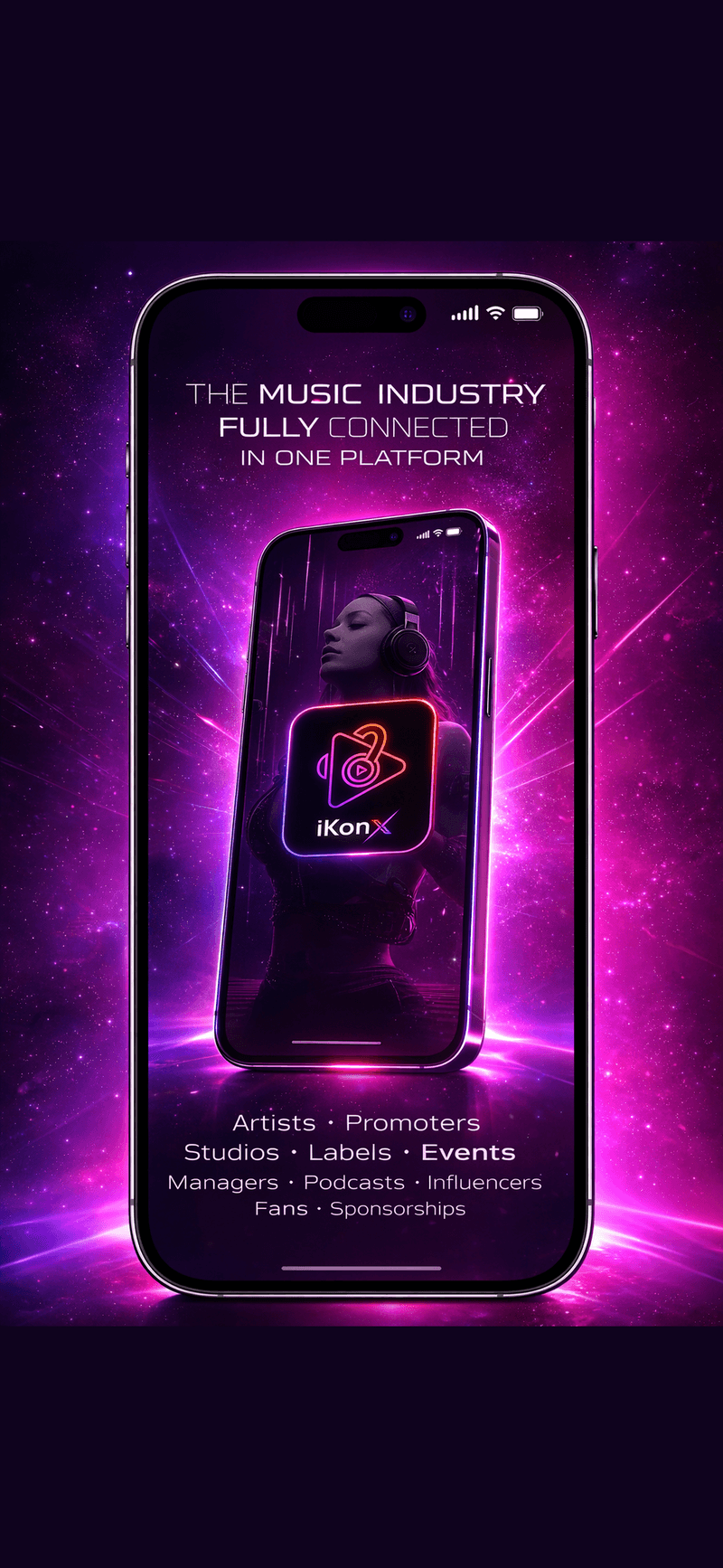
The whole network lives in one app.
iKonX puts every side of the music business in your pocket. Artists set their own price and keep 100% of it · iKonX takes 0% platform commission. Browse, message, and book straight from the app.

The clearest way to understand the music industry is as a network of roles moving two things: rights and money. Artists create the music and own (or assign) the rights to it. Labels fund, develop, and promote artists in exchange for a share of the rights and revenue. Managers guide an artist's career and take a percentage of income. Publishers handle songwriting rights and royalties. Promoters and venues put on live shows. Streaming platforms and stores distribute recordings to listeners. Each role exists to move music from the artist to the audience and money back to the artist · minus whatever each layer keeps along the way.
Money flows through a few main channels: recorded music (streaming and sales), live performance (bookings and touring), publishing (royalties when songs are used), and increasingly direct fan support (features, shoutouts, merch, and paid messages). The catch in the traditional structure is that the channels with the most middlemen · labels, distributors, agents · each take a cut, so the artist often ends up with a small slice of what their work generates.
What has changed in 2026 is leverage. Independent artists can now reach audiences, get booked, and sell directly without a gatekeeper, and a large and growing share of earning artists are self-releasing. The more an artist sells directly, the more of the money they keep. That is the shift platforms like iKonX are built on: an artist sets a price for a feature, a booking, or a shoutout and keeps 100 percent of it at 0 percent platform commission, while the buyer pays a flat 10 percent on top. Understanding the industry today means understanding that the artist can hold the center of it, not just the bottom.
Every side of the network
Set your own price and keep 100% of it. iKonX takes 0% platform commission.
Message, book a shoutout, or get a personal video · straight from the artist.
Discover unsigned talent and run the careers · before the big labels do.
Scout verified, career-stage-matched artists from one discovery deck.
List the room. Get found by the artists who need recording, mixing, mastering.
Book independent artists direct. 100% to the artist, you pay a flat 10%.
Build a festival lineup from verified performers · the whole bill in one place.
Find and book music guests direct · no publicist, no gatekeeper.
Match creators with artists for collabs · engagement over follower count.
Brand-to-artist deals at one table · 0% broker, 100% to the artist.
How the music industry works, role by role
- Artists create and own the rights. The artist makes the music and holds the recording and, with songwriters, the publishing rights. Everything else in the industry exists to move that work to listeners and money back to the artist.
- Labels fund, develop, and promote. A label invests in an artist's career in exchange for a share of rights and revenue. The trade is reach and resources for ownership and a cut, which is why understanding the deal matters so much.
- Managers and publishers guide and collect. Managers steer the career for a percentage of income, commonly 15 to 20 percent, while publishers handle songwriting rights and collect royalties when songs are used.
- Promoters and venues run live music. Promoters and venues book and stage performances, where touring and bookings turn an audience into income, often an artist's largest earning channel.
- Platforms distribute and sell. Streaming services and stores deliver recordings to listeners, while direct platforms let artists sell features, bookings, and shoutouts straight to fans and other artists.
- The artist keeps more by selling direct. Every layer that touches the money keeps a cut, so direct sales keep more with the artist. On iKonX an artist keeps 100 percent of the price they set at 0 percent platform commission, which is the modern industry's biggest shift in the artist's favor.
The old music industry model versus the direct model
| How it works | Who controls access | What the artist keeps |
|---|---|---|
| iKonX (direct artist-to-buyer) | The artist · sets price, sells direct | 100% of the price set · 0% platform commission |
| Traditional label deal | The label · controls release and budget | A small share after recoupment; the label keeps most rights and revenue |
| Streaming alone | Platforms and distributors | Thin per-stream payouts; a fraction of a cent per play after cuts |
| Booking through agents | Agents and intermediaries | The fee minus agent and middleman markups |
The industry comprises distinct roles · artists, labels, managers, publishers, promoters, venues, and platforms · that move rights and money, and traditional structures route revenue through multiple layers that each take a cut (industry guidance 2026). A large and growing share of earning artists now self-release and sell directly, keeping more of their income (Spotify Loud & Clear 2026). Per-stream payouts remain a fraction of a cent and vary by service. All figures vary and change over time. The only fixed claim is the iKonX model: artists keep 100 percent of the price they set, iKonX takes 0 percent platform commission, and the buyer pays a flat 10 percent on top; iKonX is free to download, full paid access is a flat 9.99 dollars a month, and the only payout deduction is a low, sub-5 percent withdrawal fee, disclosed in the FAQ and Terms.
How the music industry works FAQ
How does the music industry work, simply?
It works as a connected web of roles moving rights and money: artists create and own the music, labels and managers develop and promote it, publishers handle songwriting rights, promoters and venues run live shows, and platforms distribute and sell to listeners. Each layer keeps a cut as music flows to the audience and money flows back. In 2026, artists who sell directly keep far more, and on iKonX an artist keeps 100 percent of what they set at 0 percent commission.
How do musicians actually make money in the industry?
Through four main channels: recorded music (streaming and sales), live performance (bookings and touring), publishing (royalties when songs are used), and direct fan support (features, shoutouts, merch, and paid messages). Streaming alone pays a fraction of a cent per play, so working artists stack live, publishing, and direct income on top. Direct sales keep the most with the artist.
What does a record label actually do?
A label funds, develops, and promotes an artist in exchange for a share of the rights and revenue. It provides reach, budget, and resources, and in return takes ownership and a cut, often the larger share. That trade can accelerate a career, but it is why understanding the deal matters, and why many artists now build direct income instead of, or alongside, a label.
Why do artists keep so little in the traditional model?
Because every layer between the artist and the money takes a cut. Labels keep rights and revenue, distributors and platforms take fees, and agents and intermediaries add markups on bookings. By the time income reaches the artist, much of it has been shaved off. Selling directly removes those layers, which is why direct platforms keep far more with the artist.
How has the music industry changed for independent artists?
Independent artists can now reach audiences, get booked, and sell directly without a gatekeeper, and a large and growing share of earning artists self-release. The leverage has shifted toward the artist. Platforms like iKonX let an artist sell features, bookings, and shoutouts and keep 100 percent at 0 percent commission, which would have been impossible in the old gatekeeper model.
Do I still need a label to succeed in music?
Not necessarily. A label can offer reach and resources, but it is no longer the only path to an audience or income. Many artists now build sustainable careers by selling directly to fans and other artists, keeping more of what they earn. Understanding both paths lets you choose leverage over the old assumption that a deal is the only way in.
Explore the connected sides of the network
The music industry is finally connected.
Understand the industry, then take the center of it. Download iKonX, sell your work directly, and keep 100 percent of what you set at 0 percent platform commission.

DOWNLOAD THE FREE PDF TODAY:
The Independent Artist's Playbook
The master guide to working every side of the connected music industry · the umbrella over all nine vertical cheat-sheets.
Get the free PDF ->