The room already pulled. Career-stage matched, verified, reachable direct.
How much does it cost to sign an artist to a label?
Signing an artist costs far more than the advance, and the advance is the part most new labels fixate on. A realistic indie signing budget has four lines: the advance (which can be zero on a singles deal, or a few thousand on a small development deal), recording and mixing, marketing and content, and distribution plus admin. For a small independent label, a single-release deal often costs a low four-figure total once you count the record, the artwork, and the promo. An album commitment on a developing artist is a five-figure decision. Before you offer anything, work out what you can actually recoup at your revenue split, because a signing that cannot recoup is not a deal, it is a donation.
New labels get the cost of signing an artist backwards. They obsess over the advance, negotiate it hard, and then discover that the advance was never the expensive part. Recording, mixing, mastering, artwork, video, ads, and someone's time to actually run the campaign are all real money, and most of it lands after the artist has already signed.
The second mistake is discovery cost. Finding an artist worth signing eats months. Scrolling, submissions, showcases, and inbox pitches produce a lot of noise, and the artists who look best on paper are often the ones already being courted by three other labels with deeper pockets.
Then there is the recoup math that nobody runs before the offer. A label that fronts an advance plus a recording budget plus a marketing spend needs a clear line back to revenue, and if the deal's split cannot realistically pay that back on the release schedule you both agreed to, the artist is buried in an unrecouped balance and the label is out of pocket. That is how good relationships end badly.
Budget the signing as four line items, not one. Advance: what the artist gets up front, and on a modern indie singles or development deal it is often small or zero, traded for a better split. Recording: the actual cost to make the record to a releasable standard. Marketing: content, ads, playlist and press outreach, and the calendar behind it. Admin and distribution: the boring line that still has to be paid. Add them up, then run the recoup: at your split, how much revenue does this release need to break even, and is that number believable for this artist's current audience?
Structure to the artist's stage. A singles deal with a small or no advance and a strong split is a much smarter first commitment than an album advance you cannot afford, because it lets both sides prove the relationship on one release. Scale your spend to what the artist has already shown they can move, not to what you hope they will do.
On iKonX, honestly: iKonX is a live, downloadable app where verified artists set prices and get paid directly, and where the artist keeps 100% of the price they set, iKonX takes 0% platform commission, and the buyer pays a flat 10% on top. It is not a distributor, and it does not sign or fund artists. Dedicated label tooling (A and R pipelines, roster views, and deal workflow) is on the iKonX roadmap. What works today is the discovery and direct-contact layer: real, verified artists with active pages, which is a cheaper place to find an act than a showcase circuit. iKonX is free to download and explore, full access to paid features is a flat $9.99/month, and the only payout deduction is a low, sub-5% withdrawal fee when you transfer earnings out, below the industry standard.
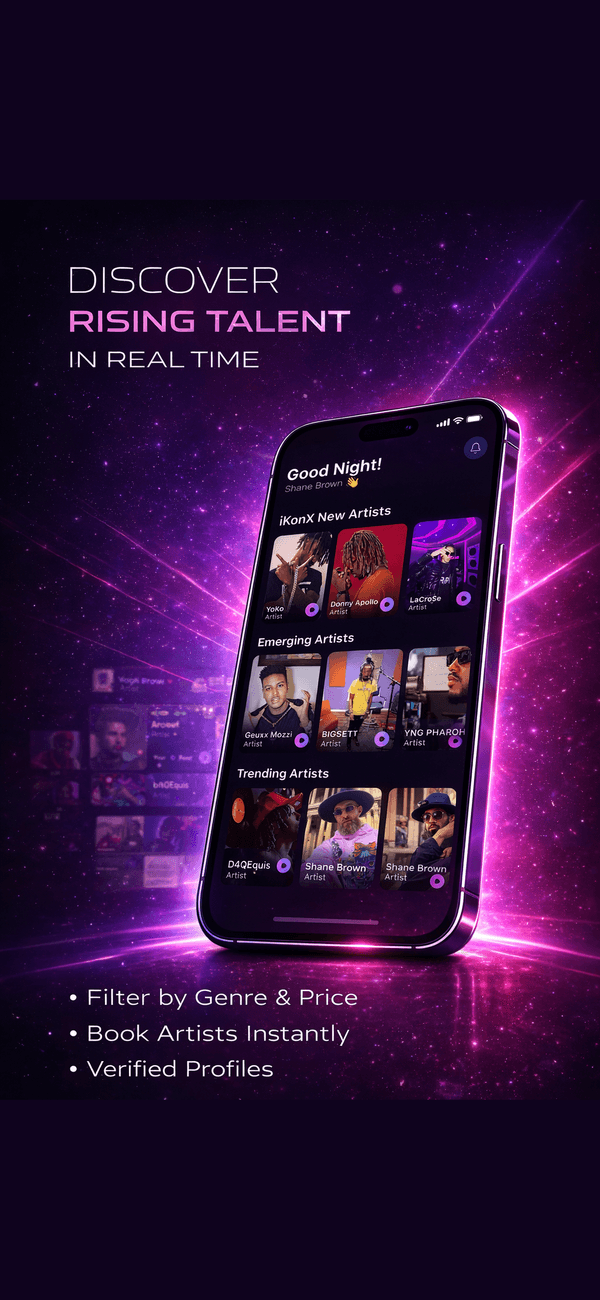
The whole network lives in one app.
iKonX puts every side of the music business in your pocket. Artists set their own price and keep 100% of it · iKonX takes 0% platform commission. Browse, message, and book straight from the app.

How to budget a signing, step by step
- Price the record first, not the advance. Recording, mixing, mastering, and artwork to a releasable standard. This is the number that decides whether the deal is a single, an EP, or an album.
- Set the advance to the stage, not the ego. A singles or development deal often carries a small or zero advance traded for a better split. That is not stingy, it is survivable for both sides.
- Budget the marketing separately. Content, ads, press, and playlist outreach, plus the hours to run them. A record with no marketing line is a record nobody hears.
- Run the recoup before you make the offer. At your split, what revenue does this release need to break even? If the number is not believable for this artist's current audience, restructure the deal instead of hoping.
- Put the deal in writing, plainly. Term, territory, deliverables, split, recoupment, and what happens if the release underperforms. An artist who understands the deal is an artist who stays.
- Pay the advance in a way both sides can see. A documented, verified payment beats a personal transfer. On iKonX the artist's page is verified and payment is handled by the platform at 0% platform commission.
Filter the deck to artists at the same rung as your label, so a signing fits where you are now, not where you wish you were.
No demo pile, no inbox gatekeeper. You contact a verified profile straight from the deck and start the conversation on your terms.
What each deal shape actually costs a small label
| Deal shape | Typical up-front cost to the label | Risk profile |
|---|---|---|
| Singles deal (small or no advance) | Recording plus a modest promo spend | Lowest. One release proves the relationship before anyone commits further |
| Development deal | A small advance plus recording plus a marketing runway | Moderate. You are funding growth, so the recoup timeline is longer |
| Album commitment | Advance plus a full record plus a real campaign | Highest. A five-figure decision on a developing artist |
| Direct-to-fan first (artist keeps their own revenue) | Nothing. On iKonX the artist keeps 100% of the price they set, iKonX takes 0% platform commission, and the buyer pays a flat 10% on top | None to the label, and it shows you whether an audience will actually pay for this artist |
Deal shapes and advance sizes vary enormously by label, market, and artist stage, so treat every number here as a range and not a quote. Traditional label royalty splits mean an artist's share arrives only after recoupment, which is why the recoup math matters more than the headline advance (Music Business Worldwide industry reporting, 2025; DropTrack label submissions guidance, 2025). The only fixed claim here is the iKonX model: the artist keeps 100% of the price they set, iKonX takes 0% platform commission, and the buyer pays a flat 10% on top. iKonX is free to download and explore, full access to paid features is a flat $9.99/month, and the only payout deduction is a low, sub-5% withdrawal fee when you transfer earnings out, below the industry standard. Label A and R tooling is on the iKonX roadmap; discovering and paying verified artists directly works today.
Cost to sign an artist FAQ
How much is a typical advance for signing an artist?
It ranges from zero to five figures and depends entirely on the deal shape. A modern indie singles or development deal often carries a small or no advance in exchange for a better split, while an album commitment on a developing artist is a much larger decision. The advance is rarely the biggest line in the budget.
What else does a label pay for besides the advance?
Recording, mixing, mastering, artwork, content and video, marketing and ads, press and playlist outreach, and distribution and admin. For a small label those lines combined usually dwarf the advance, and they land after the artist has already signed.
How do I know if a signing can recoup?
Run the math before the offer. At your revenue split, work out how much the release needs to earn to pay back the advance, the recording, and the marketing. If that number is not believable for the artist's current audience, change the deal shape rather than hoping the release outperforms.
Is it cheaper to develop an artist without signing them?
Often, yes. A single release with a small promo spend and no advance tells you most of what a signing would, at a fraction of the cost. Artists who are already earning directly from fans have proven the one thing a label most wants to know: that people will pay for their music.
Labels is coming to The Network
Scouting opens soon. Be first to the deck when it goes live · no pressure, just a seat held.
Explore the connected sides of the network
Find the talent first. Sign on your terms.
Find verified artists who are already earning from real fans, and pay them without a middleman taking a cut. Download iKonX.
DOWNLOAD THE FREE PDF TODAY:
The Indie Label A&R Scouting Playbook
A modern A&R checklist for finding, career-stage-matching, and signing unsigned artists in 2026.
Get the free PDF ->