How much does it cost to book a rapper? The 7 price tiers
Booking a rapper spans seven distinct tiers, from an unpaid or nominal open-mic slot up to six figures for a major name. The benchmark most promoters need sits in tiers two and three: hiring a rapper averages around 400 dollars for one hour with a common range of roughly 175 to 1,000, and average hip-hop bookings land near 630. Fee tracks draw and market rather than talent, which is why the right question is which tier fills your specific room.
The single most common booking mistake is shopping a tier above the room. A promoter with a 150-capacity venue chases an artist whose fee assumes 600 people, and the maths never recovers no matter how good the night is.
It happens because published price talk is dominated by the extremes. People hear headline numbers for major names and assume rap bookings are inaccessible, or they hear about a friend booking someone for two hundred dollars and assume everything is cheap. Both anchors are real and neither describes the tier they should actually be shopping in.
The second problem is that fee is treated as a measure of quality. It is not. A rapper's fee tracks their draw in your specific market, the date, your room size and how badly they want the slot. An artist with a strong regional following and a modest fee will fill your room; a technically better artist with no local audience will not, at any price.
The third problem is the hidden layers. A booking or talent agent takes 10 to 20 percent of the artist's gross fee, and marketplaces charge on both sides, commonly a 10 to 12 percent client-side service fee sitting on top of a separate performer-side fee. A quoted number and a landed cost are not the same thing, and first-time promoters routinely discover the gap at checkout.
The 7 rapper booking tiers, and what each one actually buys
Pick the tier from your room and your ticket price, not from your ambition.
Start from capacity and realistic sell-through. A 150-cap room at 20 dollars, sold at a realistic 60 percent, is 1,800 dollars of gross ticket revenue before costs. That number sets your tier, and it usually points at tier two or three. Booking tier four into that room means the show has to be perfect just to break even.
Weight local draw over reputation. The question is not how good the artist is, it is how many people in your city will buy a ticket because of their name. A tier-three local headliner will beat a tier-five artist with no regional presence in your market, and cost a fifth as much.
Build the bill, not just the headliner. Two tier-two locals under a tier-three headliner outdraws a single expensive booking most of the time, because each act brings their own people. This is the most reliable way to fill a small room.
Then price the landed cost, not the quote. Add the agent percentage if there is one, marketplace fees on both sides, sound, security and hospitality. A 600-dollar quote through a marketplace with a 10 to 12 percent client-side fee is not a 600-dollar night.
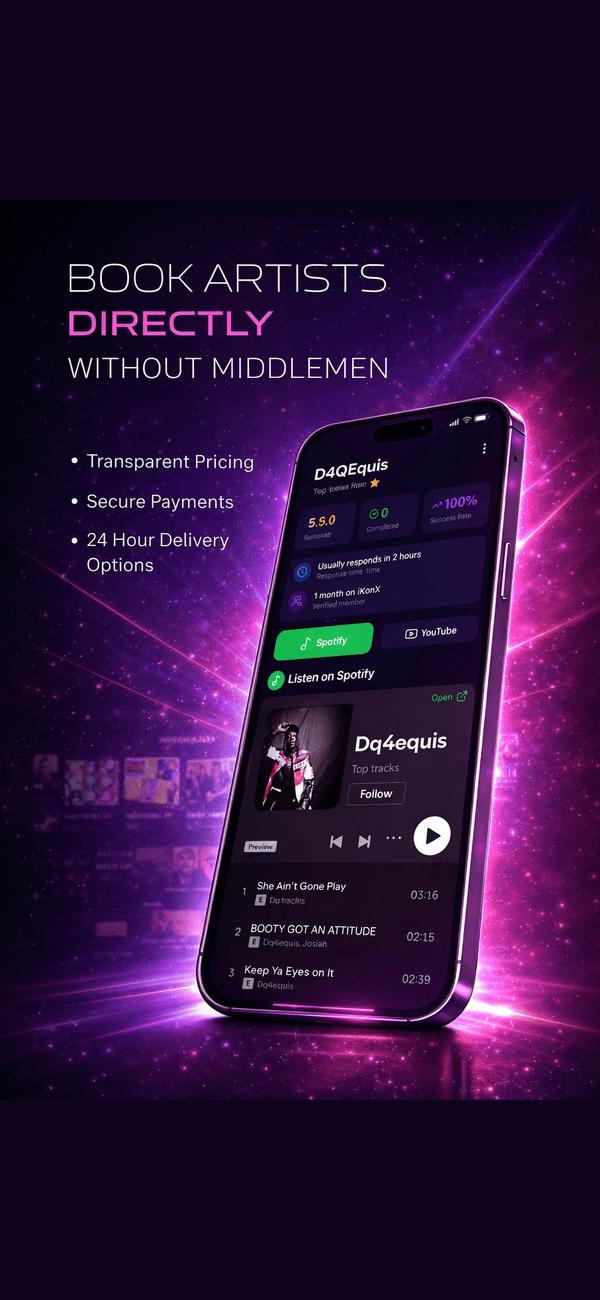
iKonX is building the Promoters side for tiers one through three, which is where most bookings actually happen and where the intermediary layers hurt most. You search bookable local rappers with prices listed up front and contact them directly, with no agent in between. The artist keeps 100 percent of the price they set, iKonX takes 0 percent platform commission, and you pay a flat 10 percent on top.
Roadmap honesty: Promoters is a roadmap side of iKonX, launching soon. It solves finding and contacting acts, not contracts or settlement.
Empty date
You have a room and a night with nothing on it yet.
Browse artists
Search verified indie acts with transparent pricing. No agent, no gatekeeper.
Lock the fee
Agree the price the artist set. They keep 100% · you pay a flat 10% on top.
Confirm + pay
Message direct, confirm the details, and pay securely in the app.
Doors open
The act shows up, the room fills, you book the room and keep the night.
Move this week · the good dates fill fastest.
The whole network lives in one app.
iKonX puts every side of the music business in your pocket. Artists set their own price and keep 100% of it · iKonX takes 0% platform commission. Browse, message, and book straight from the app.

Transparent booking fees, no surprises
$300 to $600
A local indie act for a small private show or pop-up.
100% to artist$600 to $1.5k
A headline slot or support for a ticketed venue night.
You pay flat 10%$1.5k and up
A lineup placement scaled to the act and the draw.
No broker cutThe 7 tiers side by side against room size and risk
| Tier | Typical fee | Room it fills | What comes with it |
|---|---|---|---|
| 1. First-show artist | Nominal to about 150 dollars | None on their own | Energy, no rider, no contract |
| 2. Local opener | About 150 to 400 dollars | Friends plus a modest crowd | Simple agreement, own transport |
| 3. Local headliner | About 400 to 1,000 dollars | A small room in their own city | Basic rider, deposit expected |
| 4. Regional act | About 1,000 to 5,000 dollars | Mid-size rooms across a region | Manager, contract, rider, deposit |
| 5. Buzzing artist | About 5,000 to 25,000 dollars | Sells on momentum, nationally | Agent, fast-moving fees |
| 6. Established touring act | About 25,000 to 100,000 dollars | Theatres and large clubs | Full team, production, advance |
| 7. Major name | Six figures and up | Arenas and festivals | Routed months ahead, agents only |
Benchmarks are dated and sourced. Hiring a rapper averages around 400 dollars for one hour with a range of roughly 175 to 1,000 dollars, moving with skill, travel, time of year and region (gigsalad.com, Spring 2026), and average hip-hop bookings sit near 630 dollars with hourly rates roughly 100 to 1,500 (gigsalad.com, Fall 2025). National solo musician cost averages about 429 dollars with most bookings between 313 and 586 (thumbtack.com, 2025-10-20). Booking and talent agent commissions typically run 10 to 20 percent of the artist's gross fee (matadortalent.com, 2025). Marketplaces charge on both sides, with GigSalad taking a 5 percent provider booking fee on free membership and 2.5 percent on paid alongside a 10 to 12 percent client-side service fee (help.gigsalad.com, 2025). ⚠️ Tiers 4 to 7 are an editorial framework extrapolated from market observation rather than published rate cards, since fees at those levels are privately negotiated and not disclosed. Treat tiers 1 to 3 as sourced and tiers 4 to 7 as directional. The only fixed claim here is the iKonX model: the artist keeps 100 percent of the price they set, iKonX takes 0 percent platform commission, and the buyer pays a flat 10 percent on top. iKonX is free to download and explore, full access to paid features is a flat 9.99 dollars a month, and the only payout deduction is a low, sub-5 percent withdrawal fee, below the industry standard.
Rapper booking costs: FAQ
What is the average cost to book a rapper?
Hiring a rapper averages around 400 dollars for one hour, with a common range of roughly 175 to 1,000 dollars, and average hip-hop bookings land near 630 with hourly rates from about 100 to 1,500. That average sits in tier three, the local headliner band, which is also where most promoters should be shopping. Price tracks draw and market rather than talent, so the same artist costs differently in different cities.
Which rapper tier should a small venue book?
Usually tier two or three. Work from capacity and realistic sell-through: a 150-capacity room at 20 dollars sold at 60 percent is about 1,800 dollars of gross ticket revenue before costs, which comfortably supports a tier-three headliner and two tier-two openers. Booking tier four into that room means the night has to be flawless simply to break even, which is not a plan.
Why do two rappers with similar followings charge differently?
Because fee tracks draw in your specific market rather than total following. An artist with 20,000 followers spread nationally may sell fewer tickets in your city than one with 5,000 concentrated locally. Date, room size, how badly they want the slot and whether they have an agent all move the number too. Ask what they have drawn in your market before, not what their follower count is.
What extra costs come on top of a rapper's fee?
The quote is rarely the landed cost. An agent takes 10 to 20 percent of the artist's gross, marketplaces commonly add a 10 to 12 percent client-side service fee on top of a separate performer-side fee, and then there is sound, security, hospitality and any travel or accommodation in the rider. Budget the total night, not the headline number, or the margin disappears somewhere you did not look.
Does iKonX charge a commission to book a rapper?
No. The artist keeps 100 percent of the price they set and iKonX takes 0 percent platform commission, with you paying a flat 10 percent on top, so the listed price is what the act earns. That differs from an agent taking 10 to 20 percent of gross or a marketplace layering a client-side fee on a performer-side fee. The only deduction on the artist side is a low, sub-5 percent withdrawal fee when moving earnings to a bank, a transfer cost and never a commission. iKonX is free to download and explore, full access is a flat 9.99 dollars a month, and Promoters is a roadmap side, launching soon.
Explore the connected sides of the network
Book the room. Keep the night.
iKonX is building a Promoters side where you find bookable rappers with prices listed up front. Artists keep 100 percent of the price they set, and iKonX takes 0 percent commission.

DOWNLOAD THE FREE PDF TODAY:
The Indie Booking Kit
Offer templates, a fee-range guide, and a doors-to-payout checklist for booking an indie act.
Get the free PDF ->