Should I offer free/discounted first sessions to build a client base?
Offer a discounted first session, not a free one · and treat the discount as a customer-acquisition cost, not a habit. A free session trains artists to value your time at zero, attracts people with no skin in the game, and rarely converts into a paying repeat client. A smart discounted intro · a named first-session rate, capacity-limited, still backed by a deposit · gets a new artist through your door with something at stake, so you can prove the room and win the second booking at your full rate. The whole point is the second session, because studios live on repeat clients: your odds of selling to someone you have already recorded run far higher than to a cold prospect (Marketing Metrics, 2024). So yes to a strategic first-session discount that reliably converts, no to giving your best hours away for free, and never discount the headline rate you want every other client to pay.
When the calendar goes quiet, the fastest-feeling fix is the most dangerous one: drop to free or near-free to get bodies in the room. It works for exactly one session. Then you learn what a free client is · someone who booked because it cost nothing, who reschedules without a thought, brings a phone full of half-finished ideas, asks for one more revision, and never comes back or refers anyone who would pay. Free does not build a client base. It builds a line of people who value your time at the price you set it: zero.
The gatekeeper here is not a label, a booking agent, or the market. It is the signal your own pricing sends. A brand-new artist has no way to judge your ears before they hear the work, so they read your price as a proxy for quality. Free or heavily slashed reads as low confidence, and once an artist anchors on that number, every future quote feels like a price hike. You do not just lose one session of income · you teach the exact clients you are trying to keep that your room is the cheap option.
The economics only forgive a discount when it converts. Acquiring a brand-new client costs roughly five to seven times more than keeping an existing one (Invesp, 2024), so a first-session giveaway is an acquisition cost you are paying up front. That is fine if it reliably turns into full-rate repeat bookings, and a disaster if it does not. Studio time is also perishable · a dead Tuesday afternoon earns nothing whether you gave it away or left it empty · so the real question is not free versus paid. It is which discount, on which hours, that actually earns you a second session.
Four channels artists book you for
List the room and the rate · get found by artists ready to track.
Per-song or per-stem · transparent pricing artists can say yes to.
Get booked for the final pass · a steady stream, not word of mouth.
Home studio, no big credits? List the work · the room speaks for itself.
Reframe the whole thing as a loss leader that has one job: convert a first-time artist into a paying repeat client. A loss leader only works when it reliably leads to full-price purchases, so design the offer backwards from the second booking. That means a defined first-session rate rather than a vague free, a limit on how many intro slots exist so the discount stays scarce and credible, a deposit even on the discounted session so only serious artists claim it, and a clear path to your standard rate the moment the artist is hooked on the result.
Where you can, sweeten the first booking with value instead of discounted time. A free set of stems, one free mix revision, or a free rough mix costs you little but protects the headline rate you want every client to pay · far smarter than shaving dollars off your hours, because it never tells the market your time is worth less. Reserve any real price cut for your dead hours: a soft off-peak rate on weekday mornings fills an hour that would have earned zero, without touching the prime-time number serious artists expect to pay.
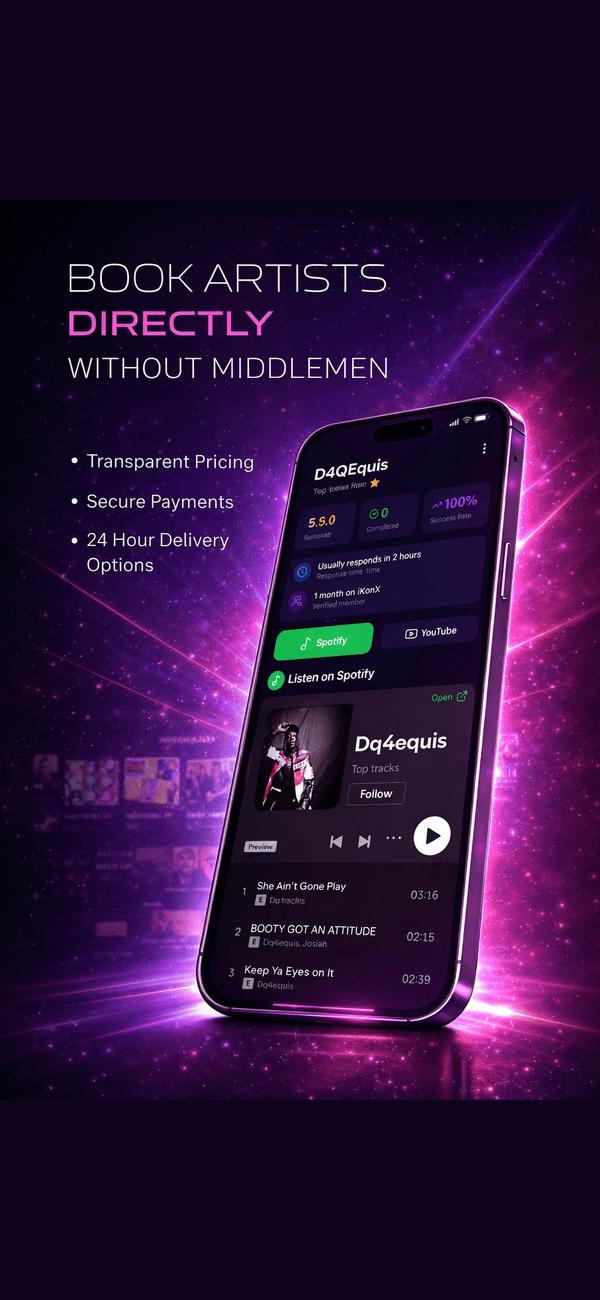
This is the studio side of iKonX we are building · a place to list your room and packaged offers, hold your client relationships in one spot you control, and turn a first session into a standing one instead of a one-off. Being honest: the studio listing and booking surface is on the roadmap, not live yet, so today this is a waitlist rather than a button. But the fee model is the point. On the live artist side of iKonX now, the artist sets their own price and keeps 100 percent of it, iKonX takes 0 percent platform commission, and the buyer pays a flat 10 percent on top. Carried to the studio side, that means the discounted intro number you set is the number you actually give · no marketplace cut eating an already-thin first session, and no commission skimmed off the repeat bookings that discount was meant to win.
The whole network lives in one app.
iKonX puts every side of the music business in your pocket. Artists set their own price and keep 100% of it · iKonX takes 0% platform commission. Browse, message, and book straight from the app.

How to run a first-session offer that actually builds a client base, step by step
- Discount the session, never the relationship. Pick a named first-session rate · a clear percentage or flat number off one booking · instead of offering free. A defined discount keeps something at stake and keeps your real rate visible, so the artist knows exactly what they will pay next time. Free tells the market your time is worth nothing; a first-session rate tells them it is worth trying.
- Cap the offer so it stays scarce and credible. Limit intro slots to a handful a month, or to your slow weekday hours only. Scarcity makes the discount feel like an opportunity rather than a permanent price, and it stops the offer from cannibalizing the full-rate sessions you could have booked anyway. An always-on discount is just a lower rate wearing a costume.
- Take a deposit even on the discounted session. A booking with money attached almost never ghosts. Collect a deposit · commonly 25 to 50 percent of the session · the moment the artist claims an intro slot. It filters out the people who were only in it because it was cheap, and it proves the artist is serious enough to be worth converting. No skin in the game, no discount.
- Sweeten with value, not with more free time. Before you cut the price further, add a low-cost extra instead: free stems, one free revision, or a free rough mix. These cost you almost nothing but raise the perceived value of the first booking while protecting the headline rate every other client pays. Reserve any real time discount for dead hours that would have earned zero regardless.
- Engineer the second booking before they leave. The discount only pays off if it converts, so make the rebook the finale of the first session. Deliver a result they are excited about, offer to lock their next date at your full rate while the project is fresh, and keep their contact and project notes somewhere you control. Repeat clients close at 60 to 70 percent versus 5 to 20 percent for a cold prospect (Marketing Metrics, 2024) · that gap is the entire reason the intro exists.
Free vs discounted vs full-rate-plus-value on a first session, 2025-2026
| First-session approach | What it costs you · 2025-2026 | What it returns |
|---|---|---|
| Free first session | Your best hours given away, usually with no deposit and no skin in the game | A few portfolio clips at best · low conversion, price-anchoring damage, and a queue of artists who value your time at zero |
| Discounted intro rate (capped, deposit required) | A defined cut off one session · commonly 20 to 50 percent, on slow hours, deposit still collected | New artists with something at stake and a real shot at converting to full-rate repeat bookings · the acquisition cost pays back if it rebooks |
| Full rate plus a value-add | A low-cost extra · free stems, one free revision, or a free rough mix · not discounted time | Protects your headline rate while still sweetening the first booking · the safest way to win a trial without teaching the market you are cheap |
| An intro discount eaten by a marketplace cut | Your discount minus a platform commission · Cameo takes 25%, BeatStars can take ~30% on some sales, Peerspace charges hosts a 20% service fee (each platform's published terms, 2025) | An already-thin intro session taxed twice · on the iKonX model the studio keeps 100% and iKonX takes 0% commission, so the discount you set is the discount you actually give |
Rate bands and discount ranges are 2025-2026 ballpark figures from published studio and engineer rate guides and vary widely by city, room, gear, and reputation · treat them as a starting frame, not a quote. The 5-to-7x acquisition-versus-retention cost is Invesp (2024); the 60-70% versus 5-20% repeat-versus-cold close rate is Marketing Metrics (2024). Platform fees are each company's own published terms as of 2025-2026 and can change: Cameo takes a 25% platform fee, BeatStars Pro plans can take a roughly 30% transaction cut on some sales plus processing, and Peerspace charges hosts a 20% service fee on the booking and add-ons · always confirm current terms. The iKonX studio side is not live yet · the 0% platform commission, you-keep-100% model is the planned model carried over from the live artist side, where the buyer pays a flat 10% on top. iKonX is free to download and explore, full access to paid features is a flat $9.99 a month, and the only payout deduction is a low, sub-5% withdrawal fee below the industry standard · never a commission on what you charge.
The best room in town does nothing if no artist can find it.
Frequently asked questions
Should I offer free studio sessions to get new clients?
Usually no. A truly free session attracts artists with no skin in the game, trains the market to value your time at zero, and rarely converts into a paying repeat client. If you want a trial offer, use a defined discounted first-session rate with a deposit instead · it gets a serious artist in the room while keeping your real rate visible. Reserve genuine free work only for a strategic collab with someone whose reach or portfolio value clearly pays you back.
Is a discounted first session worth it for a recording studio?
Yes, if it is designed to convert. A discounted first session is a customer-acquisition cost, and it only pays back when the artist rebooks at your full rate · and repeat clients close far more often than cold prospects (Marketing Metrics, 2024). Cap the offer, take a deposit, deliver a result they love, and lock the next date before they leave. If your intro clients never rebook at full price, the offer is failing and you are just running a permanent discount.
How much should I discount a first studio session?
Enough to lower the risk of trying you, not so much that it looks like your real rate. In 2025-2026 a common range is 20 to 50 percent off one session, ideally applied to slow weekday hours that would have earned nothing anyway. Keep the discount capped and clearly labeled a first-session rate so the artist knows exactly what they will pay next time. If you can, sweeten with a value-add like free stems instead of cutting deeper on time.
Won't a discount make clients expect low prices forever?
It will if the discount is open-ended or applied to your headline rate. It will not if you cap it, label it clearly as a one-time first-session rate, and quote your standard number for the second booking while the artist is still excited about the first. The safest version discounts nothing at all and instead adds a low-cost extra · free stems, one free revision, a free rough mix · so the perceived value goes up without your rate coming down.
Should I still take a deposit on a discounted first session?
Always. A booking with money attached almost never ghosts, and the deposit doubles as a filter for who is actually serious. Collect it · commonly 25 to 50 percent of the session · the moment the artist claims the intro slot. Skipping the deposit because the session is already cheap is how you fill your calendar with no-shows and give away hours you can never sell again.
Does iKonX take a cut if I run an intro offer through it?
The studio side of iKonX is not live yet, so there is nothing to list today · you can join the waitlist to claim your room early. The planned model is the one the live artist side already runs: the studio sets its own rate, including any intro rate, and keeps 100 percent of it, iKonX takes 0 percent platform commission, and the buyer pays a flat 10 percent on top. The only deduction is a low, sub-5 percent withdrawal fee when funds are transferred out. So a discount you offer is not taxed again by a marketplace cut · the number you set is the number you give. iKonX is free to download and explore, and full access to paid features is a flat $9.99 a month.
Explore the connected sides
Built for the room.
Download iKonX and start where the gatekeepers used to stand.

DOWNLOAD THE FREE PDF TODAY:
The Studio Booking Checklist
Everything to confirm before a session books · rates, room specs, deposit, and turnaround.
Get the free PDF ->