How to write a split sheet for a collab
No platform commission on the price you list · the buyer pays a flat 10% on top.
A split sheet is a single page that names every person who contributed to a song, records the percentage of the composition each one owns, and gets signed by all of them on the day it was written. At minimum it carries the song title, the date, the studio, every contributor's legal name and role, their publisher and performing rights organization affiliation, their ownership percentage, and a signature line. The percentages have to total exactly 100%. Write it before anyone leaves the room, because a split is a negotiation between friends on the day of the session and a lawsuit between strangers two years later when the song starts earning. Under US copyright law, when two or more people intend their contributions to merge into one work, they become co-owners of the whole song by default, which means a missing split sheet does not mean you own nothing, it means the ownership is undefined and contested.
The session goes great. Somebody had the melody, somebody else rewrote the second verse, the producer flipped the beat halfway through, and a friend in the corner suggested the line that ended up being the hook. Everybody hugs. Nobody writes anything down, because writing it down feels like accusing the room of something.
Eighteen months later the song is placed in a show, or it starts moving on streaming, and a check appears. Suddenly four people remember the session very differently. The person who suggested the hook line remembers it as writing the hook. The producer remembers being promised points. Nobody is lying. Memory just quietly rewrites itself in favor of the person doing the remembering.
The legal reality makes it worse, not better. Once contributions merge into one song with the intent to be a single work, the contributors are co-owners of the entire thing, not just their piece. That means a co-owner can go license the song non-exclusively without asking you, and the only thing they owe you is an accounting. With no split sheet, publishers and sync buyers see an unclear chain of title and simply move on to a song that does not carry a fight attached to it. The unwritten split does not just cost you money later. It quietly makes the song unusable.
List it. Price it. Keep it.
Treat the split sheet as part of the session, not as paperwork that comes after it. It is one page and it takes four minutes. The rule that makes it painless: the split gets agreed while everyone still likes each other, which is the same day the song gets made.
Keep the split of the composition separate in your head from the money on the recording. The composition split is who owns the song as a piece of writing, and that is what a split sheet records. Payment for the session, the feature fee, the producer's fee, and the master ownership are separate conversations, and blending them into one argument is how splits stall out. Get the percentages, get the signatures, deal with fees separately.
Also be honest about what a contribution is. Writing a line that stayed is a contribution. Being in the room, hyping the take, and ordering the food is not. Say that kindly and say it up front, before anyone has an expectation to be disappointed out of.
The money side is where iKonX comes in. Once the split is agreed, each collaborator can be paid directly for their side of the work, at a price they set on their own verified artist page. The artist keeps 100% of the price they set, iKonX takes 0% platform commission, and the buyer pays a flat 10% on top, so a feature fee or a hook fee lands whole instead of getting shaved by a middleman on the way in. iKonX is free to download and explore, full access to paid features is a flat $9.99/month, and the only payout deduction is a low, sub-5% withdrawal fee when you transfer earnings out, below the industry standard.
The whole network lives in one app.
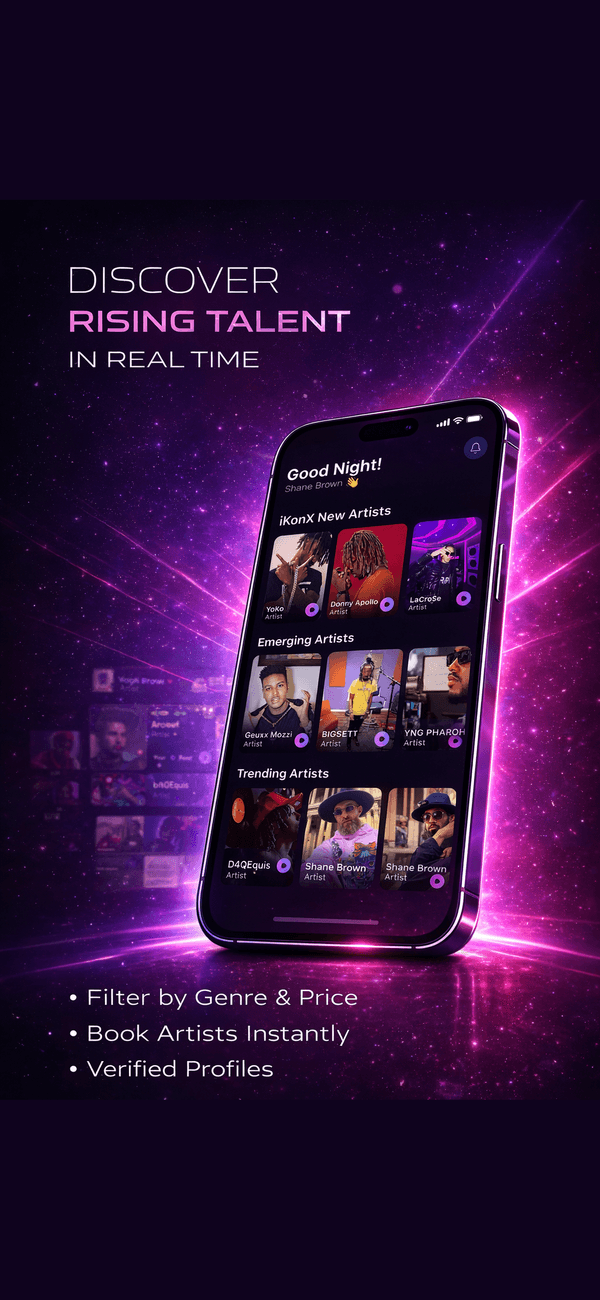
iKonX puts every side of the music business in your pocket. Artists set their own price and keep 100% of it · iKonX takes 0% platform commission. Browse, message, and book straight from the app.

How to write a split sheet, step by step
- Open the page before the session ends. Title, date, and studio at the top. If the song has no title yet, use the working title and note it. A split sheet written the next week is already a negotiation.
- List every contributor by legal name, not by tag. Stage names do not sign contracts and do not get registered. Add each person's role: lyrics, melody, topline, production, or a combination.
- Add each person's PRO and publisher. Performing rights organization affiliation and publishing entity, if they have one. This is the field that makes the sheet usable by a publisher or a sync buyer later.
- Assign the percentages out loud, together. Say the numbers in the room so nobody signs a version they never heard. The total must be exactly 100%. Common practice splits the composition evenly among writers, but even is a choice, not a law.
- Sign it, date it, and send everyone a copy the same day. Photos of a signed page in a group chat beat a perfect document nobody executed. Same day, every time.
- Register the song with your PRO using those exact numbers. A split sheet nobody registers is just a nice memory of a good session. Register it, then keep the signed page forever.
- Handle the fees separately, and get them paid up front. Composition splits are ownership. Feature fees and producer fees are payments. On iKonX you set your fee on your verified artist page and keep 100 percent of it at 0 percent platform commission.
What a split sheet does that a handshake does not
| How the split was handled | What happens when the song earns | Can a publisher or sync buyer clear it |
|---|---|---|
| Signed split sheet, same day | Percentages are documented and registered · everyone gets paid their share | Yes · the chain of title is clean |
| Verbal agreement in the session | Co-ownership exists by default but the percentages are undefined and contested | Usually not · unclear title is a reason to pass on the song |
| Group chat messages | Better than nothing as evidence, but incomplete and easy to dispute | Rarely, and not without a lawyer cleaning it up |
| Nothing at all | Any co-owner can non-exclusively license the whole song and merely owes the others an accounting | No · this is the song that quietly dies in legal |
Under US copyright law a joint work is one prepared by two or more authors with the intention that their contributions be merged into inseparable or interdependent parts of a unitary whole, and the co-authors are co-owners of copyright in the work (17 U.S.C. section 101 and section 201(a), US Copyright Office, 2025). That default co-ownership is exactly why an undocumented split is undefined rather than harmless. Registration guidance for musical compositions is published by the US Copyright Office (Circular 50, 2025). This is general information and not legal advice; consult a music attorney for your situation. The only fixed claim here is the iKonX model: the artist keeps 100% of the price they set, iKonX takes 0% platform commission, and the buyer pays a flat 10% on top. iKonX is free to download and explore, full access to paid features is a flat $9.99/month, and the only payout deduction is a low, sub-5% withdrawal fee when you transfer earnings out, below the industry standard.
Verified artists, real profiles
Split sheet FAQ
What has to be on a split sheet?
Song title, date, studio, every contributor's legal name, their role, their performing rights organization and publisher, their ownership percentage, and a signature from each of them. The percentages must total exactly 100 percent. Anything less than that is a note, not a split sheet.
Do splits have to be equal?
No. Equal splits are common because they are simple and they keep the room calm, but the percentages are whatever the writers agree to. What matters far more than the exact number is that the number is written down and signed the same day.
Does the producer get a songwriting split?
It depends on what they did. A producer who wrote melodic or lyrical content contributed to the composition and is commonly credited in the split. A producer who only shaped the recording is usually paid a fee or master points instead. Decide it out loud and write down what you decided.
What happens if we never sign a split sheet?
You do not lose ownership, you lose clarity. Co-owners of a joint work each own a share of the whole song by default, so any one of them can license it non-exclusively and merely owes the others an accounting. Undefined percentages are what stall sync deals and start lawsuits.
How do the collaborators actually get paid their fees?
Composition splits and session fees are two different things. On iKonX each artist sets their own fee on a verified artist page and keeps 100 percent of it, because iKonX takes 0 percent platform commission and the buyer pays a flat 10 percent on top.
Explore the connected sides of the network
Built for the working artist.
Agree the split in the room, then get paid your fee without a middleman taking a cut. Download iKonX.

DOWNLOAD THE FREE PDF TODAY:
Indie Feature Pricing Cheat-Sheet
What to charge for a feature verse with no following · the price math, plainly.
Get the free PDF ->