How to Rent Out My Recording Studio When I'm Not Using It
To rent out your recording studio when you are not using it, treat your idle hours as inventory you sell instead of time you waste. Pick the blocks you never book (weekday mornings, late nights, the gap between projects), set an off-peak hourly rate lower than your full-session rate, decide whether you are renting the room only or the room plus an engineer, protect yourself with a short rental agreement and proof of insurance, and list those open slots where independent artists are already looking to book time. Marketplaces like Studiotime, Peerspace, and Pirate Studios exist for this, and each takes a service or booking fee per transaction. The single biggest lever is being findable in the moment an artist needs a room · an always-on listing beats an occasional social post every time.
You built the room. You paid for the treatment, the monitors, the interface, the mics that cost more than your first car. And most weeks, that room sits dark for large chunks of the day. A recording studio is one of the few businesses where your most expensive asset spends the majority of its life earning nothing · a mixing engineer with a day job books nights and weekends, and the whole daytime calendar is just quiet.
The instinct is obvious: if the room is empty, rent it to someone who needs it. An artist tracking vocals, a podcaster who wants a treated space, a producer without a proper monitoring setup · they would all pay for a few hours in a real room. But the moment you try, the friction shows up. How do you find someone who wants the exact three-hour window you have free on Tuesday morning? How much do you charge for the room without you running the session? How do you make sure a stranger does not walk out with a 1,200 dollar microphone?
The gatekeeper problem here is quieter than in booking, but it is real. The established, always-booked studios do not need to rent out idle time · they do not have any. The rooms that sit empty are the home studios, the project studios, and the independents · the owners who could most use the extra income and have the least visibility. An artist looking to book an hourly room does not know your spare Tuesday morning exists unless you put it somewhere they are already looking. Get the pricing, rules, and discoverability right and it is close to free money on hours that paid you zero.
Four channels artists book you for
List the room and the rate · get found by artists ready to track.
Per-song or per-stem · transparent pricing artists can say yes to.
Get booked for the final pass · a steady stream, not word of mouth.
Home studio, no big credits? List the work · the room speaks for itself.
The fix is to stop thinking of your calendar as booked-or-empty and start treating it as inventory with off-peak and peak pricing, the same way a hotel does. Your dead hours are a discount product; your prime evenings and weekends are a premium one. For it to work, three things have to be true: your open slots have to be visible to artists in the moment they search, renting has to be safe (agreement, insurance, deposit, clear rules on what the renter can touch), and the price has to be right for the room only · renting the space is a different product from a full engineered session.
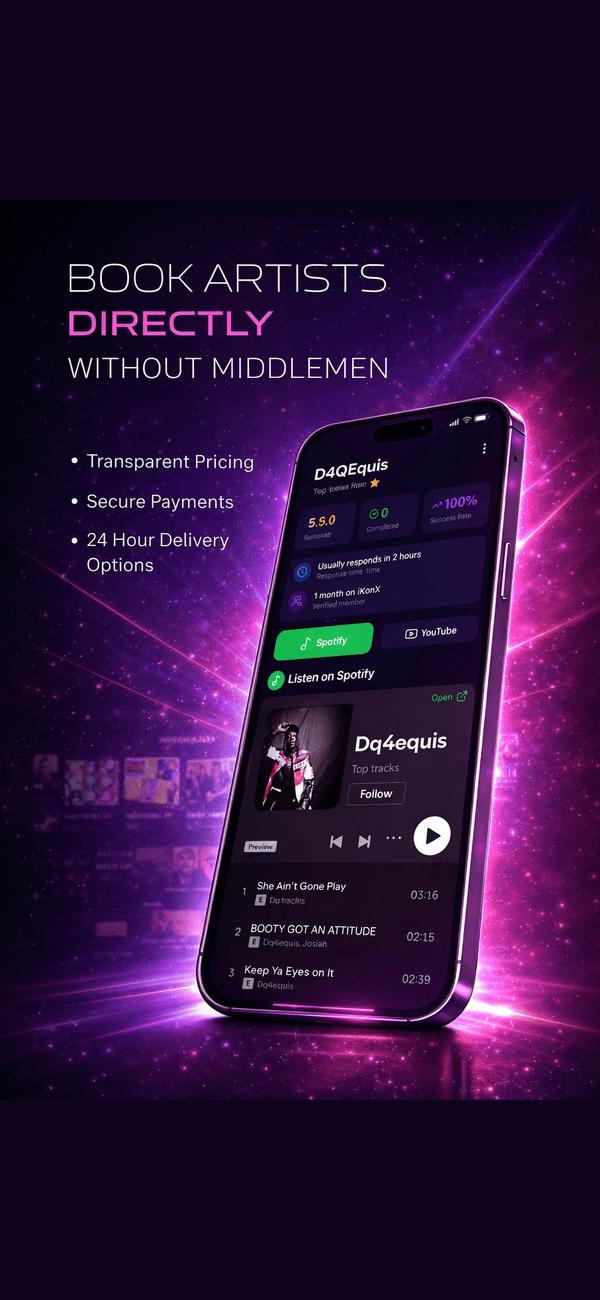
This is where iKonX is built to help. iKonX is an artist-first platform where independent artists already build profiles, connect, and book each other for paid features, shows, and sessions · which means the people most likely to rent a spare studio hour are already there. The live product today runs on a model artists trust because it is transparent: the iKonX subscription is $9.99/mo, the buyer pays a 10% service fee on top of a booking, the artist keeps 100% of their rate with 0% commission taken by iKonX, and withdrawals carry a sub-5% fee. Browsing and viewing profiles is free. Compare that to a studio-rental marketplace that skims a service fee off the top of every hour you rent · artist-first economics is a big part of why artists gather on iKonX, and a room full of artists is exactly where you want your open slots to be seen.
To be fully transparent · roadmap-honest, as we promise on every page · the dedicated studio-rental storefront inside iKonX is not live yet. Today a studio owner can already be present on iKonX as a creative, build a profile, and connect directly with the artists who use it to find rooms, collaborators, and sessions. A purpose-built listing where you post open hourly slots and take rental bookings is on the roadmap. We would rather tell you exactly what ships today than oversell what is coming · because the entire point of iKonX is being the platform artists and studio owners can actually trust.
The whole network lives in one app.
iKonX puts every side of the music business in your pocket. Artists set their own price and keep 100% of it · iKonX takes 0% platform commission. Browse, message, and book straight from the app.

How to rent out your recording studio when you are not using it, step by step
- Map your dead hours and turn them into inventory. Look at a real month of your calendar and mark every block the room sits empty · usually weekday mornings and afternoons, plus the quiet stretch between your own projects. Set a minimum rental (two or three hours is common, since a one-hour booking barely covers setup and teardown) and treat these blocks as a product you can list, not just gaps you hope to fill.
- Price the room, not the session. Renting the space is cheaper than a full engineered session because you are not in the chair. As a rough 2026 frame in most US markets, a room-only or self-serve hourly rate runs well below a full-service rate that bundles an engineer, and off-peak daytime slots are usually discounted below prime evening and weekend hours. Set a peak rate and an off-peak rate, and confirm what is included: which mics, whether the renter brings their own laptop, and whether an operator is present. Rates vary widely by city and gear, so anchor yours to comparable rooms near you.
- Protect the room before you hand over the keys. This is the step most owners skip and regret. Use a one-page rental agreement covering hours, the deposit, a damage clause, and what the renter may and may not touch. Require a refundable security deposit. Check that your studio or business insurance covers third-party use before you sublet · a standard home policy usually does not · and ask about renter insurance for higher-value rentals. Lock away your most expensive and fragile gear, and screen every booking with a quick profile check and a short message exchange.
- Decide room-only versus room-plus-operator. Some owners rent the raw space and let experienced artists run it themselves; others stay on-site as a paid operator to run the DAW and protect the gear. Room-only earns less per hour but scales to slots you cannot personally staff; room-plus-operator earns more and keeps your hands on the equipment. Many owners offer both and price them separately. If you rent room-only, leave a simple session-start guide on the desk so nobody calls you at 9 in the morning asking how to arm a track.
- List your open slots where artists already look. The whole thing lives or dies on discoverability. Post your open hours on studio-rental marketplaces and, just as importantly, be present where independent artists already gather to find rooms and collaborators · so that when an artist needs a space Tuesday morning, they can find yours instead of driving across town. The goal is an always-on, searchable presence, not a hopeful social post once a month. This is the layer iKonX is building toward: a trusted, artist-first place where the artists most likely to rent your spare hours already spend their time.
Where to rent out idle studio time in 2026: the honest comparison
| Channel | What it costs you | Best for | The catch |
|---|---|---|---|
| Your own network / word of mouth | Free | Trusted renters you already know | Cannot fill a specific empty Tuesday on demand · dries up between projects |
| Studiotime (studio-rental marketplace) | Listing is free; the platform takes a service or booking fee per transaction (confirm current rate on the platform) | Artists actively searching for hourly rooms and self-serve time | You compete on price in a crowded feed · the fee comes off your rate |
| Peerspace / Giggster / Splacer (space-rental marketplaces) | Listing is free; the platform adds a guest service fee and takes a host fee per booking (commonly a double-digit percentage · confirm current terms) | Podcasters, content shoots, and events that want a treated room, not just music sessions | Audience skews toward general creative space rental, not always working recording artists |
| Pirate Studios-style self-service network | Not a listing for your room · it is a competing 24/7 self-serve chain artists can book instead of you | Understanding what self-serve renters expect (24/7 access, flat hourly, no operator) | It is a competitor for the same dollar, not a place to list your studio |
| iKonX (live today) | $9.99/mo · buyer pays 10% on top · artist keeps 100%, iKonX takes 0% commission · sub-5% withdrawal · free to browse | Being where independent artists already connect and book | Roadmap-honest: a dedicated studio-rental storefront is not live yet · studios participate today as profiles or creatives |
Marketplace fee figures reflect each platform own published terms and can change at any time · always confirm current service, booking, and host fees on the platform itself before you list. Rental rates vary widely by city, room, and gear. The iKonX studio-rental listing side is not live yet · the $9.99/mo subscription, 10% buyer service fee, 0% artist commission, and sub-5% withdrawal are the live S114g artist-first model that already governs bookings on the platform.
The best room in town does nothing if no artist can find it.
Frequently asked questions
Can I make money renting out my recording studio when I am not using it?
Yes · renting idle hours is one of the fastest ways to earn from a room you already paid for. The studio is a fixed cost: your gear, rent, and treatment are paid whether the room is booked or empty, so every rented hour is close to pure upside. Sell your dead blocks (weekday mornings and afternoons, the gap between projects) at an off-peak rate, decide whether you are renting the room only or the room plus an operator, and put those open slots where artists are already searching. A short rental agreement, a deposit, and the right insurance turn idle time into steady side income.
How much should I charge to rent out my studio without running the session?
Charge less than a full engineered session, because renting the room is a different product from your engineering time. In most US markets in 2026, a room-only or self-serve hourly rate sits well below a full-service rate that bundles an engineer, and daytime or weekday off-peak slots are usually discounted below prime evening and weekend hours. Set a peak rate and an off-peak rate, and be explicit about what is included: which mics and outboard gear, whether the renter brings their own laptop, and whether an operator is on-site. Because rates vary widely by city and gear, anchor yours to comparable rooms near you rather than a national average.
What are the risks of renting my studio to strangers, and how do I protect myself?
The main risks are damage to expensive or fragile gear, theft, and liability if someone is injured in your space. Protect yourself with four things: a one-page rental agreement covering hours, the deposit, a damage clause, and what the renter may and may not touch; a refundable security deposit collected before the session; the right insurance · check that your studio or business policy covers third-party use, because a standard home policy usually does not; and screening every booking with a quick profile check, past reviews, and a short message exchange. Lock away your most valuable gear, and consider staying on-site as a paid operator for higher-risk rentals.
What platforms let me rent out my recording studio by the hour?
Studio-rental marketplaces like Studiotime are built for renting music rooms by the hour, while broader space-rental platforms like Peerspace, Giggster, and Splacer list treated rooms for sessions, podcasts, and shoots. Each takes a service or booking fee per transaction, so confirm current terms before you list. Self-serve chains like Pirate Studios are competitors for the same renter, not places to list your own room. iKonX is an artist-first platform where independent artists already build profiles and book each other · a dedicated studio-rental storefront is on the roadmap, but studio owners can participate today as creatives and connect directly with the artists most likely to rent a spare hour.
Is it better to rent the room only or the room plus an engineer?
It depends on which hours you are filling and how hands-on you want to be. Room-only rentals earn less per hour but let you sell slots you cannot personally staff, which is ideal for dead daytime hours · leave experienced renters a short start-up guide and let them run it. Room-plus-operator rentals earn more and keep your hands on the gear, which is safer for high-value equipment and less-experienced renters. Most owners who do this seriously offer both and price them separately.
Explore the connected sides
Built for the room.
Download iKonX and start where the gatekeepers used to stand.

DOWNLOAD THE FREE PDF TODAY:
The Studio Booking Checklist
Everything to confirm before a session books · rates, room specs, deposit, and turnaround.
Get the free PDF ->