How much should you charge for a feature verse? (Indie pricing guide 2026)
No platform commission on the price you list · the buyer pays a flat 10% on top.
Charge based on leverage, not follower count. In 2026 entry-level indie artists commonly charge 100 to 500 dollars per verse, developing artists 500 to 2,000 dollars, and established indies 2,500 to 10,000 dollars or more. Set one flat rate for a 16-bar verse, collect it up front, and on iKonX keep 100 percent of it: 0 percent platform commission, with the buyer paying a flat 10 percent on top.

The hardest part of pricing a feature verse is not the math. It is the fear that you will pick a number, name it out loud, and watch the other artist disappear. So most independent artists never set a rate at all. They quote whatever feels safe in the moment, undercharge to avoid an awkward silence, or trade verses for exposure that never arrives. The verse gets used. The income does not.
The internet does not make this easier. Search how much to charge for a feature and you get a wall of celebrity numbers, Travis Scott at a quarter million, Lil Baby at 300,000 dollars and up, that have nothing to do with an artist building from a few thousand listeners. Those figures are good for a headline and useless for a real decision. They make a fair indie rate of a couple hundred dollars feel like nothing, when in fact it is exactly right for where you are.
Then there is the collection problem hiding behind the pricing problem. Even artists who do set a fair rate lose the money at the back end, because the deal lives in DMs with no contract and no payment standing behind it. So the real question is two questions: what number is fair for your level, and how do you charge so that number actually lands.
List it. Price it. Keep it.
Start with the single most useful idea in feature pricing: price follows leverage, not talent. Your rate is not a reward for how good the verse is. It is a function of what you bring to the song, your audience, your track record, your scarcity, and how badly the other artist wants you specifically on it. That is why a clear leverage tier beats a guessed number every time.
The tiers below give you a defensible starting band for your level. Pick the band that matches your real audience behavior, not your ego, and set one flat rate inside it for a standard 16-bar verse with one or two revisions. Then raise it on proof: every time a feature drives streams, playlists, or a follow-on booking, your number can move up.
The second half of the fix is collection, and this is where the platform you sell on quietly decides how much you keep. On the freelance and beat marketplaces, the platform is paid out of your work, so the number you quote is never the number you bank. That is the gap iKonX closes. You list your feature service, you set your own price, and the buyer pays before you ever open a session. On iKonX the artist earns 100 percent of the price they set and iKonX takes 0 percent platform commission. The buyer pays a flat 10 percent on top, so your tier number is your take-home number, start to finish, with no manager or agent taking a recurring cut of a deal you sourced yourself.
The whole network lives in one app.
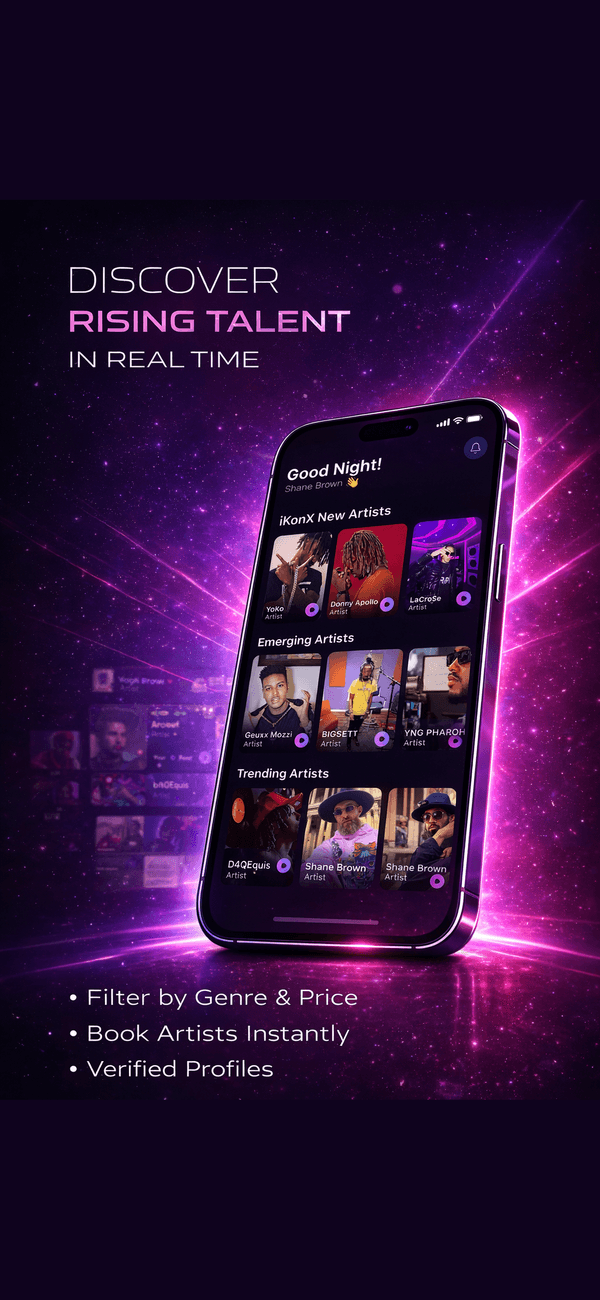
iKonX puts every side of the music business in your pocket. Artists set their own price and keep 100% of it · iKonX takes 0% platform commission. Browse, message, and book straight from the app.

How to set your feature verse rate, step by step
- Find your leverage tier first. Before you name a number, place yourself honestly. Entry-level (roughly 0 to 50k monthly listeners) sits at 100 to 500 dollars. Developing (50k to 250k) sits at 500 to 2,000 dollars. Established indie (250k to 1M plus) sits at 2,500 to 10,000 dollars and up. The tier is your floor and ceiling; the exact number comes from the steps below.
- Adjust for audience behavior, not raw count. Engaged listeners who save, replay, and follow are worth more than a big passive number. If your past features have driven real streams or playlist adds, price toward the top of your tier. If your audience is large but quiet, stay nearer the floor and build proof.
- Set one flat per-verse rate. Pick a single number for a standard 16-bar verse with one or two revisions. A flat rate is far easier to quote and collect than per-hour pricing, and it protects you when a session runs long or the asks keep coming. Quote it plainly and without apology.
- Decide buyout vs. royalty before you record. State up front whether the fee is a flat buyout or whether you keep publishing or points on the master. Decide this before the verse exists, never after the song starts to catch on. A clear split agreed early protects both the relationship and your back end.
- Collect 100 percent up front. Take the full payment before you record. Up-front collection is the single biggest difference between artists who get paid and artists who get ghosted after delivery. On iKonX this is built in, so the funds are secured before the first bar.
- Write the scope down. Agree in writing on bar count, revision count, delivery date, and deliverables (a dry vocal stem plus a wet reference). Clear scope kills the endless free-revisions trap and gives you something to point to if the ask grows.
- Raise your rate on evidence. Track which verses performed. The next time a client asks, quote from your results, a feature that charted, a playlist add, a follow-on booking, not from a number you guessed last year. Proof is the only thing that should move your tier.
What artists actually charge, by tier (the honest 2026 ranges)
| Artist tier | Typical 2026 verse range | What sets the number |
|---|---|---|
| Entry-level indie (0 to 50k monthly listeners) | 100 to 500 dollars | Local and underground collabs; sometimes free for exposure; price follows engagement, not count |
| Developing indie (50k to 250k) | 500 to 2,000 dollars | Solid engagement, growing brand, some streaming proof to point to |
| Established indie (250k to 1M plus) | 2,500 to 10,000 dollars | Strong audience, proven streaming history, selective features |
| High-leverage / brand | 10,000 to 50,000 dollars and up | Demand exceeds availability; scarcity drives the rate |
| Up-and-coming rapper (no name recognition) | as low as ~2,000 dollars | Often priced below peers to buy reach and name recognition |
| Established / major (for context) | 50,000 dollars to 250,000 dollars and beyond | Relevance-driven; some decline pay entirely and pick by respect |
Tier ranges are sourced and dated: the four indie tiers (100 to 500 / 500 to 2,000 / 2,500 to 10,000 / 10,000 to 50,000 plus) and the leverage-not-talent principle come from the 2025 indie feature pricing guide (vocal.media, 2025). The up-and-coming ~2,000 dollar floor and the established/major five- and six-figure range are from rapper feature-price breakdowns (musicindustryhowto.com, 2025; complex.com, 2024). These are directional market bands, not quotes for any specific artist, and your real number is set by your audience behavior and track record. Where you sell decides how much of that number you keep: on the BeatStars Marketplace the buyer pays a 12% service fee on top, announced August 7, 2023 (help.beatstars.com; blog.genxnotes.com); on Fiverr the seller keeps 80% after a 20% commission, with a 5.5% buyer fee on top (freelancecompare.com, 2026); SoundBetter takes a 5% platform commission (soundbetter.com FAQ, 2025); Cameo pays talent 75% and keeps 25%, with Apple's iOS fee deducted first (influencermarketinghub.com, 2025). The only fixed claim is the iKonX model: artists keep 100% of the price they set, iKonX takes 0% platform commission, and the buyer pays a flat 10% on top. iKonX is free to download and explore, full access to paid features is a flat $9.99/month, and the only payout deduction is a low, sub-5% withdrawal fee, below the industry standard.
Verified artists, real profiles
Feature verse pricing FAQ
How much should an indie artist charge for a feature verse in 2026?
Price by tier, not by guess. Entry-level indie artists (roughly 0 to 50k monthly listeners) commonly charge 100 to 500 dollars per verse, developing artists 500 to 2,000 dollars, and established indies 2,500 to 10,000 dollars or more. Set one flat rate for a standard 16-bar verse, lean toward the top of your tier if your features drive real streams, and raise it on proof. On iKonX you set that price and keep 100 percent of it.
What is a fair feature rate for an artist with a small following?
If you are in the entry-level band with a modest audience, 100 to 500 dollars is the honest range, leaning toward the lower end while you build a portfolio of features that perform. Audience behavior matters more than raw count, so engaged listeners who save and replay justify pricing higher than a large but passive following. Set one flat number, collect it up front, and move up as you gather proof.
Should I charge per verse or per hour?
Charge a single flat rate per verse. A flat number for a standard 16-bar verse with one or two revisions is far easier to quote and collect than per-hour pricing, and it protects you when a session runs long or the revisions keep coming. Per-hour pricing invites scope creep and turns your fee into a negotiation; a flat verse rate keeps the deal clean.
Why are celebrity feature prices so much higher than mine?
Because price follows leverage, not talent. Established and major artists charge tens or hundreds of thousands because their relevance and scarcity create demand, with some declining pay entirely and choosing collaborations by respect. Those numbers are not a benchmark for an indie artist; a couple hundred dollars can be exactly right for your level. Match your tier, not a headline.
Does iKonX take a commission on my feature verse?
No. The artist earns 100 percent of the price they set and iKonX takes 0 percent platform commission. The buyer pays a flat 10 percent on top of your price, so the number you set is the number you keep. The only deduction is a low, sub-5 percent withdrawal fee when you transfer your earnings out, below the industry standard, and that is a standard bank and transfer cost, never an iKonX commission on your rate. iKonX is free to download and explore; full access to paid features across all ten sides of the network is a flat 9.99 dollars a month.
How do I raise my feature rate without losing clients?
Raise it on evidence, not ego. Every time a feature you delivered drives streams, playlists, or a follow-on booking, that is proof your rate can move up a notch within or beyond your tier. Quote your next client from those results, deliver clean stems on time, and treat each feature as a business transaction with a written scope. Repeat clients and demonstrated performance, not a number you guessed, are what let you charge more.
Explore the connected sides of the network
Built for the working artist.
Pick your tier, set your rate, and keep every dollar of it. Download iKonX and price your features where the gatekeepers used to stand.

DOWNLOAD THE FREE PDF TODAY:
Indie Feature Pricing Cheat-Sheet
What to charge for a feature verse with no following · the price math, plainly.
Get the free PDF ->