The room already pulled. Career-stage matched, verified, reachable direct.
How do I find artists at the same career stage as my label?
Define your own stage honestly first, by the budget you can actually spend and the reach you can actually deliver, then screen for artists whose current traction and needs sit right at that line. An artist too far above you will outgrow the deal and resent it. One too far below will drain your roster. Fit is a stage match, not a talent contest.
Most small labels sign the wrong artists for the most understandable reason: they sign up. They find someone clearly on the rise, someone a bigger label would want, and they stretch to sign them because it feels like a win. Then the artist grows past what the label can deliver in a year, the label cannot fund the next step, and the relationship curdles into resentment on both sides. The artist feels held back. The label feels used. Nobody was wrong to want it. The stage just did not match.
The opposite mistake is quieter and just as expensive. A label plays it safe and signs artists well below its own reach, artists with almost no traction and a lot of need, and then spends its entire budget doing the work of building an audience from zero. That is not a label, that is a development charity, and it burns cash the label needed for the artists who could actually return it.
The real skill nobody teaches is honest self-assessment. You cannot match an artist to your stage if you have not defined your stage, and most labels describe themselves in aspirations rather than capabilities. What matters is not where you want to be. It is what you can spend on a release this quarter, what reach you can genuinely deliver, and what an artist would actually get from you that they could not get alone.
Start by writing down your real stage in three numbers: what you can spend to sign and support one artist this year, how many real listeners you can move a release in front of, and how many releases you can properly work at once. Not your dream version. Your true version. Those three numbers define the shape of the artist who fits you, and they are the filter everything else runs through.
Then screen artists against that shape. The right fit is an artist whose current traction is close to what you can amplify, whose needs are things you can actually provide, and who would clearly gain something from your reach that they cannot get on their own. An artist already pulling numbers you could never move is a flight risk. An artist with no traction at all is a cost center. The one in the middle, rising and reachable and slightly stuck, is the one who grows with you instead of past you.
Look for the specific stuck. The best signing for a small label is often an artist who is doing everything right and has hit a ceiling they cannot break alone: solid streams that have plateaued, a real local audience with no path out of the region, a catalog with no marketing behind it. Your reach is the exact thing they are missing, which means the deal is valuable to them precisely because your stage matches their need.
Then look where you can see traction directly. That is the part iKonX is built around: a place where independent artists show up to get paid and get booked, so their activity is visible rather than their follower count. Today iKonX is where the artist you might sign already gets paid, keeping 100 percent of the price they set at 0 percent platform commission, which tells you they are already running a real independent operation. A dedicated label view, with A&R pipeline and roster tools, is on the roadmap rather than live, and I would rather say that plainly. iKonX is free to download and explore, and full access to paid features is a flat $9.99 a month.
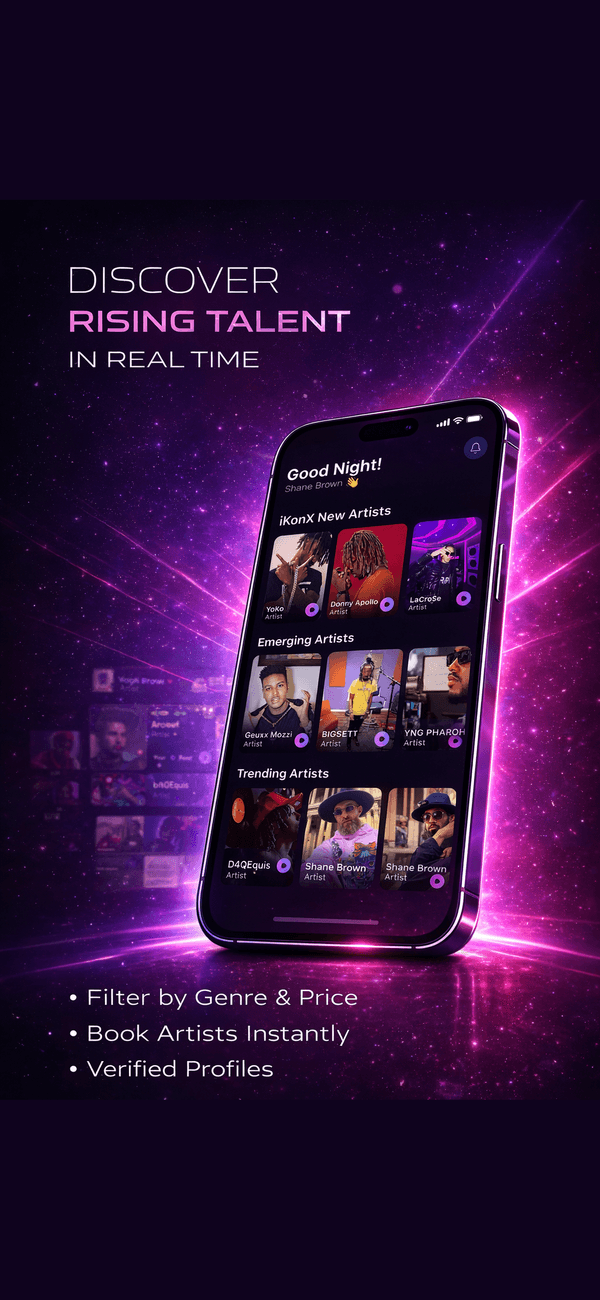
The whole network lives in one app.
iKonX puts every side of the music business in your pocket. Artists set their own price and keep 100% of it · iKonX takes 0% platform commission. Browse, message, and book straight from the app.

How to find artists that match your label's stage, step by step
- Define your stage in three real numbers. Write down what you can spend to support one artist this year, how many real listeners you can move a release in front of, and how many releases you can work well at once. Use your true version, not your dream version. These three numbers are the filter every candidate runs through.
- Reject the flight risks above you. An artist already pulling numbers you could never amplify will outgrow the deal within a year and resent it. It feels like a win to sign them, but a stage mismatch upward almost always ends in a bad separation. Let the bigger label have the ones who need a bigger label.
- Reject the cost centers below you. An artist with almost no traction and a lot of need turns your label into a development charity that burns the budget you needed for artists who could return it. Building an audience from zero is a different business than running a label.
- Find the specific stuck. The best fit is an artist doing everything right who has hit a ceiling they cannot break alone: plateaued streams, a strong local audience with no way out of the region, a catalog with no marketing. Your reach is exactly what they are missing, which is why your stage matches their need.
- Verify they already run a real operation. Look where you can see activity directly, not just followers. An artist already getting paid and booked as an independent is one who has proven they can execute. On iKonX that activity is visible today, and a dedicated label A&R view is on the roadmap.
Filter the deck to artists at the same rung as your label, so a signing fits where you are now, not where you wish you were.
No demo pile, no inbox gatekeeper. You contact a verified profile straight from the deck and start the conversation on your terms.
Three ways to match a signing to your stage (and where each lands)
| Signing up (above your reach) | Signing down (below your reach) | Signing at your stage | |
|---|---|---|---|
| How it feels | Like a win | Safe and cheap | Unglamorous but right |
| What actually happens | Artist outgrows the deal, resents it | You fund an audience from zero | Artist grows with you, not past you |
| Budget impact | You cannot fund the next step | Cash center drains the roster | Your spend moves the needle |
| Leverage | All theirs, they can walk | All yours, they have no options | Balanced, both sides gain |
| Outcome | Bad separation | Slow bleed | A deal that compounds |
| On iKonX | See who already runs a real independent operation today · a dedicated label A&R view is on the roadmap | ||
Sources and dates. 17 U.S.C. 201(a) and 17 U.S.C. 204(a) (live, July 2026): an artist owns their masters and compositions unless they transfer those rights in a signed writing, so a recording agreement is a negotiated transfer, not an automatic one, and the balance of leverage in that negotiation is exactly what a stage match protects. Copyright Royalty Board: statutory mechanical rates for digital phonorecord deliveries are set on a multi-year schedule, which is one fixed cost a label of any stage plans around. Career-stage matching, budget-shape screening, and the flight-risk and cost-center dynamics described here are market observation from the independent industry in 2026, not published statistics, and iKonX label tooling described as roadmap is not a live feature. Practical guidance, not legal advice. The iKonX model is the only fixed claim: artists keep 100% of the price they set, iKonX takes 0% platform commission, the buyer pays a flat 10% on top, iKonX is free to download and explore, full access to paid features is a flat $9.99/month, and the only payout deduction is a low, sub-5% withdrawal fee, below the industry standard.
Career-stage artist fit FAQ
How do I know what career stage my label is actually at?
Write it in three real numbers: what you can spend to support one artist this year, how many real listeners you can move a release in front of, and how many releases you can work well at once. Use your true version, not your aspiration. Most labels describe themselves in dreams, and that is exactly why they sign artists who do not fit.
Why is signing a bigger artist than my label a mistake?
Because they will outgrow the deal and resent it. An artist already pulling numbers you cannot amplify will hit the ceiling of what you can fund within a year, and the relationship sours. It feels like a win to sign them, but an upward stage mismatch almost always ends in a bad separation. Let a bigger label carry the ones who need one.
What kind of artist grows with a small label instead of past it?
An artist doing everything right who has hit a ceiling they cannot break alone: plateaued streams, a strong local audience with no path out of the region, or a catalog with no marketing behind it. Your reach is the exact thing they are missing, so the deal is valuable to them precisely because your stage matches their need.
Where can I see artists who already run a real operation?
In places built around paid work, where activity is visible rather than follower count. An artist already getting paid and booked as an independent has proven they can execute, which is a far better signal than a big passive following. On iKonX that activity is visible today, and a dedicated label A&R view is on the roadmap.
Can I use iKonX to run my label right now?
Not as a label dashboard yet, and I will be straight about it. Today iKonX serves the artist side: it is where an independent artist gets paid, keeping 100 percent of the price they set at 0 percent platform commission, with the buyer paying a flat 10 percent on top and a sub-5 percent withdrawal fee below the industry standard. A dedicated label view with A&R pipeline and roster tools is on the roadmap, not live.
Labels is coming to The Network
Scouting opens soon. Be first to the deck when it goes live · no pressure, just a seat held.
Explore the connected sides of the network
Find the talent first. Sign on your terms.
Define your stage in three honest numbers, then sign the artist whose need your reach actually meets. Download iKonX and see which independents already run a real operation.
DOWNLOAD THE FREE PDF TODAY:
The Indie Label A&R Scouting Playbook
A modern A&R checklist for finding, career-stage-matching, and signing unsigned artists in 2026.
Get the free PDF ->