How do you get more studio bookings?
You get more studio bookings by fixing three things in order: be findable where artists actually look, publish your rates so nobody has to ask, and engineer the second session before the first one ends. Most studios stall because they rely on word of mouth alone, which is the main customer source for roughly 63 percent of small businesses but scales badly. Studios that stay full treat discovery and rebooking as a system, not luck.
Most half-empty studios are not empty because the room is bad. They are empty because of a discovery problem dressed up as a marketing problem.
The default plan is word of mouth. That is not wrong, and it is what most small businesses run on: around 63 percent of small and medium businesses count on word of mouth as their main source of new customers. The trouble is that word of mouth is a ceiling, not an engine. It grows at the speed of your existing clients' social circles, it goes quiet exactly when you need it most, and it cannot be turned up in a slow month.
The second failure is hidden pricing. A studio that will not publish a rate is asking every prospective client to open a negotiation before they know whether they can afford the room. Most artists will not send that message. They will keep scrolling to a studio that answered the question on the page. For context on the spread they are pricing against, mid-tier rooms commonly run about 70 to 100 dollars an hour, and professional rooms in major cities run roughly 150 to 300.
The third failure costs the most money and gets the least attention: the session ends, the client says that was great, and nobody books anything. Every studio owner has had a brilliant session with someone they never saw again. That is not a client-quality problem, it is a process gap.
Four channels artists book you for
List the room and the rate · get found by artists ready to track.
Per-song or per-stem · transparent pricing artists can say yes to.
Get booked for the final pass · a steady stream, not word of mouth.
Home studio, no big credits? List the work · the room speaks for itself.
The fix is a three-layer system, and the order matters because each layer feeds the next.
Layer one: be findable. You need at least one surface where an artist searching for a room in your city can find you without a referral. That means a real listing with photos, gear, rates and location, and it means being where artists already are rather than where studio owners talk to each other. Referral traffic is a bonus on top of this layer, never a substitute for it.
Layer two: remove the price question. Publish an hourly rate, a block rate, and what is included: engineer, mixing, stems, revisions. Clarity converts because it removes the awkward first message. It also filters. You would rather lose a client to your rate on your page than spend four messages discovering they had a fifty dollar budget.
Layer three: engineer the rebook. Book the next session while the client is still in the room. Send the rough within twenty four hours. Keep a simple list of who recorded what and when, and reach out when the next logical step is due. Repeat clients cost nothing to acquire and they are the entire difference between a studio that survives and one that compounds.
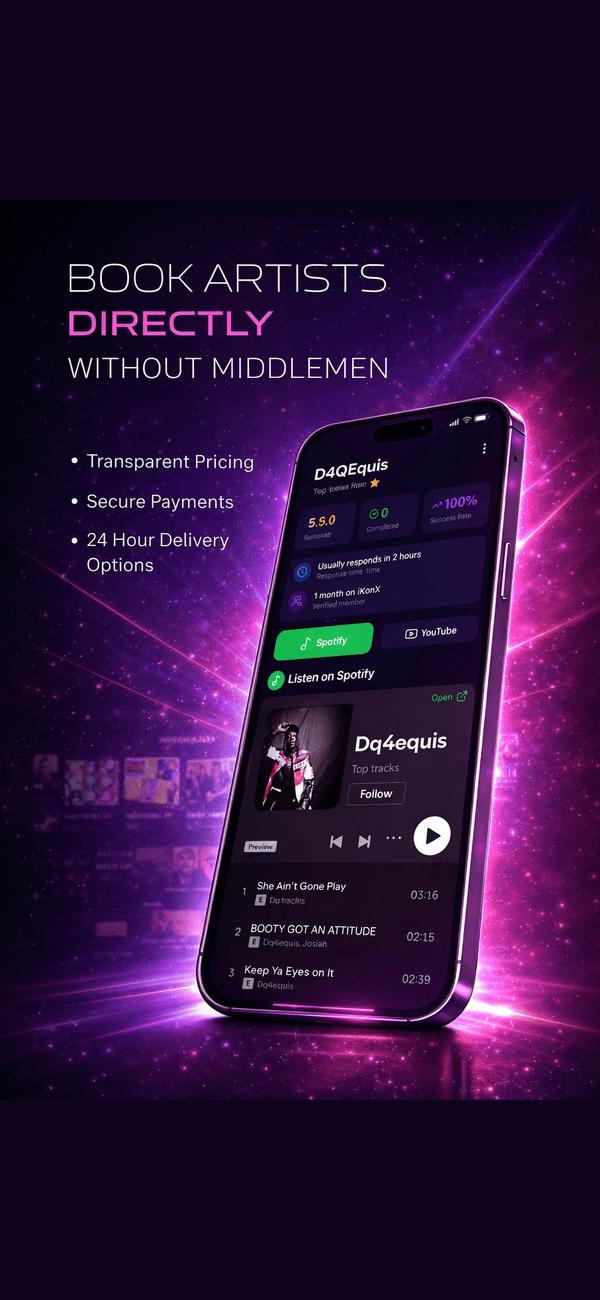
iKonX sits on layer one, which is the layer most studios are weakest on. It is the discovery and direct-contact rail: artists search bookable rooms with rates listed up front and message the studio directly, with no agency in the middle. When a session is booked through the platform, the studio keeps 100 percent of the price it sets, iKonX takes 0 percent platform commission, and the artist pays a flat 10 percent on top. That matters against marketplaces that take a percentage of the booking, since Peerspace charges hosts a 20 percent service fee on the booking amount and add-ons.
Roadmap honesty: Studios is a roadmap side of iKonX, launching soon. Today it solves discovery and direct contact, not scheduling software or invoicing.
The whole network lives in one app.
iKonX puts every side of the music business in your pocket. Artists set their own price and keep 100% of it · iKonX takes 0% platform commission. Browse, message, and book straight from the app.

How to fill your studio calendar, step by step
- Audit your findability first. Search your own city plus recording studio the way a stranger would, in a private window. If you do not appear in the first two screens on any surface an artist actually uses, that is your bottleneck, and no amount of posting fixes it.
- Publish a rate card, publicly. Hourly, half-day and full-day, plus what is included and what costs extra. Anchor against the market: mid-tier rooms commonly sit near 70 to 100 dollars an hour and professional big-city rooms run 150 to 300, so name where you sit and why.
- Fix the first ninety seconds of contact. Reply fast, with the rate, the next three open slots, and one question. Most studios lose bookings in the gap between the message and the reply, not on price.
- Sell the block, not the hour. An artist booking four hours behaves differently from one booking one. Offer a small discount on blocks and a clear deliverable at the end, so the client can picture leaving with something finished.
- Close the rebook in the room. Before the client packs up, ask what the next step is and put a date on it. This single habit converts more revenue than any advertising you will buy this year.
- Fill the dead hours deliberately. Weekday daytime is the hardest block to sell, so give it a purpose: a discounted demo rate, a podcast rate, or a rate for local artists building a first project. An hour sold at a discount beats an hour sold to nobody.
Where studio bookings actually come from, and what each channel costs
| Channel | What it costs | How fast it works | Scales? |
|---|---|---|---|
| Word of mouth | Free | Slow and unpredictable | No, it is a ceiling |
| Paid search ads | About 5.26 dollars per click on average across industries | Fast while funded | Yes, while you pay |
| Studio marketplaces | Commonly a percentage of each booking, up to about a 20 percent host fee | Medium | Yes, at a per-booking cost |
| Subscription listing | A flat monthly fee, no booking commission | Medium | Yes, cost stays flat |
| iKonX (Studios launching soon) | The rate you list, plus a flat 10 percent paid by the artist on top | Medium | Yes, no commission on your rate |
Benchmarks are dated and sourced. Mid-tier studio rooms commonly run about 70 to 100 dollars an hour and professional rooms in major cities roughly 150 to 300 dollars an hour (prostudiotime.com, 2025), within a wider worldwide 30 to 300 dollar spread by tier and market (midination.com, 2025). Around 63 percent of small and medium businesses rely on word of mouth as their main source of new customers (pymnts.com, 2025). Average cost per click across industries was about 5.26 dollars in 2025 (wordstream.com, 2025). Peerspace charges hosts a 20 percent service fee on the booking amount and add-ons (support.peerspace.com, 2025), while Studiotime charges a listing subscription from about 20 dollars a month with no booking commission (studiotime.io, 2025). The only fixed claim here is the iKonX model: the artist keeps 100 percent of the price they set, iKonX takes 0 percent platform commission, and the buyer pays a flat 10 percent on top. iKonX is free to download and explore, full access to paid features is a flat 9.99 dollars a month, and the only payout deduction is a low, sub-5 percent withdrawal fee, below the industry standard.
The best room in town does nothing if no artist can find it.
Getting more studio bookings: FAQ
Why is my recording studio not getting bookings?
Almost always one of three reasons. You are not findable to anyone outside your existing circle, so only referrals reach you. Your rates are hidden, so prospective clients have to open a negotiation before they know whether they can afford you. Or you have no rebooking habit, so every session restarts the acquisition process from zero. Fix findability first, because pricing and rebooking only matter once people can actually find the room.
Should I publish my studio rates online?
Yes. Hidden pricing costs more bookings than a high price does. Publishing an hourly and a block rate removes the awkward opening message, filters out clients who were never going to book, and lets serious clients qualify themselves before they contact you. Anchor honestly against the market, where mid-tier rooms commonly sit near 70 to 100 dollars an hour and professional big-city rooms run 150 to 300.
How much should I charge for studio time in 2026?
Price against your tier and market rather than against the cheapest room in town. Mid-tier rooms commonly run about 70 to 100 dollars an hour, professional rooms in major cities roughly 150 to 300, and the worldwide spread runs from about 30 to 300 depending on tier. Decide which tier your room genuinely is on gear, acoustics and engineer experience, then price inside that band and say clearly what is included.
How do I fill empty weekday studio hours?
Give the dead block a different product rather than discounting your main rate across the board. Weekday daytime sells well as a demo rate, a podcast or voiceover rate, or a local-artist rate for people building a first project. The economics are simple: an hour sold at a reduced rate earns more than an hour sold to nobody, and it often introduces a client who later books at full price.
Does iKonX take a commission on studio bookings?
No. The studio keeps 100 percent of the price it sets and iKonX takes 0 percent platform commission. The artist pays a flat 10 percent on top, so the rate you list is the rate you receive. That is a different model from marketplaces that deduct a percentage of the booking, such as the 20 percent host service fee charged elsewhere. The only deduction on your side is a low, sub-5 percent withdrawal fee when you move earnings to your bank, which is a transfer cost and never a commission. iKonX is free to download and explore, and full access to paid features is a flat 9.99 dollars a month. Studios is a roadmap side of iKonX, launching soon.
Explore the connected sides of the network
Built for the room.
iKonX is building a Studios side where artists find bookable rooms with rates listed up front and message you directly. Artists keep 100 percent of the price they set, and iKonX takes 0 percent commission.

DOWNLOAD THE FREE PDF TODAY:
The Studio Booking Checklist
Everything to confirm before a session books · rates, room specs, deposit, and turnaround.
Get the free PDF ->